

Supportive, Professional, Client-Focused Service
From prototypes to full-scale production, we’ve got you covered.



Prototype manufacturing is the construction of physical, pre-production models from digital data in order to test the function, geometry, and material behavior before commissioning the long lead-time production tooling. Whether developing a new smart watch case, a next-gen autonomous vehicle sensor assembly or a complex class II medical device, prototyping reduces development risk, defrays downstream costs due to costly rework, and hastens time to market.
📋 Quick Specs: Prototype Manufacturing
| Lead Time — 3D Printing (FDM/SLA) | 1–5 business days |
| Lead Time — CNC Machining | 3–7 business days |
| Lead Time — Injection Molding | 2–4 weeks (with tooling) |
| Dimensional Tolerance — CNC / DMLS | ±0.005″ (±0.127 mm) |
| Dimensional Tolerance — SLA / SLS | ±0.010″ (±0.254 mm) |
| MOQ | 1 piece (no minimum) |
| Rapid Prototyping Market (2025) | $4.01B USD · CAGR 20.49% to 2034 |
| Lecreator Certifications | ISO 9001:2015 · AS9100D · ISO 13485 · ITAR |

From the mobile phone housing in our pocket to the car bracket in our vehicle or to a class II medical device implant guide, nearly every manufactured part relies on some form of prototype manufacturing during product development. This critical design stage is where your engineers get to hold the future of your company in their hands. A prototype acts as the tangible representation of what’s possible in the digital space — it allows teams to hold, test, and refine the design before committing to expensive mass production tooling. Every issue caught at the prototype stage is a cost-effective fix compared to the same change after the final product tooling has been cut.
Risk reduction is the overriding principle at this stage. Physical prototypes allow manufacturers and product developers to catch subtle, hard-to-simulate design issues – such as micro-warping in injected molded walls, unseen stress concentrations under a live load or unexpected fit interferences between two mated parts – all at the fraction of the cost of finding it after the steel tooling has been commissioned.
Rapid prototyping market value hit USD 4.01 billion in 2025, projected to expand at a CAGR of 20.49% through 2034 as demand for agile product development, shorter product cycles in the automotive, aerospace, consumer electronics, and medical device segments grows.
While rapid prototyping has its roots in startup innovation, it is now a common, even required, part of product development for the largest companies across sectors. Largest buyers of rapid prototyping services are Tier 1 automotive manufacturers, aerospace OEMs, and medical device companies engaged in ongoing prototype programs during and between major product refresh cycles. At Lecreator, our 10,000+ delivered projects span single appearance models, multi-iteration functional prototype series, and pre-production builds for FDA 510(k) submissions.
📌 Project: Medical Device Prototype
A medical startup needed to demonstrate viability of a hand-held diagnostic device prior to submission for FDA 510(k) clearance. Using SLA for the housing geometry and CNC machining for precision metal components, Lecreator delivered three prototype generations in six weeks at 42% below the initial tooling budget. The device received FDA approval.
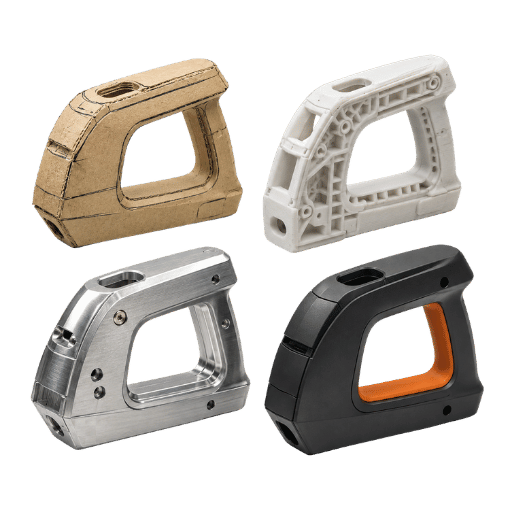
Not all prototype builds are created equal. Using a more complex, higher fidelity prototype earlier in the development process can not only waste project funds, but can also slow down the decision-making process. Here are four major categories that generally correlate to a given stage of product development.
| Type | Fidelity | Primary Purpose | Typical Method | Relative Cost |
|---|---|---|---|---|
| Proof-of-Concept | Low | Validate a core technical assumption | FDM, hand-built | $ |
| Visual / Appearance | Medium | Investor demos, ergonomic review, market testing | SLA, vacuum casting | $$ |
| Functional Prototype | High | Performance testing, regulatory submissions | CNC, SLS, DMLS | $$$ |
| Pre-Production | Very High | Final validation, tooling sign-off, buyer samples | Injection molding, CNC | $$$$ |
✅ Functional Prototypes: When to Use
⚠ Visual Prototypes: Limitations
⚠ Common Mistake: Over-Engineering Early Iterations
Many teams have a tendency to skip the most basic form of prototype building and leap straight to high-fidelity prototypes on the first-build; that shortcut usually adds weeks or months to a project cycle. Prove the concept out with form-fit-function first. This allows the team to find the obvious issues first before investing in production-material equivalents.

Moving CAD data from digital to physical, the prototyping process typically spans six defined stages — from modeling through final iteration. Teams or companies that skip stages at any point in the process-even a low fidelity stage–pay for that time exponentially in the late-stage costly errors discovered, especially if they reach this discovery point after committing to paid-for, final production tooling.
“The best prototypes are not ones that answer every question. They’re ones that identify and specifically interrogate the biggest, most dangerous unknown factors in the project. By targeting those points, you’re really focusing the team’s effort on reducing risk before something catastrophic occurs.”
— Harvard Business Review, Prototyping That’s Less Prone to Failure
Concept Definition & Requirements Capture
Define functional requirements, dimensional constraints, regulatory targets, and budget envelope. Output: a one-page specification sheet that every downstream decision references.
CAD Modeling
Convert concept to a 3D CAD model with fully defined geometry, GD&T callouts, and material specifications. Modern CAD platforms allow finite element analysis runs before the first physical build — catching gross structural issues at zero material cost.
Design for Manufacturability (DFM) Review
A qualified partner reviews the design for draft angles, under cuts, wall thickness uniformity, and tolerance conflicts before the first build. DFM at Step 3 costs a fraction of the same change made post-tooling. This manufacturability check also confirms that tolerance callouts are achievable with the chosen process.
Material Selection
Choose materials that match the functional requirements of this specific test — not necessarily the final production material. For structural testing, use production-equivalent alloys. For form/fit evaluation, less expensive analog materials save budget without compromising the test outcome.
Prototype Fabrication
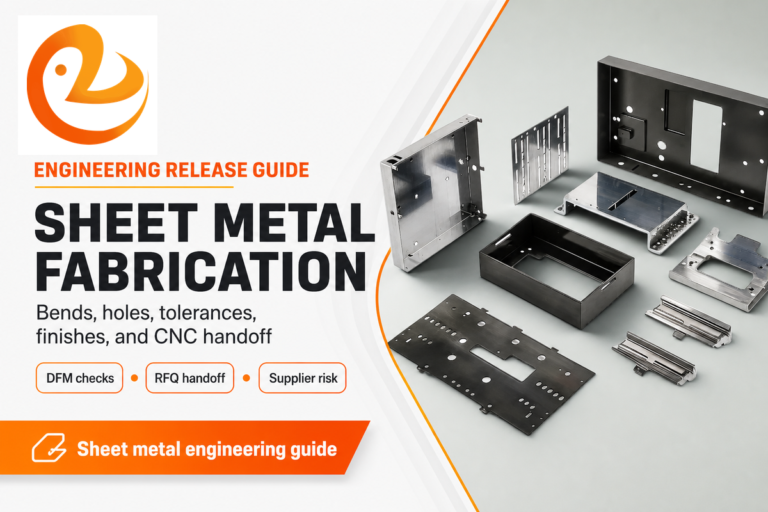
The part is built using the selected process — 3D printing, CNC machining, injection molding, sheet metal fabrication, or a hybrid. For process routing criteria by part geometry and tolerance requirement, see the rapid manufacturing workflow guide.
Testing, Evaluation & Iteration
Test against the requirements defined in Step 1. Document every failure mode, refine the CAD model, and repeat. This is where the 3-Prototype Rule applies — teams that plan for at least 3 iterations reach production-ready status 40% faster than those expecting a single build to pass.
📐 Engineering Note: DFM at Step 3
Lecreator’s Step 3DFM review can detect undercuts, draft violations, and unsupported walls, preventing material from even being cut. DFM review is standard across all Lecreator prototyping projects, identifying and resolving 3–7 issues per prototype-which would later cause tool revisions or non-conformities-for significant cost and schedule savings.

Wrong process selection-the most prevalent technical problem in prototype manufacturing. Choose manufacturing techniques that complement tolerances, speed, and material properties, rather than choosing because you are familiar with the process.
| Technology | Tolerance | Lead Time | Material Range | Best For | Cost (1–5 units) |
|---|---|---|---|---|---|
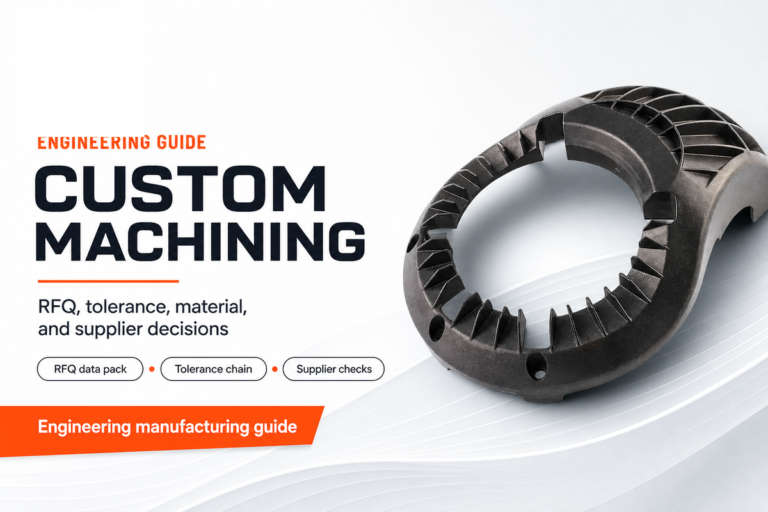
| CNC Machining | ±0.005″ | 3–7 days | Metals, engineering plastics | Functional metal parts, tight tolerances | $$$ |
| SLA (Resin) | ±0.010″ | 1–3 days | Photopolymer resins | Fine detail, optical/clear parts | $$ |
| FDM (3D Printing) | ±0.020″ | 1–5 days | PLA, ABS, PETG, Nylon | Concept models, early iteration | $ |
| SLS / MJF | ±0.010″ | 3–7 days | Nylon PA12, TPU, composite | Complex geometry, functional plastic | $$ |
| DMLS / SLM | ±0.005″ | 5–10 days | Ti-6Al-4V, Inconel, 316L, AlSi10Mg | Internal channels, lattice structures | $$$$ |
| Rapid Injection Molding | ±0.003″ | 2–4 weeks | ABS, PC, PP, Nylon, TPE | 50–500 unit bridge production | $$$$ |
| Sheet Metal Fabrication | ±0.010″ | 3–7 days | Steel, aluminum, stainless | Enclosures, brackets, flat profiles | $$ |
Additional process-specific guidance: laser cutting for 2D profile parts and custom metal stamping for bridge-phase low-volume runs.
| IF your priority is… | AND material is… | THEN use… |
|---|---|---|
| High dimensional accuracy (≤±0.005″) | Metal | CNC Machining |
| Complex internal channels or lattice geometry | Metal | DMLS / SLM |
| Fastest concept validation (1–3 days) | Plastic | FDM or SLA |
| High surface quality / optical clarity | Plastic / Optical | SLA |
| Production-grade material properties | Any thermoplastic | Rapid Injection Molding |
| Flat profiles, enclosures, brackets | Sheet Metal | Laser Cutting + Forming |
🔑 The 3-Prototype Rule
Lecreator data across 10,000+ projects shows that teams planning for at least three iterations reached production-ready status 40% faster than those attempting single-build validation.
Each design iteration corrects a particular type of problem. Stage 1 addresses general form and arrangement. Stage 2 addresses material behavior and tolerance conflicts. Stage 3 examines manufacturing issues. Since simulation cannot simulate all three types of problems at once, the most efficient approach to time to market is through front-loading physical prototyping cycles.
Costs, 1-50 pieces: Additive manufacturing processes (FDM and SLA) typically cost more than CNC. However, as unit volumes rise, the break-even flips. For example, CNC manufactured aluminum brackets may cost $380 at the first unit, decreasing to $22 by the 75th unit due to setup costs being amortized. Combine volume, tolerances, and cost for best selection.

Choose prototype materials based on what they can tell you, rather than your choice for the end-use parts. For fatigue or structural tests, try production comparable alloys. Lower cost alternative materials are also effective choices, however, these provide limited value unless your goal is merely a dimensional fit-check.
| Material | Tensile Strength | Temp Rating | Best Prototype Use | Compatible Processes |
|---|---|---|---|---|
| Al 6061-T6 | 310 MPa | to 300°F | Structural / functional metal parts | CNC, Sheet Metal |
| Al 7075-T6 | 503 MPa | to 250°F | Aerospace / high-load prototyping | CNC Machining |
| Ti-6Al-4V | 950 MPa | to 600°F | Medical implants, aerospace frames | CNC, DMLS |
| 316L Stainless | 580 MPa | to 1400°F | Corrosion-resistant housings | CNC, DMLS |
| ABS | 40 MPa | to 175°F | Consumer product housings, snap-fit checks | FDM, Injection Molding |
| Nylon PA12 | 50 MPa | to 250°F | Functional hinges, living joints | SLS, MJF |
| PEEK | 100 MPa | to 480°F | High-temp medical / aerospace applications | CNC, high-temp FDM |
The Library of Materials at Lecreator contains more than 50 types of metal, plastic, and composite materials. Check the aluminum 5052 guide or Aluminum 2024 CNC machining guide for guidance on the tolerances, hardness levels, and processes compatible with the top two aerospace-quality aluminum alloys.
📐 Engineering Note: The Production-Match Rule
If you’re interested in structural, thermal or fatigue load tests, your chosen alloy and heat treatments need to mirror your production specifications. The aluminum parts would behave under cyclic load conditions unlike the 7075 T6 alloy in a production scenario. As one notable example, one automotive manufacturer’s prototypes passed the load test criteria, but they had a load failure on a steel component when the stress distribution dynamics became dissimilar between the prototypes and the production components.

Costs span from under $100 for a basic FDM prototype to over $10,000 for high-precision CNC metal assemblies — driven by process type, material, part complexity, quantity, and required tolerance.
FDM / SLA
$50–$500
1–5 day lead time
CNC Metal
$300–$5,000+
3–7 day lead time
DMLS Metal 3D
$500–$10,000+
5–10 day lead time
A $5,000 prototype series that catches a dimensional error before steel mold tooling saves a minimum of $75,000 in rework plus 8–12 weeks of schedule recovery. For time-critical projects, see fast prototyping lead times — 24-hour turnaround is available for FDM and SLA when design files are production-ready.
Lecreator project benchmarks:
🏥 Medical Handheld Device
3 iterations · 6 weeks
42% under tooling budget
✓ FDA 510(k) Approved
⚡ EV Battery Thermal System
12 weeks · $180,000
DMLS + CNC multi-material
✓ OEM Approved
🤖 Cobot Arm Demo Units
5 units · $68k of $75k budget
Appearance + functional hybrid
✓ $12M Series A Closed

An unqualified Prototype Manufacturer: the difference is not found in marketing collateral-it will become apparent in dimensional reports, material certs, and the DFM comments you won’t get prior to the cut of your first part. Score any prototype supplier before you release an RFQ based on this list:
Quality Management Certification. ISO 9001:2015 is the bare minimum, while AS9100D is standard for aerospace components, ISO 13485 is typical for medical prototypes going to regulatory submission and ITAR Registration applies for defense-related hardware where controlled technical data exists.
DFM Feedback before first build. A qualified provider should review your CAD file for manufacturability concerns and communicate concerns prior to pricing the job. Pricing provided without a DFM review will be repriced once your part becomes active.
Multi-Technology in-house capability. A single process manufacturer will favor it; therefore recommendations may not be impartial. In-house CNC machining, additive manufacturing (3D Printing), and injection molding are needed for objective solution recommendations.
Dimensional Inspection report on every part delivered, not simply a visual check. This may be in the form of CMM data or an FAI report.
NDA and IP Protection. Standard operating procedure at any reputable prototype manufacturing shop. Anyone who balks at signing a mutual NDA is generally a deal killer for serious projects.
Prototype to Production Continuity. You’ll ideally want the same manufacturing service capable of running prototype, bridge production and then the low volume end of production too. This dramatically reduces knowledge transfer risk.
Verified Industry References. Ask for 2-3 contacts at companies in your sector and follow-up via a phone call to confirm process and delivery performance.
⚠ Red Flags
DFM not offered. No quality certifications listed. NDA refusal. No dimensional reports delivered. Only one manufacturing process.
Lecreator Rapid Prototyping Manufacturing Services
ISO 9001:2015. AS9100D. ISO 13485. ITAR Registered. 10K+ parts completed. 0.005” tolerances. In-house FDM, SLA, SLS, MJF, DMLS. In-house CNC Machining. Injection Molding. Sheet Metal Fabrication. Vacuum Casting. 50+ material options.

The leap from a validated prototype to production scale run is when the most damaging, expensive errors can happen to product development initiatives. Components that operated fine at the prototype stage often will fail at production volume due to differences in material, process and cumulative tolerance stacks up in mating assemblies. A three-stage gate model prevents quality regression in the scale-up:
Stage 1
Prototype
1–50 units
CNC / 3D printing. Design validation, functional testing.
Stage 2
Bridge Production
50–10,000 units
Bridge tooling / rapid injection mold. Market seeding, design lock.
Stage 3
Mass Production
10,000+ units
Production steel tooling. High-volume consistency.
For most hardware products, low volume bridge production is a critical not-to-be-skipped phase where you finalize the product’s production assembly order, finalize and lock the bill of materials, and build product inventory to achieve initial revenue while tooling is under construction. Skipping directly from prototype to mass production is the single most common cause of first-lot recalls and costly product launch failures.
Swiss lathe precision parts capability accommodates the closed-loop iteration cycles required between prototype and initial production quantities for high-precision turned and milled bridge phase components. The rapid manufacturing process guide specifically guides the processes for bridge production routing.

Both rapid prototyping and digital manufacturing are now growing at a much faster clip than the majority of the legacy manufacturing sector. Three data points characterize this development:
$21.47B
Rapid Prototyping Market by 2034
From $4.01B (2025) · CAGR 20.49%
Precedence Research
30%
Development cycle reduction
Companies using additive manufacturing vs traditional methods
Industry composite, 2025
20.07%
Mordor CAGR (Rapid Prototyping)
$3.25B (2025) → $9.65B by 2030
Mordor Intelligence
Three technology shifts are driving this market expansion:
In short, the message for engineering departments is crystal-clear. Companies that make a strategic investment in 3D printing now (using DMLS, multi-material techniques) along with AI-enabled DFM systems will simply be structurally faster than their competitors in product development through the year 2030.
📚 Related Articles
References & Data Sources
About This Analysis
Here at Lecreator, we’ve helped over 10,000 clients make a smooth and efficient transition from concept to production, specializing in an array of technologies:FDM, SLA, SLS, MJF, DMLS, CNC Machining, Injection Molding, Sheet Metal Fabrication, and Vacuum Casting. We aim to capture the most common design decisions and real-world challenges faced by engineering teams each and every day.
Frommaterial selection for early-stage function to late-stage prototype validation before tooling, our insights have been supported where possible by independently validated market data, or proprietary data from our own 10,000+ projects. Market data references are based on publicly reported information as of 2025 and reflect market forecasts where available; we do not receive compensation from the research providers cited.
Lecreator Engineering Team
ISO 9001:2015 & AS9100D Certified Prototyping Specialists 10,000+ Projects Delivered Reviewed May 2026