

Supportive, Professional, Client-Focused Service
From prototypes to full-scale production, we’ve got you covered.


Commonly known as Acrylic Glass, Polymethyl Methacrylate (PMMA) is a versatile thermoplastic that bridges the gap between aesthetic appeal and engineering durability. It has become a cornerstone material for precision CNC machining and laser engraving applications.
Why Choose Acrylic? It offers a unique combination of high tensile strength and superior surface finish capabilities, making it ideal for everything from medical manifolds to point-of-sale displays. It looks and feels premium while holding up to rigorous technical demands.
When your project requires transparency, Acrylic is the industry standard. It matches the optical clarity of glass but provides significant engineering advantages in terms of weight, safety, and machinability.
Achieve glass-level clarity or better. With a light transmittance greater than 92%, machined acrylic components offer pristine visibility for lenses, guides, and display panels.
Safety is paramount. Acrylic offers 10 to 17 times greater impact resistance than glass while being virtually shatter-resistant, making it ideal for protective enclosures.
Optimize your assembly weight. A sheet of acrylic weighs 50% less than an equivalent glass sheet, simplifying installation and reducing shipping costs for bulk orders.
For outdoor or harsh environment applications, material degradation is a major concern. Acrylic (PMMA) stands out as a robust solution.
Unlike many plastics that yellow or become brittle, Acrylic is naturally resistant to sun degradation. It maintains its optical properties and structural integrity even after prolonged UV exposure.
The material features low water absorption (0.3%), ensuring dimensional stability. Our processing systems maintain these properties, resulting in minimal property loss during the machining process.
High-Quality Custom Acrylic CNC Machining Parts Services with Precision and Reliability. Get tailored solutions for your specific needs!
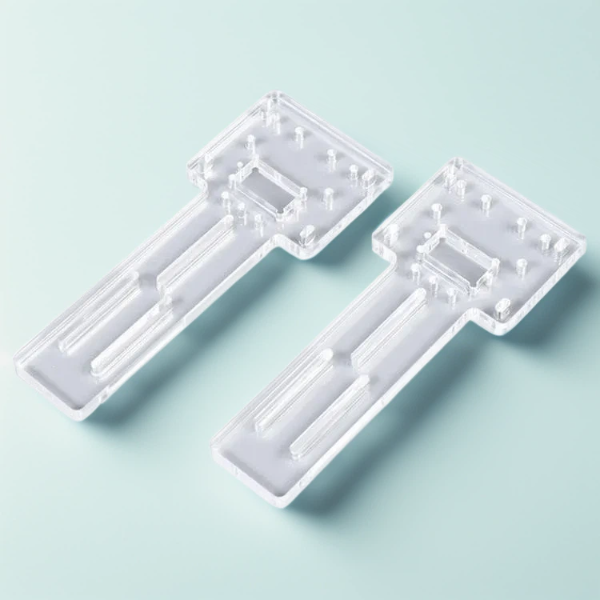
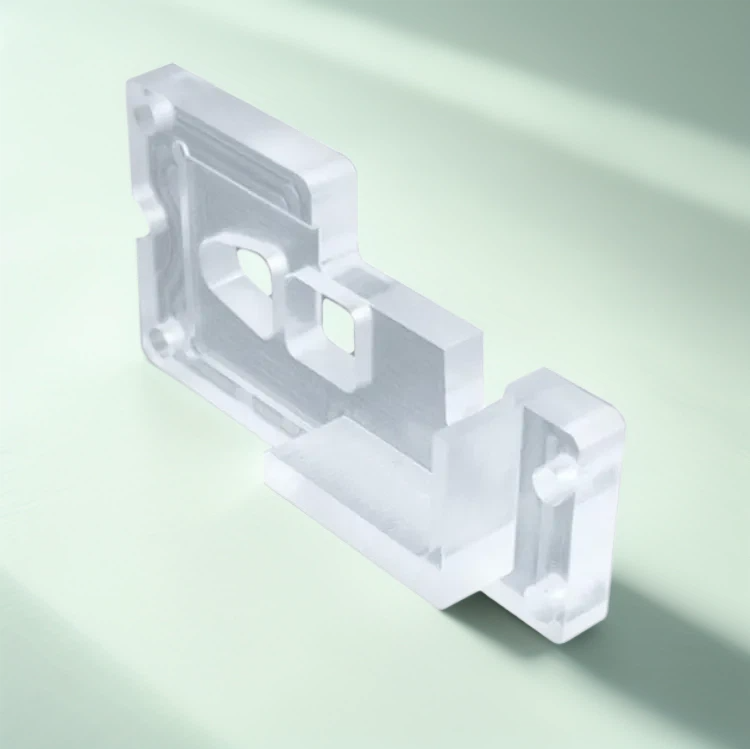

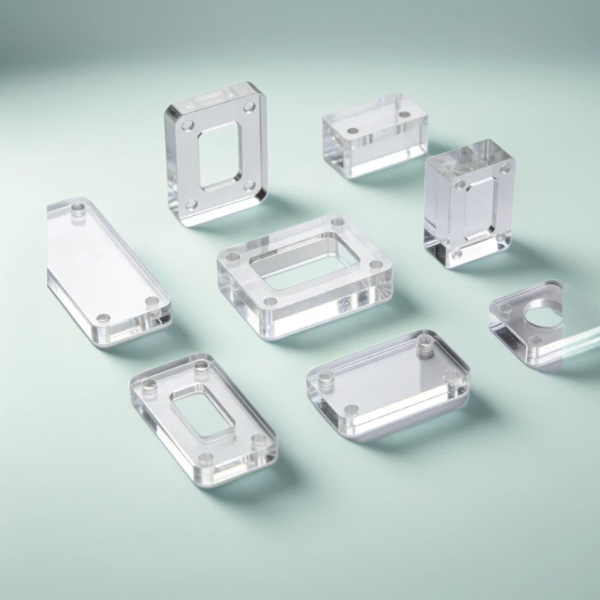
No matter what your needs are, be it a singular prototype or a batch of parts, you can trust our CNC machining services to meet the high standard of precision and clarity to get the job done when it comes to acrylic products.
We use both 3 and 5-axis milling to create 3D multi-faceted and pocketed acrylic parts. We are a perfect fit for making high detail and complex 3D panels and display and housing enclosures.
With our CNC lathes, we can create acrylic rotational parts like capsules, tubes, and any type of lens or other smooth surface components.
For any 2D profile, high-speed CNC routing is the best option. Great for making cheap and quick parts like signs, displays, and other flat pieces.
We can engrave logos, patterns, and any other decorative detail to acrylic products. Many of our engravings are made so that the product is illuminated when a light is placed behind it.
We are able to create precise, clean, and thorough holes that match our thread specifications and won’t crack during machining.
For machining we are able to use heat bending to create curved panels and enclosures or any complex shape length.
Acrylic’s tight tolerances and relief cut openings require specialized proficiency. The acrylic clear cutting room is designed and built to give our staff engineered facilities whose built processes give the company the capacity to cut acrylic to the tolerances and relief cut openings as standard to the company.
| Specification | Standard | Precision |
|---|---|---|
| Linear Dimensions | ±0.005 inches | ±0.002 inches |
| Hole Diameters | ±0.003 inches | ±0.001 inches |
| Surface Flatness | 0.005 inches per foot | 0.002 inches per foot |
| Perpendicularity | 0.005 inches | 0.002 inches |
| Thread Class | 2B | 3B |
| Min Wall Thickness | 0.040 inches | 0.030 inches |
| Min Corner Radius | 0.031 inches | 0.015 inches |
| Surface Roughness | Ra 1.6μm | Ra 0.8μm |
When it comes to functional prototypes, or grade optical pieces, we offer varying finishes to achieve your preferred look and performance.
Standard finish where tool marks are visible, making it budget-friendly for functional components and prototypes.
Optical clarity is achieved via chemical polishing and transparency is restored to a glass-like state on surfaces that have been machined.
Polishing through heat to achieve clarity on the edges. Perfect for edges that are meant to be displayed, and for surfaces that need to transmit light.
Sanding, buffing, painting, silk-screening, and UV printing to branded components.
Over 10 years of experience in ductile machining has provided us with the technical knowledge needed to achieve excellence in the industry and develop trustworthy partnerships with our clients.
Over 50,000 pieces of acrylic have been processed by our engineers. You will know the unique characteristics of PMMA and what the optimal feeds and speeds, and tooling will be to avoid the nasty outcomes of cracking, melting, and stress marks.
Each part goes through various documentation processes, such as dimension inspections and visual inspections. Material certificates, inspection documentation, and full traceability documentation are provided for the regulated industry.
Our fluctuating capacity provides from one piece prototypes to 10,000 or more production runs, with only 3-5 business days standard lead time. A fast service is also provided for critical projects.
Our engineers provide design reviews for manufacturability, providing suggestions for optimization for cost, quality, and lead time, before production starts. This is included for free with every quote.
There are no hidden fees with our instant online quotes, and you can see the pricing breakdown for material, machining, and finishing. Volume discounts are applied automatically, and pricing for various services is simplified and made clear.
Express shipping through DHL and FedEx is available globally. Project managers will provide you with frequent updates and a 24-hour response time guarantee.
Having certifications shows that we focus on quality, safety, and compliance and show that we care about multiple fields and industries.
Quality Management
Medical Devices
Aerospace
Defensive Compliance
Environmental
Each of our case studies showcases our custom PMMA CNC machining of large architectural panels and optical components.
SiliconPure Technologies was looking for custom-made precise acrylic parts required in wafer handling equipment used in worldwide semiconductor fabs. The specifications were quite complex:
Low-out-gassing cast acrylic and PMMA with ESD-dissipative Properties were specified.
Diamond tooling with HEPA-filtered coolant ensures particle generation where all machining was done in a controlled Class 1000 environment.
Multi-step annealing process eliminates internal stresses, causing dimensional stability.
For their camera enclosures, we required exceptional optical properties:
Selected cell-cast acrylic with certified optical properties.
Achieved optical-quality surfaces directly from the machine using diamond tooling.
Groove machined to ±0.002” tolerance for perfect sealing.
BioAnalytica needed fluid handling manifolds meeting high precision standards:
Medical-grade cast acrylic selected with full traceability.
0.5mm end mills used for channels. Ra < 0.8 μm finish.
IPA-based cleaning verified to USP <788> standards.
Free online tools to help you design and specify precision acrylic parts. Calculate weight, compare materials, convert tolerances, and estimate costs.
💡 Note: Acrylic (PMMA) density: 1.17-1.20 g/cm³. This calculator uses 1.19 g/cm³ (industry standard). Weight is ~50% less than glass.
Compare material properties to choose the right transparent material for your application.
| Property | Acrylic (PMMA) | Polycarbonate (PC) | Glass |
|---|---|---|---|
| Light Transmission | 92% | 88% | 90% |
| Impact Resistance | 10-17× glass | 250× glass | 1× (baseline) |
| Density | 1.19 g/cm³ | 1.20 g/cm³ | 2.50 g/cm³ |
| UV Resistance | Excellent | Poor (yellows) | Good |
| CNC Machinability | Excellent | Good (melts) | Poor |
| Relative Cost | $$ | $$$ | $ |
📏 Quick Reference:
1 inch = 25.4 mm
1 mm = 0.03937 inch
Standard acrylic tolerance: ±0.005″ (±0.127mm)
🔍 Note: Cast acrylic achieves 92% light transmission. For maximum transmission, use vapor polishing (Ra 0.4μm).
Upload a CAD file to get a detailed quote in a day! Every quote comes with a free DFM analysis.
CNC acrylic machining means removing material in a subtractive manufacturing process from sheets or blocks of acrylic (specifically Polymethyl Methacrylate, PMMA) to make custom parts using a CNC (Computer Numerically Controlled) machine that is a mill or a mill built specifically for machining plastics. It is a process widely used in making clear and transparent parts that need to be built with specific tolerances. Parts made out of acrylic that have gone through this process have excellent optical clarity and light transmission, and many machining shops have instant quoting available online for one-off prototypes or high-quantity production runs.
CNC turning does work on thermoplastics and acrylic machining, but is only limited to parts that are round or axis-symmetric (i.e., things that are shaped like a can). That said, CNC turning is extremely useful in making optical tubes, containers, and mechanical components for cars and planes. The trick is to use the right tool and to avoid high contact pressure or high RPM; otherwise, the part can melt or break, which is not a good thing.
Acrylic is a lightweight, shatter-resistant substitute for glass with superior impact resistance and is easier to process. When looking for glass alternatives, acrylic (polymethyl methacrylate) provides high transparency and optical clarity and is also less brittle. Acrylic is preferred in applications where UV stability and resistance to abrasion matter. Although, polycarbonate may be preferred if higher impact strength is required. Acrylic is also one of the preferred materials for these applications because of its cost-effectiveness and the ease with which it can be processed to achieve the required optical characteristics.
Optically clear machined acrylic is largely applied in the production of display windows, lenses, light guides, various medical devices, and various architectural elements. In the automotive and aerospace industries, and also in consumer electronics, machined acrylic is leaned on in the production of prototypes and also for the production of the final product where high light transmission and specific optical characteristics are required. In CNC acrylic machining, optically clear acrylic can be machined into various geometries which is useful in prototyping to evaluate the optical properties before high-volume production is done through injection molding.
Vibration and thermal effects are minimized using high-quality CNC mills, careful tool selection, controlled spindle speeds, and proper fixturing. Their in-house inspections and metrology systems ensure repeatability and adherence to specifications. Additional finishing and polishing steps improve optical clarity and remove tool marks for optical components. Post-processing services to improve durability and UV resistance, like flame polishing and UV-stable coatings, are common in shops, and inspection results are often documented.
For rapid prototyping and low to medium volumes, acrylic CNC machining is the most affordable and flexible in terms of turnaround time and design when compared to injection molding, which is only cost effective at high volumes due to tooling costs. Among other things, it offers excellent optical properties and allows for complex geometries and rapid design iteration. CNC acrylic is best for validating the final part and small batch production, but for long-term volume production, injection molding is an alternative and hybrid approaches may also best.
Acrylic is one of the most UV radiation resistant materials. For most outdoor applications, acrylic maintains optical clarity and does not yellow. However, yellowing without additives and optical clarity degradation could occur for outdoor applications with a long duration of exposure. Fortunately, UV-stable grades of polymethyl methacrylate and UV coating technologies can help. For outdoor applications like signage, aerospace windows, and lighting, manufacturers recommend UV-stable materials. In addition, UV degradation-resistant materials can be improved with additional UV post-processing treatments.
Polishing acrylic parts, ultrasonic cleaning, and coating with UV, anti-scratch, and anti-reflective coatings are common. For transparent optical parts, post-processing flame polishing is often done to achieve the desired optical quality. Measurement inspection is performed to verify design resolution and surface finish quality. These steps are done to ensure the optical components, like enclosures and lenses, are compliant to customer specifications.