

Supportive, Professional, Client-Focused Service
From prototypes to full-scale production, we’ve got you covered.


ABS stands for Acrylonitrile Butadiene Styrene and is one of the most engineered thermoplastic materials used for CNC machining due to the property of being cost-effective and having a perfect blend of attributes.
Work with this thermoplastic is quite easy, as it is perfect for CNC machining milling, turning, along with drilling operations without much hassle.
Check out our collection of custom ABS machining parts that provide quality, durable solutions tailored to your needs.
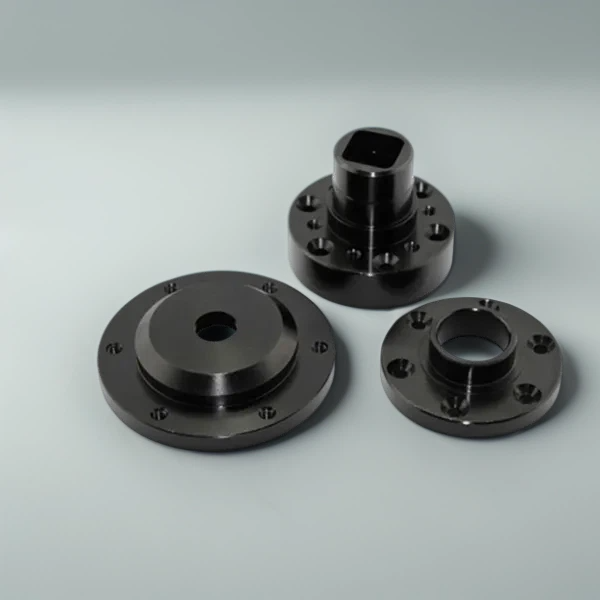
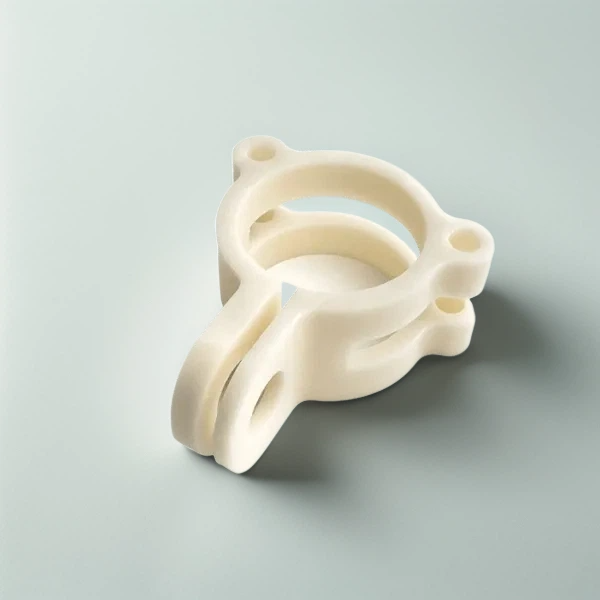


Detailed specifications for CNC machining grade ABS plastic per ASTM standards
| Property | Value | Test Method |
|---|---|---|
| Tensile Strength | 29.6 – 60 MPa (4,300 – 8,700 psi) | ASTM D638 |
| Flexural Modulus | 2.1 – 2.4 GPa (305,000 – 348,000 psi) | ASTM D790 |
| Impact Strength (Notched Izod) | 200 – 400 J/m (3.7 – 7.5 ft-lb/in) | ASTM D256 |
| Heat Deflection Temperature | 88 – 100°C (190 – 212°F) @ 1.8 MPa | ASTM D648 |
| Density | 1.04 – 1.07 g/cm³ (0.038 – 0.039 lb/in³) | ASTM D792 |
| Shore D Hardness | 75 – 85 | ASTM D2240 |
| Coefficient of Thermal Expansion | 73 – 108 µm/m·°C (41 – 60 µin/in·°F) | ASTM D696 |
| Operating Temperature | -20°C to 80°C (-4°F to 176°F) | — |
| Dielectric Strength | 15 – 17 kV/mm | ASTM D149 |
| Water Absorption (24hr) | 0.2 – 0.4% | ASTM D570 |
Using sophisticated technology as well as knowledge to build precision plastic components.
We offer 3, 4, and 5-axis CNC machining to accommodate complex designs in ABS plastic. We take care of the details, ins and outs, as well as any complicated abs undercuts and tight tolerances.
We offer a fully equipped CNC turning and lathe system to create cylindrical and rotated ABS plastic components, achieving a fine finish and perfect alignment.
We provide tight tolerances, helping functional prototypes as well as production-grade ABS components. We maintain a high standard of quality which ensures constancy with any quantity of parts.
Different ABS grades for different applications
This is the least expensive option. Expect full tool marks, as this is done straight out the of the machine.
This option has tool marks abrasion to a dull matte finish via progressively sanding.
Surface is worked to a semi-gloss sheen or high-gloss via machine or hand polishing.
This finish is quite glossy and clear. Also, very flexible to works done via acetone vapor.
A combination of primer, topcoat, and UV protection paint can be applied.
Finish can be decorative or functional by chroming, nickel, or other metal plating.
Spanning automotive, electronic, medical, and consumer industries. See how we’ve assisted leading companies tackle and solve complex machining challenges.
AutoTech required 200 prototype dashboard trim assemblies for fit/form/function testing for 8 separate vehicle configurations within 18 months. Key hurdles:
MedDiagnostics needed to scale up production for their FDA 510(k) approved blood analyzer. Complexities included:
RoboArm Dynamics upgraded their cobot line to meet ISO 10218-1 safety standards. Existing aluminum end effectors were too heavy for force-limited operation.
TechInstruments needed housings for a new line of portable test equipment. They were undecided between ABS and Polycarbonate based on:
We conducted a structured evaluation producing 20 identical housings in both materials:
Rigorous quality control for every ABS machined part
Quality Management System Certified
Medical Device Quality Management
Aerospace Quality Management
Defense & Export Compliance
Understand our prices with no hidden or unexpected costs.
More time is required for simple, moderate, or complex geometries.
More time is needed for larger parts, as they require more material.
Specialty grades (FR, ESD, Heat Resistant) are more expensive.
Additional finishing requires more processing time.
More precision and time are needed for tighter tolerances.
Discounts for larger quantities starting from 25+ units.
Join the list of hundreds of companies that trust Lecreator with their ABS CNC machining. Instantly get a quote or speak to one of our engineers for your specific needs.
Get Your Quote NowCNC machining ABS is when computer-controlled machinery is used to produce ABS finished products. ABS is an ideal material to be used for prototyping and final product manufacturing as it has great mechanical properties, ideal for many consumer products, as it is tough and strong. These properties also make it suitable for many other industries, like automotive, aerospace, and many more. CNC machining ABS can produce high quality prototypes with high precision and are highly accurate when it comes to mass production.
CNC milling ABS is done with common machining strategies that include slotting, facing, and profiling, which are done on 3 or 5 axis mills. ABS is a common thermoplastic that has a good rate of machinability, meaning it will be much easier to create than other thermoplastics. Proper rates, speeds, and evacuation will create a smooth final product.
The final tolerances of precision-machined ABS parts depend on numerous factors such as overall part size and machine production setup, ranging to ±0.005". With secondary processing such as sanding, vapor smoothing, and annealing, machining surface finishes also achieve excellence. Consider manufacturability, wall thickness, and heat deflection to guarantee that functional demands are achieved, and determine any final part values for using parts.
Machine Shops rely on experienced machinists to efficiently create prototypes and production runs of custom ABS parts at a reasonable cost. In such cases, small to medium volumes or CAD designs that are expensive in injection molding are ideal for low-cost CNC machining, tech to your needs. Although injection molding can be cost-effective for larger volumes, machinists can provide prototypes and low-cost iterations, quick assignments, and small end-use parts.
CNC machining ABS results in more accurate and stronger parts with better surface finish than some 3D printing processes, which makes it better for functional prototyping and for end-use applications. 3D printing is better for timeliness and for more complicated shapes or low-cost iterations, and then there is injection molding for mass production when parts have high complexity and varying geometries. 3D printing is used in the initial design phase, CNC machining in the production of functional prototypes of sufficient quantity, and injection molding in the targeted high-use applications.
Certainly! ABS is highly suitable to use in combinations of metal and plastic assemblies because it is highly durable. It is common that accurately designed ABS parts are mounted to metal brackets or other metal fastening systems; it is advisable to make the mating thermal configuration so that stress will not be problematic.
For heat resistance and impact strength of ABS to be improved, use good carbide tooling and appropriate spindle speeds while using coolant to prevent melting. In the design of the part, minimize the stress concentrators, use rounded corners and if volumes will be high and high service temperatures are to be expected, alternate cycles may be used. Choose design features that distribute loads to keep tensile strength and impact resistance. These are applicable for end-use enclosures and casings.
For small to medium volume runs, production machining is preferable if high tolerances, good surface finish, and quick turnaround is desired. Production machining of ABS works best when the part is to be functional, when precision is necessary, or when the cost of injection molding is high. It fits design requirements in the automotive and consumer goods industry, aerospace prototyping, and any applications that require high-quality end-use parts that need quick turnaround and good mechanical properties.