Fraud Blocker

Get in touch with Lecreator Company

Contact Form 在用

Metal CNC Machining

Precision Metal CNC Machining Services

Serving the needs of both rapid prototyping and high-volume production runs, we deliver aluminum, steel, titanium, and alloy milled and turned parts for specifications in tight tolerances that perform through industry-leading quality with speed.

What is a CNC Metal Machining Service?

Metal machining refers to a set of subtractive manufacturing processes operated by computer-controlled machine tools that remove material from chunks of metal, and also produce extremely precise parts with very fine tolerances in the order of 0.001″ to 0.005″. The measure of CNC machining makes possible the shaping of exotic geometries existing within intricate features—such as those having a smooth surface finish—otherwise impossible to realize by manual machining.
CNC (Computer Numerical Control) is an automated control method by which different tools and equipment can be maneuvered by the pre-configured software. Precision CNC machining extends the prospect for repeatable precision as well, in turn creating extremely accurate parts created in their exact state simply by programming 1 prototype or programming tens of copies for production.
The Process Flow
It all starts with the submission of your CAD (computer-aided design) file. This will be converted into G-code, which is the language that instructs our CNC machines on tool paths, cutting speeds, and feed rates. Because they work on many axes, they can approach the workpiece from many angles, enabling the creation of undercuts, compound curves, and other features that define contemporary precision manufacturing.

Why Choose Our CNC Metal Machining Service?

Unmatched Precision
To achieve tolerances as tight as ±0.0005″ for critical applications
Material Versatility
Machine aluminum, steel, titanium, brass, copper, and exotic alloys
Repeatability
Reproducible parts from prototype through production
Complex Geometries
Five-axis machining permits the production of features that cannot be expected by all other methods
Scalability
Efficient and cost-effective all the way from single prototype to high-volume business.

Precision Metal Machining Processes For CNC Parts

We have an extensive range of machining services to produce parts that are highly precise according to your specific demand, which may converge in simple turning parts to more complex multi-axis units.

⚙️

CNC Milling

Our in-house CNC milling equipment runs on vertical machining centers with 3, 4, or 5 axes to machine out flat surfaces, pockets, slots, contours, and textures in different configurations. Their applications span from housings, brackets, and bearing plates to workpieces having different features on different faces.

  • 3-Axis milling for prismatic or flat surfaces
  • Parts needing features indexed on 4-Axis milling
  • High-Speed machining, for improved surface finish
Maximum part size: 1270 x 508 x 635mm
Tolerance: Standard ±0.001″
🔄

CNC Turning

CNC turning creates cylindrical parts by rotational motion of the workpiece put against stationary cutting tools. These turning centers carry milling, drilling, and threading, with a vast number of live tooling capabilities, therefore reducing secondary setups. Although some texts do sound mechanical when I like them wild, some get the job done:

  • Shafts, Pins, Bushings and Round Components
  • Live Tooling for Cross Drilling and Milling
  • Internal Threads and External Threads
Max Diameter: 300mm
Tolerance: +/-0.0005″ achievable
🎯

5-Axis CNC Machining

5-Axis machining refers to machining done simultaneously in all five axes, which means machining complex shapes, geometrical forms in one single run. The process eliminates multiple setups, reduces human errors and saves turnaround time when making such components for aerospace or medicine.

  • Complex contours and compound angles
  • Turbine blades and impellers
  • Reduced setup time and improved accuracy
Max Part Size: 500 x 450 x 400 mm
Tolerance: +/-0.0005″ is very much achievable.
🔬

Swiss CNC Machining

Swiss-type CNC lathes are magic when it comes to producing small, highly accurate, and complex turned parts. The sliding headstock design supports long, slender parts–an absolute advantage for medical devices, electronics, and precision instrumentation.

  • Design-Forged medical screws and dental corkscrew implant
  • An opportunity of electronic connectors and pins
  • One small source of watch components and precision instruments that may exhibit a burstiness of frequency.
Outside diameter limited to approximately 20mm
Accuracy: ±0.0002″ capable
💥

Wire Electrical Discharge Machining

Developed for precision mold components and gears, wire EDM cuts electrically conductive materials while using a wire electrode that will allow tight tolerances and contribute to sharp internal corners.

  • All tool steels and carbide can be cut.
  • Makes internal corners with great sharpness and fine details
  • An absence of deforming force on the material being cut
Available size of part: 400 x 300 x 220mm
Tolerance: ±0.0001″ achievable
💧

CNC Grinding

Precision grinding eliminates production and reduces wear dynamically for impeccable sealing surfaces or axial bearing journals along with mating pieces. Our cylindrical and surface grinding equipment is a valuable addition to our machining activities.
  • Surface finish to 8 μin Ra
  • Cylindrical and surface grinding
  • Post Finish Heat Treat
Finish over: 8 μin Ra
Tolerances of: ±0.0001
Metals We Machine
CNC Machining Materials — Metals & Alloys
We offer a comprehensive selection of metals and advanced composites. From standard aluminum grades to exotic titanium and carbon fiber, our material expertise ensures optimal performance for your specific application.
Aluminum CNC Machining
Aluminum Alloys
6061 2A12 & LY12 2024 6063 7050
Aluminum offers several advantages such as excellent machinability, low weight and resistance to corrosion. 6061 is ideal for general purpose applications.
Applications Aerospace structures, electronics enclosures, automotive parts, heat sinks.
aluminum guide
Stainless Steel CNC Machining
Stainless Steel
304 316/316L 303 17-4 PH 410 Duplex 2205
Offers high strength and superior corrosion resistance. 303 provides excellent machinability, 316L is preferred for medical/marine use.
Applications Medical instruments, food processing, marine hardware, chemical processing.
stainless steel guide
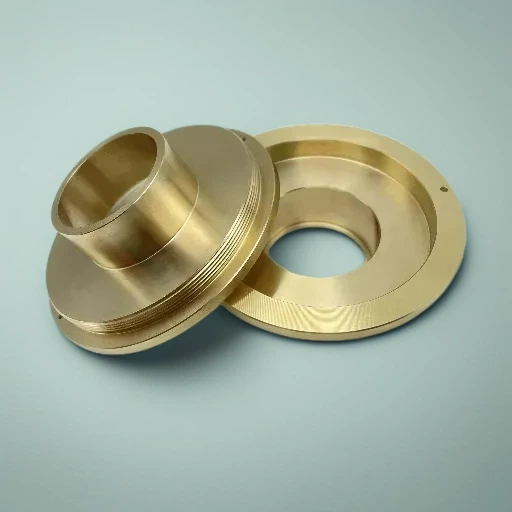
Brass CNC Machining
Brass
C3604 / CC3604 H59 (GB) H62 (GB) C210 C220 C230 C260 C272
Brass is known for its low friction coefficient and high machinability. It provides a unique aesthetic gold-like appearance.
Applications Plumbing fittings, decorative hardware, bearings, musical instruments.
brass guide
Copper CNC Machining
Copper
C101 C110
Pure copper offers exceptional electrical and thermal conductivity. It is soft and ductile, making it ideal for efficiency.
Applications Electrical contacts, heat exchangers, welding electrodes, bus bars.
copper guide
Titanium CNC Machining
Titanium Alloys
Grade 5 Grade 2 Grade 1
Outstanding strength-to-weight ratio and biocompatibility. Grade 5 is the workhorse of aerospace.
Applications Aerospace fasteners, medical implants, marine components.
titanium guide
Magnesium CNC Machining
Magnesium
AZ31B AZ91D
The lightest structural metal available, 33% lighter than aluminum with excellent vibration damping.
Applications Automotive die-castings, camera bodies, lightweight electronics.
magnesium guide
Carbon Fiber Machining
Carbon Fiber
Standard Modulus High Modulus
A high-performance composite material offering stiffness and strength far exceeding metals by weight. We machine carbon fiber sheets/plates with precision.
carbon fiber guide

🧮 CNC Machining Calculators

Essential calculators for cost estimation, material selection, weight calculation, and cutting parameters

💰 CNC Machining Cost Estimator

Get instant price estimates based on material, size, and complexity factors.

🔩 Material Selector & Comparison

Compare properties of common CNC machining materials. Select up to 3 materials to compare.

Filter by:

⚖️ Material Weight Calculator

Calculate weight for common shapes using actual material densities.

⚡ Cutting Speed & Feed Calculator

Calculate optimal RPM and feed rate based on material and tooling.

We Address Your Difficulties
Typical Metal CNC Machining Problems & Our Remedies
We recognize the challenges that procurement managers, engineers and manufacturers have to deal with. Here’s our solution.
01
Quality Differences Among Batches
The Challenge
Each order comes with a different quality of parts leading to assembly problems and rework.
Our Solution
SPC (Statistical Process Control) control over every run. CMM inspection with comprehensive dimensional reports. Same tooling for all batches.
02
Lead Times That Cannot Be Predicted
The Challenge
Suppliers fail to meet their deadlines, and therefore your production schedule and customer commitments are affected.
Our Solution
Online real-time order tracking portal. 98%+ on-time delivery rate. Devoted capacity planning with buffer stocks.
03
Getting Accurate Quotes Is Laborious
The Challenge
Getting quotations takes several weeks. The final invoices are not in line with the initial quotes.
Our Solution
Instant online quoting for standard parts. Detailed quotes within 24 hours for complex jobs. Transparent pricing with no hidden fees.
04
Design-to-Manufacturing Gaps
The Challenge
Parts are designed without considering manufacturability, leading to high costs or impossible features.
Our Solution
Free Design for Manufacturability (DFM) Review with every quote. Engineers identify cost-saving opportunities before production.
05
Material Traceability Concerns
The Challenge
Uncertain material origins create compliance risks for aerospace, medical and defense applications.
Our Solution
Full material certifications (MTRs) with every order. Domestic and traceable material sourcing. Complete lot traceability.
06
From Prototype to Production Scaling
The Challenge
Prototype supplier is unable to handle production volumes. Wasting time by starting over with a new supplier.
Our Solution
Seamless transition from prototype to production. Maintaining quality standards from 1 part to 100,000. 50+ CNC machines ready.

Features of Precision CNC Machining

Our advanced equipment and stringent quality checks aim to cater to the demands of the highest specifications.
Adaptable Machining
Dimensional tolerances that are as tight as ±,0.0005″ (±0.0127mm) are highly guaranteed and can be achieved through the use of state-of-the-art precision CNC equipment in a temperature-controlled environment.
Complex Geometry-Able
5-axis continuous machining offers undercuts, multi-angle features, and high-complexity contours, all with open setups.
Big Part Machining
Milling capacity is 80″ x 40″ x 30″. Turning capability is for parts of 24″ diameter and 60″ length.
Micro Machining
The machining of small parts featuring micro-characteristics such as features as small as 0.005″ as performed by using specialized cutting tools and unique detail.
Wark surface
Similarity to the finish can be obtained from parts where input DSL is 16 μin (0.4 [m) or even lower; mirror polish is an option in optical applications.
Fast Facts
Standard Tolerance ±0.005″ (±0.127mm)
Precision Tolerance ±0.0005″ (±0.0127mm)
Max Milling Size 80″ x 40″ x 30″
Max Turning Diameter 610mm (24″)
Finish Standard Ra 63μ” (1.6μm)
Superior Finish Ra 16μ” (0.4μm)
5-10 Days Prototype
24-48 Hours Rush

Metal CNC Machining Capabilities

The area of our facility which is 45,000 square feet accommodates more than 50 CNC machines which are the newest 5-axis machining centers, Swiss lathes, and metrology equipment to support the accuracy desired by you.
50+ CNC Machines
45K Sq Ft Facility
24/7 Production Capability
100% CMM Inspected
Advanced Metal CNC Machining Equipment
Equipment Type Make/Model Quantity Capacity
5-Axis Machining Centers DMG MORI DMU 50, Mazak Variaxis i-600 6 500 x 450 x 400mm
CNC Vertical Mills Haas VF-4, VF-6, Mazak VCN-530C 12 1270 x 508 x 635mm
CNC Horizontal Mills Mazak HCN-5000, Okuma MB-5000H 4 800 x 800 x 800mm
CNC Turning Centers Mazak QT-250, Doosan Lynx 220 8 Ø300mm x 500mm
Swiss-Type Lathes Citizen L20, Star SR-20 6 Ø20mm
Wire EDM Mitsubishi MV1200R, Sodick VL400Q 3 400 x 300 x 220mm
CMM Inspection Zeiss Contura, Mitutoyo Crysta-Apex 4 700 x 1000 x 600mm

Metal CNC Machining Quality Assurance & Certifications

Quality isn’t just a department — it’s our culture. The quality management system of ours that is thorough ensures that every part coming out meets or goes beyond your requirements.
ISO 9001:2015
Quality Management
A global standard for quality management systems in all industries
AS9100D
Aerospace Quality
Quality management system for aviation, space, and defense that is specific to the aerospace industry
ISO 13485
Medical Devices
Quality management system for the production of medical devices
ITAR
Defense Trade
Submitted for defense articles under International Traffic in Arms Regulations
Our Quality Process
1
Incoming Inspection
Verification of material certification, testing of composition, validation of dimensions
2
In-Process Control
Statistical Process Control monitoring, approval of first article, measurement in real time
3
Final Inspection
Complete CMM inspection on crucial features, visual inspection, functional testing
4
Documentation
Complete inspection reports, material certifications, certificates of conformity, lot traceability

What Affects Metal CNC Machining Costs?

Discover the key factors that influence metal CNC machining costs, including material choice, design complexity, and production volume.
Cost Impact by Factor
Machining Time 35%
Material 25%
Setup/Programming 15%
Finishing 12%
Inspection 8%
Overhead 5%
5 Ways to Reduce CNC Machining Costs
1
Optimize Design for Manufacturability Follow DFM guidelines to reduce machining time
2
Specify Only Necessary Tolerances Tight tolerances where not needed increase cost
3
Choose Cost-Effective Materials Consider 6061 aluminum vs. 7075 for non-critical applications
4
Increase Quantity Setup costs are spread across more parts
5
Standardize Features Use standard hole sizes, thread sizes, and corner radii

Metal CNC Machining Case Studies

Precision Solutions for Critical Industries
Case Study 01
Aerospace CNC Machining
Titanium Fuel System Components for Next-Generation Aircraft
Client Industry Tier 1 Aerospace Supplier
Materials Titanium Grade 5 (Ti-6Al-4V)
Certifications AS9100D, NADCAP
Volume 2,400 units annually
The Challenge
A primary aerospace systems manufacturer came to us with difficulty regarding previous suppliers’ inability to achieve the necessary tolerances for titanium fuel system components.
  • Positional tolerances of ±0.0005” on critical bore alignments
  • Surface finish requirements of Ra 16 μin on sealing surfaces
  • 100% material traceability with full certification documentation
  • First Article Inspection (FAI) per AS9102 standards
The previous supplier had more than 18% of the product defective, which disrupted the ongoing production and exhausted the budget. The client needed a contractor with an understanding of the complexities and challenges of titanium CNC machining and the AS9100 requirements.
Our Plan
Our engineering team conducted an in-depth analysis of design for manufacturability (DFM) and created an all-inclusive machining strategy relating to the following:
1. Process Improvement
  • Introduced custom carbide tool with TiAlN coating made for machining titanium Grade 5 that resulted in a tool life improvement of 340%.
  • Set adaptable machining parameters that changed cutting speeds based on real-time thermal data.
  • Employed 5-axis CNC machining centers to minimize setups for complicated features.
2. Quality Assurance System
  • In-process CMM verification implemented at 3 key production stages.
  • Special custom gages manufactured for 100% verification of bore alignment.
  • Full lot traceability implemented (from raw material certification to final inspection).
Outcomes
Scrap Rate
18% to 0.8%
Delivery
99.2% for 2 years
Cost Savings
$847,000 /yr
FAI Pass Rate
100% on 1st attempt
“Our supply chain was transformed through their expertise in titanium CNC machining and in AS9100 processes. There was a 60% reduction in the workload for incoming inspection as a result of the consistent quality we now achieve.”
— Director of Supplier Quality, Tier 1 Aerospace Supplier
Case Study 02
Medical Device CNC Machining
Precision Surgical Instrument Components with ISO 13485 Compliance
Client Industry Medical Device (FDA Class II)
Materials 316L SS, 17-4 PH Stainless
Certifications ISO 13485:2016, FDA Registered
Volume 15,000 units/year (12 SKUs)
The Challenge
A quickly expanding medical device firm was preparing their FDA 510(k) submission for their groundbreaking minimally invasive surgical system. They encountered more than a few obstacles, including:
  • The required validated manufacturing processes had to be fully documented for FDA submission
  • The tolerances, as tight as ±0.0002″, were needed on articulating joint components
  • There was a need for an electro-polished surface finish due to biocompatibility requirements
  • The need to scale from prototype quantities (50 units) quickly to production volumes (15,000+ annually)
The prototype supplier was unable to provide the required documentation due to their lack of ISO 13485 certification.
Proposed Approach
1. Manufacturability Design Collaboration
The engineering team collaborated with the client’s R&D department across three design iterations.
  • Reduced the number of high-precision features needing special tooling by 40%.
  • Identified tolerance requirements that could be relaxed to reduce cost by 23% per part.
  • Optimized internal corner radii to match standard tooling.
2. Confirmed Manufacturing Method
  • Developed and validated the IQ/OQ/PQ protocols for all critical machining processes.
  • Developed and maintained complete Device History Records (DHRs) for each production lot.
  • Implemented Change Control procedure with the client’s QMS.
  • Used Swiss CNC turning for high-precision, small-diameter parts.
Outcomes
FDA 510(k) Clearance
Obtained in 6 months
Process Validation
No findings in FDA audit
Production Cpk
Critical dims > 1.67
Time to Scale
8 weeks
“They became part of the team during the FDA prep. The documentation was so good that the FDA reviewer complimented the team on the quality of our manufacturing validation package.”
— VP of Quality, Medical Device Startup
Case Study 03
Automotive CNC Parts Manufacturing
Aluminum Motor Housing Components for Electric Vehicle Powertrain
Client Industry Electric Vehicle Manufacturer
Materials Aluminum 6061-T6, 7075-T651
Certifications IATF 16949, ISO 9001:2015
Volume 8,000 → 25,000 units/month
The Challenge
An emerging EV manufacturer was developing a next-generation drive unit and needed a precision CNC machining partner capable of supporting their aggressive timeline:
  • Complex aluminum motor housing with integrated cooling channels requiring 5-axis CNC machining
  • Thin wall sections (2.5mm) with flatness requirements of 0.05mm over 300mm
  • Rapid iteration—12 design revisions in 4 months during development phase
  • Need to transition from low volume (50/month) to high-volume production
Our Solution
1. Agile Prototype Support
  • Established dedicated prototype cell with 48-hour turnaround for design iterations
  • Assigned dedicated program engineer for daily coordination
  • Created modular fixturing system allowing rapid changeover between revisions
2. Aluminum CNC Machining Optimization
  • Developed custom clamping strategy to minimize distortion in thin-wall sections
  • Implemented high-speed aluminum milling with optimized chip evacuation, reducing cycle time by 35%
  • Applied thermal compensation algorithms to maintain tolerances
Results
Iterations
12 revs in 4 mos
Lead Time
Avg 48 hours
Scaling
50 to 8,000 /mo
Cost Reduction
42% optimized
“Due to the versatility of the firm’s rapid prototyping, we were able to stick to our development schedule. On Friday we redesigned a cooling channel and by Monday morning we had machined parts ready to test.”
— Chief Engineer, EV Powertrain Division
Case Study 04
Defense CNC Machining
ITAR-Compliant Guidance System Components
Client Industry Prime Defense Contractor
Materials Inconel 718, 15-5 PH, 4340 Steel
Certifications ITAR, AS9100D, NIST 800-171
Volume Low volume, high mix (50 – 500)
The Challenge
Major defense contractors require domestic CNC machine shops to comply with ITAR-controlled technical data. This one, however, has a more challenging tier screening level of the guidance system components which include:
  • Complete ITAR compliance including controlled access, document security, and personnel screening
  • Machining Inconel 718 with tolerances of ±0.0003” and a surface finish of Ra 8 μin
  • NIST 800-171 cybersecurity requirements for Controlled Unclassified Information (CUI)
  • Complete material traceability with MIL-STD documentation
The client was urgently required to reshore critical manufacturing of guidance system components due to the termination of their offshore supplier relationship based on ITAR concerns.
Our Solution
  • Set up a dedicated secure manufacturing cell with access control, security cameras, and visitor tracking
  • Set up Inconel specific machining processes using ceramic tooling with high pressure coolant systems
  • Set up encrypted file transfer and storage systems complying with NIST 800-171
  • Set up special inspection processes with 100% dimensional check and documented chain of custody
Results
ITAR Audit
No findings
Onboarding
12 wks to 1st delivery
Quality
0 ppm / 18 mos
Delivery
100% on-time
“Finding an ITAR compliant shop with genuine Inconel machining capabilities is rare. They have become our only go to for all guidance system mechanical components.”
— Supply Chain Director, Defense Prime Contractor

Metal CNC Machining FAQs

What is a CNC machine, and how does it relate to metal CNC machining?

The CNC machine, or computer numerical control is a programmable tool used, including CNC milling or lathe, for automating the machining process in the production of metal parts. In metal CNC machining, the CNC machine utilizes paths for cutting tools to remove raw metals (such as stainless steel, titanium, aluminum, and brass) so they meet tight tolerances and the required surface finish for precision parts and prototypes.

How does the machining process differ between traditional machining and CNC machining services?

Traditional machining often requires the manual positioning and movement of the tool using jigs and hand-fed tools. In contrast, CNC machining utilizes technology to automate the cutting action through CNC systems for repeatability and higher throughput. CNC services are applied like CNC milling and CNC turning to reduce the machining time, improve consistency for complex parts, and to enable advanced capabilities like 5-axis CNC for complex geometries compared to many manual methods.

Which metal is fabricated in combination with CNC metal cutting?

Metal fabrication is an amalgam of CNC metal cutting and shapes the sheet metal by welding, bending, finishing, and related jobs. In some cases, we would start with laser cutting of sheet metal, followed by CNC routing of the profile and terminal operations like anodizing or plating for finished assembly-ready parts in alloy steel, carbon steel, or stainless steel.

What metals and alloys are well-suited for machining metal through CNC machines such as mills and lathes?

Metals used for CNC machining open the doors to various practical applications, such as alloys in which they are used as been chosen for either aluminum, stainless steel, carbon steel, titanium, brass, and more. The final choice is determined by certain properties like mechanical properties, corrosion resistance, machinability, etc. Titanium and alloy steel may need special coatings for cutting tools or dictate slower feed speeds for heat and tool wear in the provision of high-precision CNC-machined parts.

What machining capability and tolerances can I expect from precision CNC machining?

Modern machining capabilities range a huge gamut from prototype single-piece runs to high-volume production of cnc machined parts. Precision CNC shops generally hold very tight tolerances (often a few thousandths-of-an-inch plus, depending on material and geometry) and provide nice surfaces via operations such as grinding or polishing. State-of-the-art shops offer really high-precision CNC machining for critical machine parts and assemblies.

How are CNC machining processes like CNC milling and CNC turning combined when manufacturing complex parts?

CNC milling shapes features like slots, recessing to pockets, and faces by stripping material using rotating cutters, whereas CNC turning works on the principle of cylindrical features and rotates the workpiece. Opportunities exist for manufacturing complex parts featuring threaded bores, undercuts, and intricate contours using both milling and turning in sequential sequences on multitask mill-turn centers or using multi-operation work setups, greatly simplifying the manufacturing process and reducing assembly hassle issues that is encountered and accuracy limitations.

Is it possible to integrate sheet metal fabrication with CNC machining services for assemblies?

Yes, many manufacturers integrate sheet metal fabrication—laser cutting, punching, and forming—with CNC machining to create mixed-material assemblies. CNC machining offers high-precision machined features, such as tapped holes and critical mating surfaces, whereas sheet metal provides light-weight enclosures and brackets. Using both, the pair gives way to fully functional assemblies, both for prototyping and full-scale production.

There are numerous reasons in favor of using CNC machining services online in contrast to local machine centers.

Online custom CNC machining services normally offer instant quoting, rapid prototyping, and scalable manufacturing based on submitted CAD files for prototype and final assembled parts. These services offer a wide network of machining capabilities that cover 5-axis CNC, as well as CNC milling and turning, a plethora of material options (stainless steel, aluminum, titanium), and, with consistent quality controls, they can shorten lead times compared to dealing with multiple machine shops at once.

What should I look for when ordering custom CNC metal parts to ensure manufacturability?

For a product's manufacturability, CAD models have to have clear tolerances, material selection like aluminum, brass, stainless steel, titanium, etc., as well as desired surface finish requirements, and any special requirements like heat treatment or plated for surfacing. For a machined process, considering CNC milling and turning techniques allows a thinner component with a minimum feature size, thin walls for sheet metals or machined parts, and an inspection criterion. Early discussions and formal contact with the machine-shop supplier may assist in achieving a better cost, reducing machining period, and eliminating the need for revisions.