

Supportive, Professional, Client-Focused Service
From prototypes to full-scale production, we’ve got you covered.


What Engineers and Buyers Need to Know About CNC Milling Services
📐 Quick Specs — CNC Milling at a Glance
| Axis Range | 3-axis, 4-axis, 5-axis |
| Standard Tolerance | ±0.05 mm (ISO 2768-m) |
| Precision Tolerance | ±0.01 mm |
| Surface Finish | Ra 1.6–3.2 μm (as-machined) |
| Spindle Speed | 8,000–30,000 RPM |
| Materials | 50+ metals and plastics |
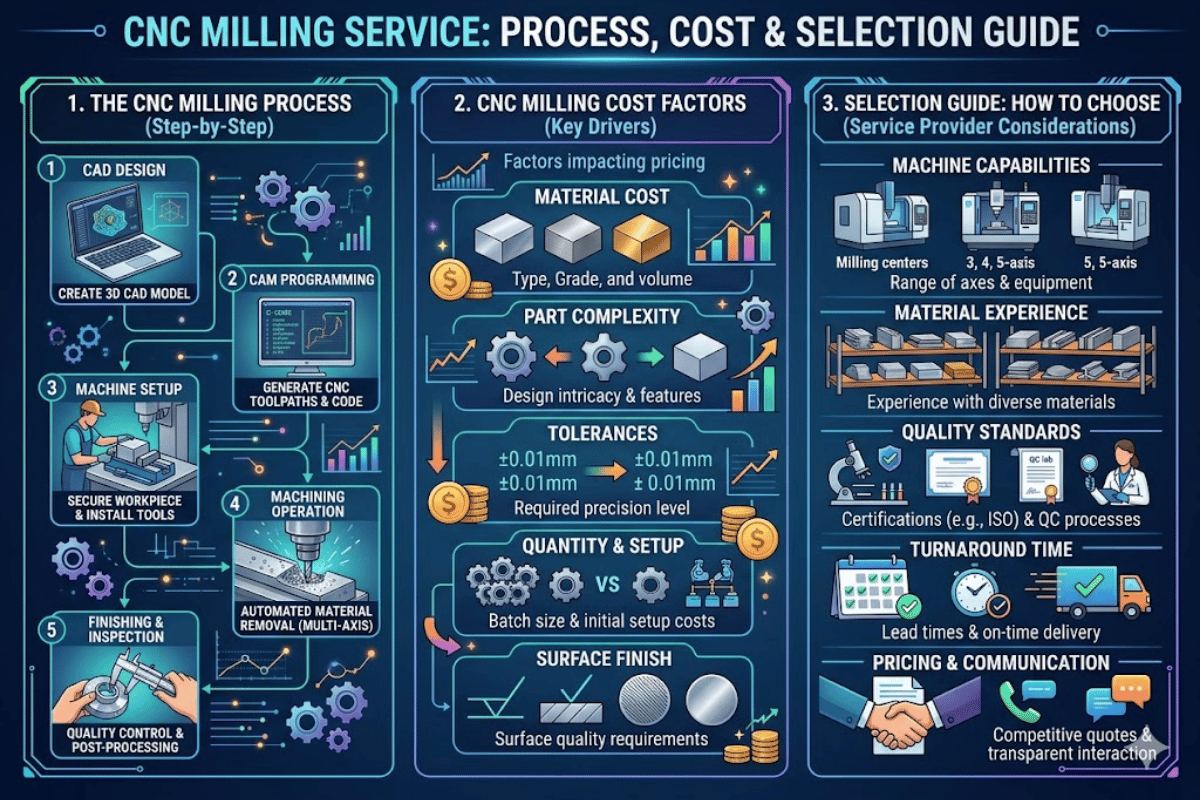
Determining your ideal CNC milling provider is about far more than currency-to-currency (or dollar-to-dollar). Part qualities, leadtime, and costs add up to more than most design engineers realize – especially for selecting the right number of axes, material grade, or tolerance class for your part. Between toolpath generation to final inspection, this guide discusses the CNC machining process, compares costs region-by-region and machine-by-machine, and offers a real-world baseline for decision-making – so you can order under the certainty you need, rather than guesswork.
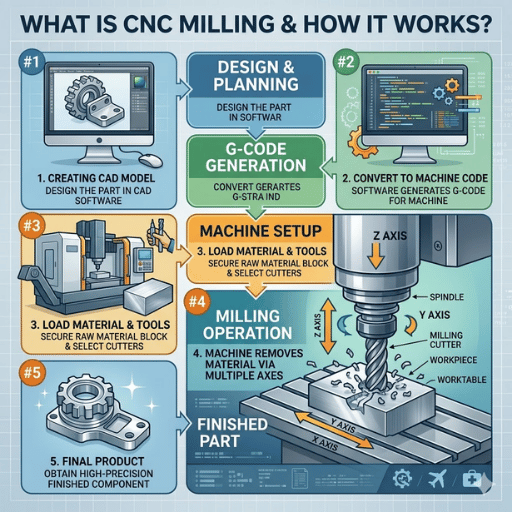
CNC milling, a subtractive manufacturing process, includes many CNC machine types and techniques. Because it removes unwanted material through a rotating cutting tool to generate custom parts, machinist instructions throughout the process: from choosing the tool’s speed to controlling where each cutter bit travels.
The machining process moves through three key stages:
Design Stage – CAD. Using either native SolidWorks/Fusion 360 or neutral formats like IGES or STEP, the smooth operation of CNC milling depends on accurately dimensioned CAD models. Inaccurate CAD models are like broken machinery – the result is lost hours chasing machining tolerances.
Toolpath Stage – CAM. While CNC mills run on G-code files (a series of instruction sets specifying the precise movement of the tool, including when it should slow down or stop) to create custom CNC parts, the primary logic behind milling is an experienced programmer who selects tools, plans stepovers, chooses roughing and finishing cycles, and programs the toolpath.
Execution Stage – CNC machining. Hard machines drill, cut, and perform precision machining on raw stock. Cutting (Vc) varies depending on the composition of the substrate: aluminum alloys at 200-400 m/min, carbon steels at 80-150 m/min, and titanium alloys at 30-70 m/min. This is limited by the thermal stability of carbide machining tools, such as carbide drills, going too fast will simply burn the inserts and wear them out.
Today’s milling centers feature spindle speeds from 8,000 to 30,000 RPM and maintain positioning accuracies of as fine as 0.005 mm in high-end applications. Combining the rigidity of the machine body, the precision of the ball screws, and the rapid feedback of the control provide the ability for a single CNC machine to repeatedly generate identical 1000 piece quantities of same parts.
Answering the questions; How many axes should I choose? How many parts should I be producing? What tolerance class is needed? How can I best save lead time? literally turns a CNC mill into a real-world tool of part creation – the implications of your selection process cut themselves right down through surface finish, tool wear, and cycle time.
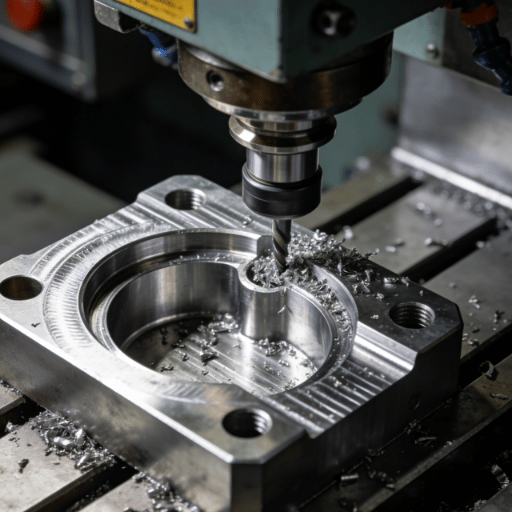
More axes on a CNC machine means all the work happens in a single setup. For complexity, if you need to add undetermined angles or get to undercuts, the more axes a CNC mill has the less re-fixturing becomes — CNC machining applications from aerospace brackets to medical housings benefit from this, and thus the more money you save overall.
| Feature | 3-Axis | 4-Axis | 5-Axis |
|---|---|---|---|
| Axes of Motion | X, Y, Z | X, Y, Z + A (rotation) | X, Y, Z + A + B (rotation) |
| Best For | Flat/prismatic parts, brackets | Cylindrical features, cam lobes | Turbine blades, impellers, medical implants |
| Typical Tolerance | ±0.05 mm | ±0.03 mm | ±0.01 mm |
| Setup Changes | 3–6 per part | 1–3 per part | 0–1 per part |
| Relative Cost | $35–55/hr | $50–90/hr | $75–250/hr |
| Typical Parts | Enclosures, plates, jigs | Shafts, gear blanks, fixtures | Aerospace brackets, impellers, surgical tools |
⚙️ Engineering Note — 3+2 Indexed vs. Simultaneous 5-Axis
In 3+2 (positional) machining, the two rotary axes are held at a fixed angle, but machining is carried out using the three linear axes. This method is used for most multi-face parts and is faster in programming time. Simultaneous 5 axis refers to the five axes being constantly in motion during the cut,ideal for sculptured surfaces such as turbine blades or contours for bone implants where continually changing tool vectors are necessary in order to keep tool tangent to surface.
High volume shops suggest 5-axis for all parts featuring undercuts, compound angles of draft or additional features that could otherwise be machined with more than 4 setups on 3 axis. For extended information please visit 5-axis CNC machining for complex components.
main point to remember: match axes of movement to shape of part. 3 axis will do 60-70% of average CNC machined parts, while 5 axes pays it’s own way on any part that might have to be done in multiple setups.
Materials determine machining cost, cycle time and functional performance. CNC machining facilities generally maintain stock of well over 50 forms of metal and plastic, yet six account for nearly 80% of all CNC millings placed. The most popular are summarized below.
| Material | Tensile Strength | Machinability Rating | Best For | Cost Tier |
|---|---|---|---|---|
| Aluminum 6061-T6 | 310 MPa | 90% (excellent) | Enclosures, brackets, prototype parts | $ |
| Aluminum 7075-T6 | 572 MPa | 70% | Aerospace structural, high-stress fixtures | $$ |
| Stainless Steel 304 | 515 MPa | 45% | Food-grade equipment, marine hardware | $$ |
| Stainless Steel 316L | 485 MPa | 40% | Medical devices, chemical processing | $$$ |
| Titanium Ti-6Al-4V | 950 MPa | 22% | Aerospace, medical implants | $$$$ |
| Brass C360 | 340 MPa | 100% (reference) | Connectors, valve bodies, fittings | $$ |
| POM (Delrin) | 70 MPa | 95% | Gears, bushings, low-friction guides | $ |
| PEEK | 100 MPa | 55% | High-temp seals, semiconductor fixtures | $$$$ |
It makes sense to do almost all CNC milling on aluminum alloys – the 6061 formed the bulk of the CNC work I did, as they will machine quicker and consistently produce good chip formation over other alloys, and the tooling is cheaper. For corrosion resistant metal parts in, say, a marine or medical environment, stainless steel 316L is most common despite being about 2.5 times slower than aluminum in the machine. Brass C360 is the criterion machinability (100%) and is used for, amongst other things electrical connectors and plumbing fittings.
On the plastics side, POM (Delrin) and PEEK constitute most of the good plastics orders. POM machines as clean as brass for a very much lower cost than PEEK. PEEK can endure continuous temperatures up to 250C – thus it may be the only plastic if it is used at high temperatures in aerospace and semiconductors.
⚙️ Engineering Note — Al 6061-T6 vs. 7075-T6
6061-T6: 310 MPa tensile strength, good weldability and very good anodizing response, default alloy for most production and prototype enclosures. 7075-T6: 572 MPa (84% stronger) alloy for aerospace structural components, not weldable reliably and about 30-40% more expensive per raw stock. Default to 6061, unless the mechanical loading warrants 7075. Read the full mach comparison in our 6061 vs 7075 aluminum article.
Having trouble choosing the right material for your project?
The pages for aluminum CNC machining and stainless steel CNC machining at Le-creator are packed with the technical information for each grade.
Lesson learned: Use Al 6061-T6 by default for both cost and speed. Use stainless steel or titanium only if the application absolutely requires corrosion resistance, biocompatibility, or high tensile strength.
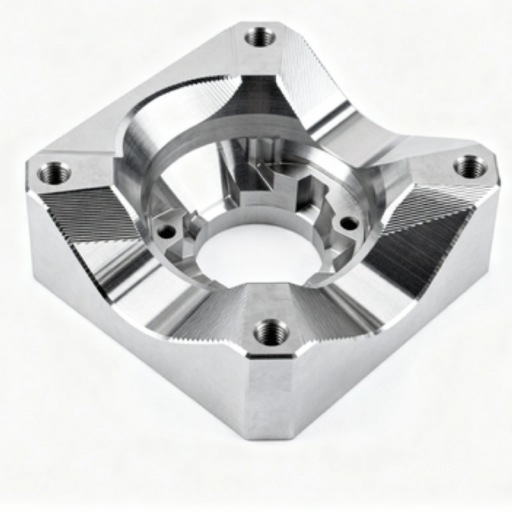
Specifying tolerance classes and surface finish requirements
all have a linear effect on machining time and cost. Overspecifying tolerance classes by one class results in being 30-50% more expensive per part, underspecifying results in assembly failures. Knowing the ISO 2768 tolerance classes enables you to specify only what a part needs – nothing more.
ISO 2768 General Tolerances (Linear Dimensions)
| Dimension Range | Class f (fine) | Class m (medium) | Class c (coarse) |
|---|---|---|---|
| 0.5–6 mm | ±0.05 mm | ±0.10 mm | ±0.20 mm |
| 6–30 mm | ±0.05 mm | ±0.10 mm | ±0.30 mm |
| 30–120 mm | ±0.10 mm | ±0.15 mm | ±0.50 mm |
| 120–400 mm | ±0.15 mm | ±0.20 mm | ±0.80 mm |
Surface Finish Reference Values
| Finish Type | Ra Value | Method |
|---|---|---|
| As-machined (standard) | Ra 3.2 μm | Standard CNC milling |
| Fine machined | Ra 1.6 μm | Finishing pass, lower feed |
| Polished | Ra 0.8 μm | Hand or machine polishing |
| Mirror | Ra 0.4 μm | Multi-stage lapping |
⚙️ Engineering Note — ISO 2768-m vs. ISO 2768-f
(ISO 2768-m – medium.) Common tolerance class in CNC-manufactured parts. Requires most of the non-critical dimensions. Use (ISO 2768-f – fine.) only for mating surfaces, bearing bores or locating features.
Dovetailing different tolerance classes on one drawing tight on the critical dimensions and relaxed on the less critical will keep costs down without compromising fit.
DFM Tips for Tolerance and Feature Design:
Most important point — always default to ISO 2768-m and Ra 3.2 μm. Tighten tolerances judiciously on mating features — blanket tight tolerances are not optimal for part function and cost more.
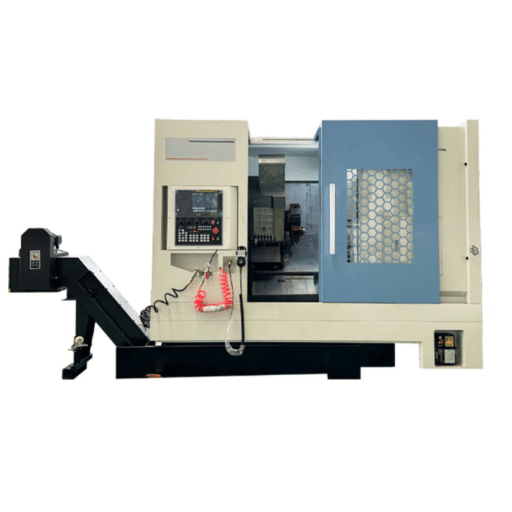
Cost of CNC milling is dependent on machine type, material, desired tolerance and quantity. Once you understand how the shops are pricing work you can estimate the cost before uploading a CAD file and commanding a quick quote – and identify when you’re being overcharged.
3-Axis Hourly Rate
$35–55/hr
5-Axis Hourly Rate
$75–250/hr
Cost Factors That Drive CNC Milling Pricing:
Regional Cost Comparison (CNC Machining Hourly Rates):
| Region | 3-Axis Rate | 5-Axis Rate |
|---|---|---|
| China (Shenzhen/Dongguan) | $12–25/hr | $30–75/hr |
| Europe (Germany/UK) | $45–90/hr | $90–200/hr |
| United States | $35–150/hr | $75–250/hr |
💡 Pro Tip — 5 Ways to Reduce CNC Milling Cost
Ready to see exact pricing for your part? Get an instant quote by uploading your CAD file.
Key takeaway: Machine time dominates CNC milling cost. Sourcing from China’s Shenzhen/Dongguan CNC manufacturing cluster can reduce machining rates by 50–70% compared to U.S. shops — without sacrificing quality when the supplier holds ISO 9001 and performs in-process inspection.

CNC milling, CNC turning, and 3D printing each suit different part geometries, volumes, and tolerance requirements. Choosing the wrong custom manufacturing process at the design stage forces costly re-engineering later. Here is how the three processes compare on the factors that matter most to engineers and procurement teams.
| Factor | CNC Milling | CNC Turning | 3D Printing (FDM/SLS) |
|---|---|---|---|
| Geometry | Prismatic, pocketed, multi-face | Rotational/cylindrical | Complex organic, lattice, internal channels |
| Typical Tolerance | ±0.01–0.05 mm | ±0.01–0.03 mm | ±0.10–0.30 mm |
| Best Volume | 1–10,000 parts | 1–100,000 parts | 1–50 parts (prototyping) |
| Materials | 50+ metals and plastics | 40+ metals and plastics | 15–30 polymers, limited metals |
| Lead Time (prototype) | 3–7 days | 3–7 days | 1–3 days |
| Surface Finish | Ra 0.8–3.2 μm | Ra 0.4–3.2 μm | Ra 6–15 μm (layer lines visible) |
✔ CNC Milling Advantages
⚠️ CNC Milling Limitations
Note that sheet metal fabrication (bending, stamping, laser cutting) fills another niche – thin-gauge enclosures and brackets in 0.25 – 6mm thick material. When a part contains both the sheet metal forming (die stamping, laser-cut) and machined features, many shops will laser-cut the blank and then CNC mill the precision interfaces in a secondary operation.
Decision framework: CNC mill any prismatic metal parts to 0.05 mm or better. Outsource CNC turning for shafts, bushings, other round parts. 3D print early prototypes in ABS or resin where dimensional accuracy doesn’t matter as much as form accuracy. Use wire EDM machining for parts with thin slots or R0.1 mm internal sharp corners. For a more in depth comparison, see our CNC milling vs CNC turning guide.
Key point: CNC mill non-rotational metal parts from prototype through mid-volume production. When you start producing round parts, switch to turning, and when you want to check form, go for 3D printing.
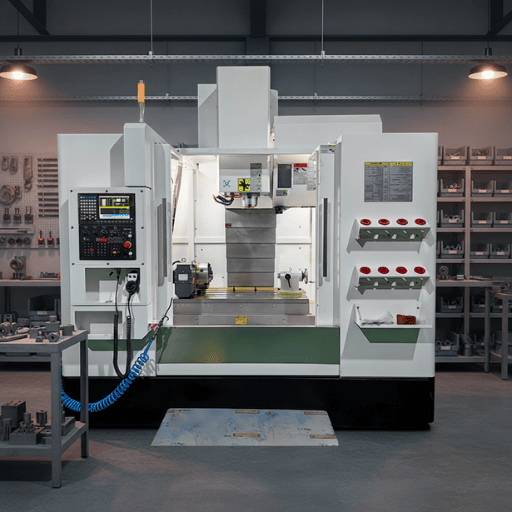
You can’t assume any online CNC machining service will give you the same output, communication, or leadtime as our global network of trusted part manufacturers. Just because a machine shop can do automotive brackets, doesn’t mean they can do aerospace grade parts. Use the checklist below to vet a CNC machining shop online before you buy.
✔ 8-Point Supplier Evaluation Checklist
⚠️ Red Flags When Evaluating a CNC Milling Provider
Le-creator operates a single shop in Shenzhen with over 80 CNC (3-5 axes), ISO 9001 certified machines, in-house CMM inspection, and 98% first-pass yield on 17 years of production. To see the implications for your part, check out Le-creator’s CNC machining capabilities or visit the CNC machining service overview.
High level key point: certification and DFM feedback quality and in-house inspection tell you more about CNC milling quality than simply pricing. Machine ownership is a concern- work that is subcontracted to a third-party cannot be held to the same tolerances as in-house work.
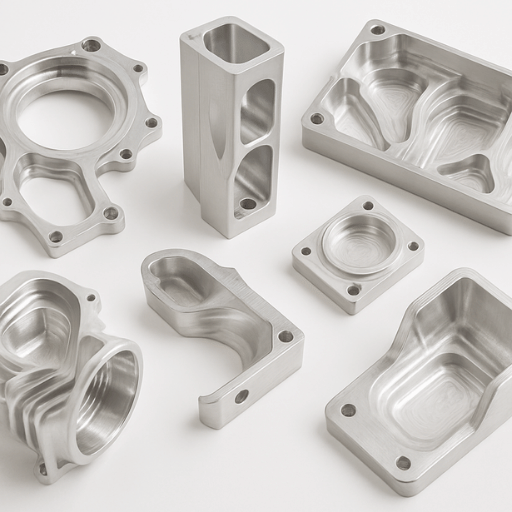
Typical 3-axis CNC milling rate: 35-55 USD/hr (US), $12-25/hr (China). 5-axes pricing for domestic providers ranges from 75-250 USD/hr. per part cost has other variables: material, tolerance, batch size, etc.
CNC milling tool remains stationary and the work is rotated to create prismatic shapes, pockets, and slots. CNC turning employs a fixed cutting tool while the work rotates around it; this method is better for parts that are fully cylindrical, such as pins, bushings, and shafts. Complex geometries often demand milling and turning used in sequence to finish a part.
CNC machining materials included aluminum (6061, 7075), stainless steel (304, 316L), copper, brass, plastics like POM (Delrin), PEEK, nylon and others in excess of 50 varieties. Material selection is driven by cost, functional strength, and corrosion resistance.
Present CNC milling dimensions tolerances: 0.05 mm (standard, ISO 2768-m). Calibrated equipment achieves 0.01 mm tolerances. Increased tolerance levels can be 30-50% more expensive; apply precision tolerances only on mating surfaces.
Rapid prototyping orders (1-10 parts) average 3-7 business days to manufacture. Up to 1,000 parts for production assembly can cost 10-20 business days to engineer. Prototype is target design specification; production is the finished product. Accelerated service can reduce prototype time to 1-3 days at a 30-50% premium. Many quality CNC providers offer quick-turn parts programs for urgent orders.
CNC 5-axes can generate complex 3D shapes, including scalloped surfs, undercuts, and angles in one hit. Complex parts like turbine blades, cosmetic shells, and medical implants commonly use simultaneous 5-axes. For internal volumes, 3D printing or EDM may solve the problem since setup 5-axes milling cannot reach inside the part.
Use standard tolerances (ISO 2768-m) for non-critical dimensions. Select aluminum (cost, machinability) over steel or titanium. Replace 5-axes with 3-axes parts by avoiding undercut regions and use CNC machining design features, like round edges or horizontal shapes. Group similar parts into bulk orders to absorb CNC setup time costs. Skip cosmetic surfaces finishes, apply Ra 3.2 μm (rough machined) surface quality is good for parts fitting inside other assemblies.
Submit CAD file and get a quote instantly. Le-creator creates prototype part in as few as 3 days at 0.01 mm accuracy using 80+ CNC machines in our Shenzhen, China factory.
The Team Behind This Analysis
This CNC milling strategies guide was developed by Le-creator engineering Department (Le-creator Technology Co. Ltd.), combining 80+ CNC mills – including 3-axes, 4-axes, 5-axes – from a single Shenzhen facility. Le-creator displays more than 10 years CNC projects, assemble and test experience, over 95% first attempt success rate; process engineers and technical writers modeled this guide using actual shop floor data and representative project results to benefit manufacturers researching potential manufacturer for CNC project quotes.