

Supportive, Professional, Client-Focused Service
From prototypes to full-scale production, we’ve got you covered.



Stainless Steel CNC Machining: What Engineers Need to Know Before Ordering Parts
| Most Machinable Grade | 303 (machinability index: 78%) |
| Most Common Grade | 304 (accounts for ~50% of all stainless steel production) |
| Typical CNC Tolerance | ±0.025 mm (±0.001″) standard |
| Achievable Precision | ±0.005 mm (±0.0002″) with grinding |
| Surface Finish Range | 0.05–3.2 μm Ra (as-machined to mirror polish) |
| Chromium Content | ≥10.5% (defines stainless classification per ASTM A276) |
| Key Machining Challenge | Work hardening during interrupted cuts |
Stainless steel has become one of the most requested CNC machining materials—and one of the most misunderstood. Engineers choose it for corrosion resistance, strength, and regulatory compliance, but the material science tradeoffs between requesting a CNC machined stainless steel part and actually receiving one are surprisingly few design teams recognize.
This guide covers the material science facts that will make or break your stainless steel CNC project: grade choice, cutting parameters, design-for-manufacturing rules, surface finishing requirements, and cost drivers. All data points are from published standards and technical references—not marketing materials.
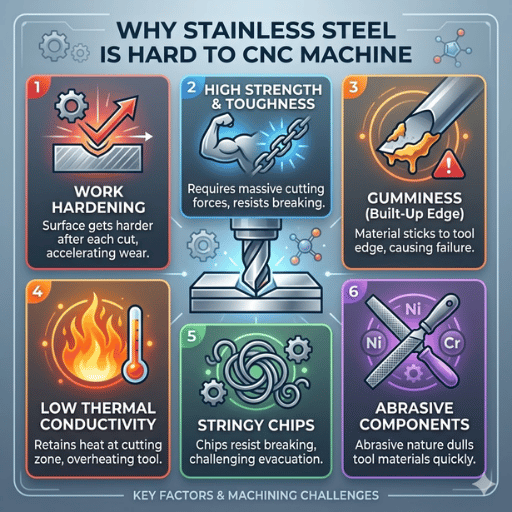
Stainless steels can be a nightmare to machine because of three properties that reinforce each other: low thermal conductivity, work hardening, and abrasive chromium carbides. Here’s a how-to-avoid: know the mechanisms first. …
…The thermal conductivity of 300 series stainless steel (usually austenitic) is 15 W/mK on average—roughly 1/3 that of carbon steels (45-58 W/mK) and less than 1/15 that of a common aluminum alloy (235W/mK), according to published data from the Thermtest thermal conductivity reference table. What this means during machining is that a large portion of the cutting heat is not transferred through the workpiece into the chips and tools, but remains trapped at the tool-chip interface. This increases tool wear and promotes built-up-edge.
| Property | 304 Stainless Steel | 1045 Carbon Steel | 6061 Aluminum |
|---|---|---|---|
| Thermal Conductivity | 16.2 W/m·K | 49.8 W/m·K | 167 W/m·K |
| Hardness (Brinell) | 201 HB | 163 HB | 95 HB |
| Work Hardening Rate | High (austenitic) | Low | Negligible |
| Machinability Index | 45% | 65% | ~300% |
| Typical Tool Life | Baseline | ~2× longer | ~5× longer |
…Work hardening is also a factor. When the tool machine passes over austenitic stainless steel, most of the energy imparted to the workpiece goes into increasing the surface hardness of the uncut material. If the subsequent pass takes a cut that is too minor—the work-hardened layer—the tool is running against hardened material instead of fresh material. This creates a destructive feedback loop: more heat, more friction, faster work hardening, and rapid tool failure.
…Is the chromium that provides stainless steel corrosion resistance (as long as it contains a minimum of 10.5% according to the ASTM A276 standard) and that forms chromium carbide particles within the metal matrix. These carbides are microscopic abrasives at the cutting edge of the tool and cause flank wear even at moderate speeds.
…The application of aluminum or mild steel CNC machining guidelines. Their lower feeds produce chips that are thinner and hotter, which in turn produces more heat and triggers work hardening. Stainless steel CN machining parameters need to be tested to reliably maintain at least 0.002” (0.05 mm) per tooth chip load to avoid the work-hardened layer.
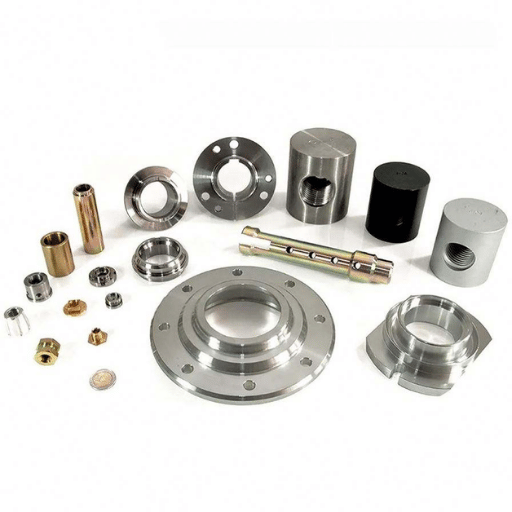
Ultimately, your choice of stainless steel grade accounts for approximately 60% of your part’s machining complexity and 30-40% of the raw material cost. Selecting an alloy based on corrosion resistance alone and ignoring machinability is the most frequent error that drives stainless steel CNC project costs through the roof.
While all stainless steels have a minimum of 10.5% chromium, other alloying elements such as nickel, molybdenum, and sulfur categorize stainless steels into four main types—each exhibiting unique machinability characteristics:
| Grade | Family | Machinability | Tensile Strength | Corrosion Resistance | Magnetic | Best For |
|---|---|---|---|---|---|---|
| 303 | Austenitic | 78% | 620 MPa | Moderate | No | High-volume turned parts, shafts, fittings |
| 304 | Austenitic | 45% | 515 MPa | Good | No | General purpose, food equipment, architectural |
| 316 | Austenitic | 36% | 515 MPa | Excellent | No | Marine, chemical, medical implants |
| 410 | Martensitic | 54% | 480 MPa | Moderate | Yes | Valve components, pump shafts, fasteners |
| 430 | Ferritic | 55% | 450 MPa | Good | Yes | Automotive trim, kitchen sinks, appliances |
| 17-4 PH | Precipitation Hardening | 45% (annealed) | 1,070 MPa (H900) | Good | Yes | Aerospace brackets, gears, high-strength shafts |
| Duplex 2205 | Duplex | ~30% | 620 MPa | Excellent | Partially | Oil and gas, desalination, pressure vessels |
| 15-5 PH | Precipitation Hardening | 40% (annealed) | 1,000 MPa (H900) | Good | Yes | Aerospace structural, nuclear components |
Machinability index as compared to AISI B1112 free-machining steel (100%). The higher the index, the easier the material is to machine.
Comparing 304 stainless steel machining to 303 stainless steel machining reveals a major gap. The sulfur and selenium additions that boost 303 machinability to 78% now reduce corrosion resistance and make the product practically unweldable. For tight tolerances requiring both good machinability and weldability, 304 remains the defining standard although 45% machinability is achieved.
Addition of 2-3% molybdenum to 316 stainless steel machining achieves excellent corrosion resistance in chloride environments but makes it the most difficult of the common austenitic grades to machine. Expect to spend 15-25% more cycle time for the same geometry compared to 304.
📐 Engineering Note
Specify hot-finished or cold-finished castings per ASTM A276. Cold-finished 304 has roughly 20% higher ultimate tensile strength (620 MPa vs. 515 MPa) and less ductility, slightly changing machined surface finish and forces. Call out condition on your drawing.
In applications that will not be affected by austenitic properties (non-magnetic, high corrosion resistance) consider ferritic or martensitic stainless steel alloys. 410 stainless steel has 54% machinability, a good compromise of machinability and corrosion resistance, far easier than 304.
For high strength and aerospace stainless steel applications, 17-4 is normally machined in the annealed Condition A (~45 machinability) and heat treated to H900 or H1025; parts are machined in Condition A then heat set after. Machining after heat treatment drops the machinability by roughly 50% (to 25%) and must employ very tight tooling and slow feeds. We work with 17-4 during both conditions in aerospace and machine tool projects across multiple stainless steel grades.
Finding the optimal speeds and feeds for stainless steel machining is better achieved by avoiding the extremes than in trying to maximize material removal rate. When machining at the optimum parameters, the material will be neither work hardened nor accelerate tool wear excessively. The table below is conservative reference for carbide tooling based on published machinability data from the Nickel Institute’s stainless steel machining handbook.
| Operation | Grade | SFM (Carbide) | Feed (IPT) | DOC (inches) |
|---|---|---|---|---|
| End Milling | 303 | 300–450 | 0.003–0.006 | 0.040–0.100 |
| End Milling | 304 | 250–350 | 0.003–0.005 | 0.030–0.080 |
| End Milling | 316 | 200–300 | 0.002–0.004 | 0.030–0.060 |
| End Milling | 17-4 PH (annealed) | 250–350 | 0.003–0.005 | 0.030–0.080 |
| CNC Turning | 304 | 300–500 | 0.005–0.012 IPR | 0.040–0.120 |
| CNC Turning | 316 | 250–400 | 0.004–0.010 IPR | 0.030–0.100 |
| Drilling | 304/316 | 80–120 | 0.004–0.008 IPR | — |
SFM = Surface Feet per Minute. IPT = Inches Per Tooth. IPR = Inches Per Revolution. DOC = Depth of Cut. Values for coated carbide inserts/end mills with coolant.
In CNC milling stainless steel machining end mills selection affects both surface finishing and maximum cutting tool life. Coated carbide end mills have roughly 50% longer operating life than uncoated carbide tools in austenitic machinability grades.
[Reference source:http://cnccookbook.com/choosing-the-best-cnc-milling-cutter-in-stainless-steel/]
📐 Engineering Note
For austenitic stainless steels, use an end mill with 40–45° helix angle and variable pitch geometry. The high helix moves stringy chips from austenitic grades more effectively and the variable pitch minimizes harmonic resonance. Combined, these changes cut finished surface chatter marks by about 40% compared to standard single-pitch helix end mills.
Never let the cutting tool dwell in stainless steel. Say you are running a live tool spindle, your CNC blanking out and either goes to sleep, pauses during a tool change or during a programmed feed hold it just stops for a moment. The heat-affected zone work-hardens and the cutting tool encounters the material at a far more difficult state when the machine restarts. Program climb milling tool paths with huge areas of continuous engagement,
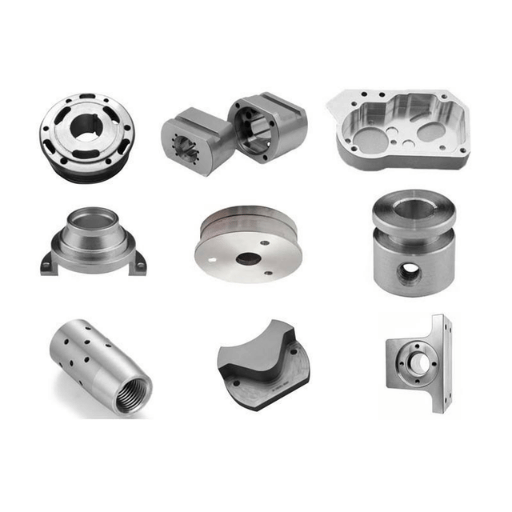
Design features that perform well when machining aluminum or mild steel often create issues when machining steel grades much harder than the SMX 26-23-22. High forces, low thermal conductance, and work hardening tendencies all influence ideal wall thicknesses, corner radii, and hole geometries in stainless steel.
Attach your CAD design as a STEP (.stp) file with a 2D drawing noting critical dimensions. This elimiates arguments about nominal versus actual geometry and clarifies which features are critical to finished part function.
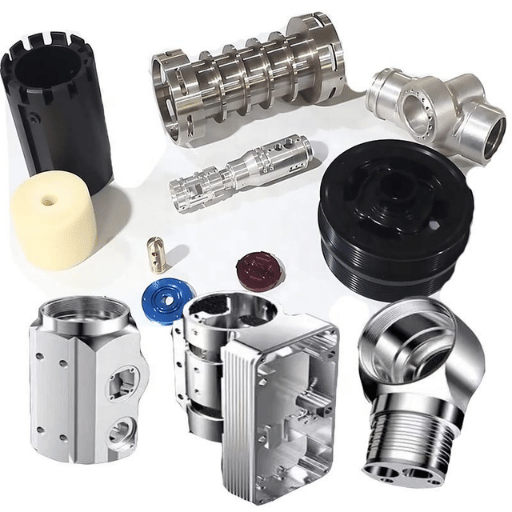
The finished surface of a CNC machined stainless steel part is not only aesthetically important, it determines corrosion resistance, cleanability, fatigue life, industry compliance, and extends the life of subsequent steps in the finishing process. Choose a post shaping treatment according to application conditions and industry standards.
| Finish Type | Ra (μm) | Relative Cost | Best Application |
|---|---|---|---|
| As-Machined | 1.6–3.2 | 1× | Non-critical internal components |
| Bead Blasted | 1.0–2.5 | 1.2× | Uniform matte appearance, hides tool marks |
| Brushed / Satin | 0.4–1.2 | 1.5× | Architectural, consumer products |
| Passivated (ASTM A967) | No change to Ra | 1.3× | All stainless steel parts (recommended baseline) |
| Electropolished | 0.2–0.4 | 2.5× | Medical devices, pharmaceutical, semiconductor |
| Mirror Polished | ≤0.05 | 4–6× | Optical components, luxury goods |
Passivation removes free iron from the surface of machined stainless steel parts, restoring the chromium oxide layer that provides corrosion resistance. Per the ASTM A967 standard, two primary chemical methods are approved:
Industry data from the Able Electropolishing technical comparison shows that electropolishing provides approximately 30 times greater corrosion resistance than passivation alone, because it removes a controlled micro-layer (typically 10–40 μm) of surface material along with embedded contaminants, micro-burrs, and surface stress.
📐 Engineering Note
For food-contact stainless steel components manufactured from 316L per 3-A Sanitary Standards, specify electropolished finish ≤0.8 μm Ra followed by citric acid passivation per ASTM A967 Method C. This combination meets FDA requirements while minimizing bacterial adhesion surface area.
The cost of CNC machining stainless steel parts is typically 1.5-3 higher than equivalent parts in aluminum and 1.2-1.8 higher than carbon steel. These multipliers come from four primary cost drivers – and understanding them gives you direct control over your project budget.
Cost Drivers in Stainless Steel CNC Machining
✔ Advantages of SS CNC Machining
⚠ Limitations to Consider
To obtain an exact quote on your custom stainless steel CNC machining project, Le-creator offers DFM feedback along with all quotes—helping find cost saving measures prior to production.
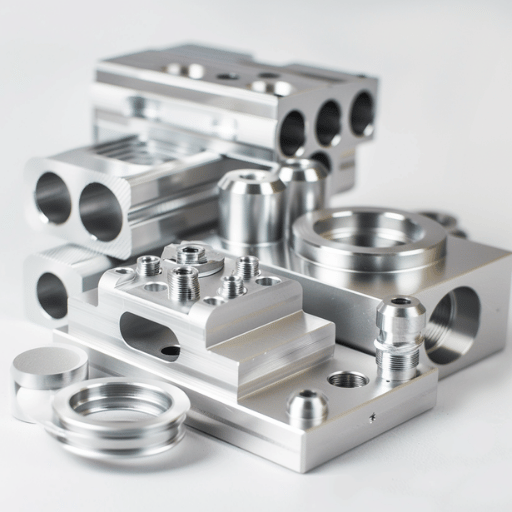
Send us your CAD design and we will give you a free DFM review with your quotation, within 24 hours in most instances.
This reference document has been developed by Le-creator’s in-house engineering department, with the experience of 17 years of precision CNC machining of 304, 316L, 17-4 PH, duplex stainless. It is drawing from published data sources for cutting parameters and the Nickel Institute’s research for material data. Material cost ranges are based on available 2025-2026 stock in bar and plate forms. Where the fabrication references a particular tolerance or Ra mentioned it is value that has been verified in Le-creator’s own inspection and 3D inspection record on thousands of delivered stainless steel parts .