

Supportive, Professional, Client-Focused Service
From prototypes to full-scale production, we’ve got you covered.


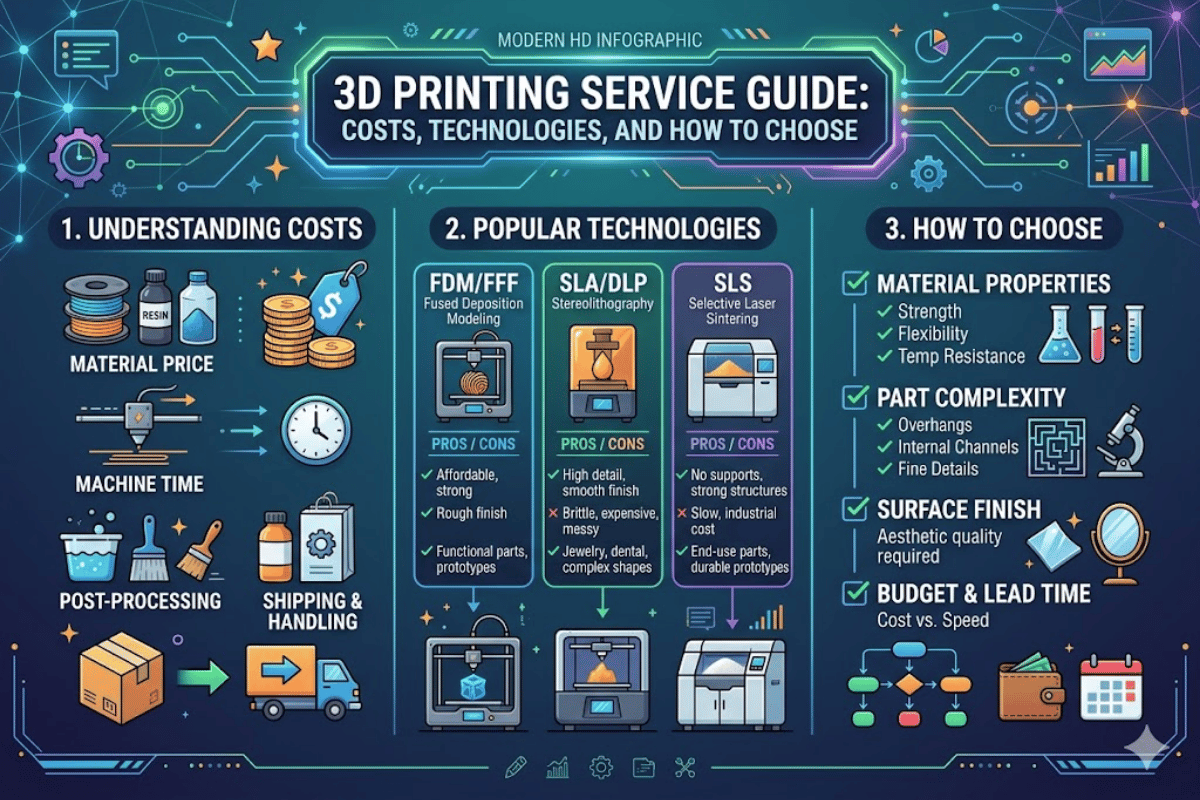
The Complete Guide to 3D Printing Services: Technologies, Costs, and Provider Selection
| Technologies Covered | FDM, SLA, SLS, MJF, DMLS/SLM, PolyJet |
| Cost Range (Per Part) | $3 – $1,000+ |
| Typical Lead Time | 1 – 10 business days |
| Common Materials | PLA, ABS, Nylon PA12, Resin, Stainless Steel, Titanium |
| Global Market Size (2025) | $30.55 billion (projected $168.93B by 2033) |
| Minimum Order | No minimum at most online services |
By 2025, the 3D printing industry surpassed $30 billion and 3D printing service providers have emerged to support everything from rapid prototyping to the serial production of 10,000+ parts. However, selecting the right service, technology, and material remains one of the most daunting choices faced by engineers and sourcing teams.
This guide provides a clear explanation of the 6 major 3D printing processes, real-world printing costs data, a framework to analyze providers, and practical design guidance so you are prepared to move forward confidently with your next project.

A 3D printing service takes your digital 3D model and converts it into a tangible part by using a shape layer-by-layer manufacturing process. Interestingly, unlike CNC machining, in which material is continually carved away, this additive manufacturing – one of the most important manufacturing technologies available today – is capable of generating geometries that would otherwise be impossible to machine. For example, complex internal channels, lattices, and organic shapes.
Most 3D printing service providers follow these steps in their typical order workflow:
Typical lead times vary a lot by technology, with FDM parts shipping in around 3-5 days, SLA in 2-4 days, and metal parts taking 5-10 days. Expedited shipping can normally reduce lead time by 50%, although usually at a 50-100% premium.

Selecting your printing technology is the single most critical factor in any 3D printing project. Each manufacturing process is based around a different principle for solidifying material which brings with it unique benefits in precision, part weight, material property, and cost. Here is a direct comparison of the six most common processes.
| Technology | Process | Tolerance | Layer Height | Best For |
|---|---|---|---|---|
| FDM | Fused deposition modeling — thermoplastic filament extruded through heated nozzle | ±0.5 mm | 50–400 μm | Concept models, jigs, fixtures, low-cost prototypes |
| SLA | Stereolithography — UV laser cures liquid resin layer by layer | ±0.1 mm | 25–100 μm | High-detail prototypes, dental models, jewelry masters |
| SLS | Selective laser sintering — laser fuses nylon powder in a heated bed | ±0.3 mm | 100–120 μm | Functional parts, snap-fits, living hinges, production runs |
| MJF | Multi jet fusion — inkjet applies fusing agent on nylon powder, infrared energy sinters | ±0.3 mm | 80 μm | End-use plastic parts, batch production with consistent properties |
| DMLS/SLM | Direct metal laser sintering / selective laser melting — laser fuses metal powder | ±0.1 mm | 20–50 μm | Aerospace brackets, medical implants, tooling inserts |
| PolyJet | Inkjet deposits photopolymer droplets, UV-cured instantly | ±0.1 mm | 16–32 μm | Multi-material parts, overmolding simulation, full-color models |
Powder-bed processes such as SLS / MJF produce fully dense (isotropic) parts because the powder in the build chamber acts as the support. FDM part processing is anisotropic because failure is much more likely along the layer lines. Researchers found, as published in Nature Scientific Reports, that FDM PLA specimens tested perpendicular to layer lines yielded 15-20% less tensile strength than specimens printed with the same orientation.
📐 Engineering Note
Surface Finish: FDM Ra 15-25 m, SLA Ra 2-4 m, SLS Ra 6-12 m. For Ra requirements below Ra 3.2 m (N7 equivalent per ISO 21920-2), SLA or PolyJet are the only additive manufacturing processes that can provide such fine detail without secondary finishing operations. Different 3D printing processes produce vastly different surface characteristics.
Material impacts not only your part, but also your cost and lead time. Below is a breakdown of part properties across 30-150+ materials available from 3D printing online service bureaus is detailed in this section.
| Material | Tensile Strength | HDT | Cost Tier | Typical Applications |
|---|---|---|---|---|
| PLA | 50–60 MPa | 55°C | $ ($50–80/kg) | Visual prototypes, form-check models |
| ABS | 34–36 MPa | 98°C | $ ($50–100/kg) | Enclosures, housings, heat-exposed fixtures |
| Nylon PA12 | 48–80 MPa | 180°C | $$ (~$100/kg) | Snap-fits, hinges, end-use production parts |
| Standard Resin (SLA) | 38–65 MPa | 42–58°C | $$ ($79–200/L) | Dental models, jewelry masters, high-detail prototypes |
| 17-4 PH Stainless Steel | up to 1,372 MPa | >400°C | $$$ (varies) | Aerospace brackets, surgical instruments, tooling |
| PA12 + Carbon Fiber | up to 70 MPa | 175°C | $$$ (varies) | Lightweight structural parts, drone frames, automotive brackets |
✔ Advantages of Plastic 3D Printing
⚠ Limitations of Plastic 3D Printing
Carbon fiber filled filament. Structural material testing data published in Material Data Reports by Formlabs shows that CF filled material increases tensile strength by 30-50% and increases stiffness by 50-100% over the base polymer. However, CF filled material is highly abrasive, requiring a hardened steel nozzle, which adds to operating costs if in-house FDM units are utilized.
PLA has a heat deflection temperature of 55C. Parts in PLA will warp and distort inside a car dashboard or near electronics or sources of heat above 50C. For heat-resistant functional parts, select ABS (98C HDT), Nylon PA12 (180C), or High Temp Resin (238C).

3D printing costs can be as little as $3 to over $1,000 for large metal parts. Unlike injection molding, no tooling costs exist, making the 3D printing process a cost-effective manufacturing process for custom 3D printed parts less than 1,000 units. Seven variables determine what you pay.
| Pricing Factor | Impact on Cost | How to Reduce |
|---|---|---|
| Material | PLA $50–80/kg vs. Titanium $300–600/kg | Use plastics for non-structural prototypes |
| Print Time | $15–25/hr (desktop) to $50–200/hr (industrial) | Reduce infill density; orient to minimize height |
| Part Complexity | Support structures add 20–40% to material and time | Design self-supporting angles (keep overhangs under 45°) |
| Technology | FDM cheapest; DMLS/SLM 5–10x more expensive | Match technology to actual requirements, not “best available” |
| Post-Processing | Sanding, painting, or plating adds $10–100+ per part | Specify only where surface finish is critical |
| Rush Orders | 50–100% surcharge on standard pricing | Plan ahead; batch orders to hit volume discounts |
| Industry Certifications | Medical/aerospace adds 200–300% due to compliance, documentation, and biocompatible materials | Only certify parts that require it |
The pricing estimates included above come from data collected across multiple online 3D printing service providers and industry surveys summarized by Grand View Research. Individual quotes are dependent upon geometry, volume, and service bureau location.
Combine multiple parts in one print run. Many service bureaus including SLS and MJF providers can nest dozens of parts in the same build to cut cost 15-30%. Request volume pricing on orders over 50 units.
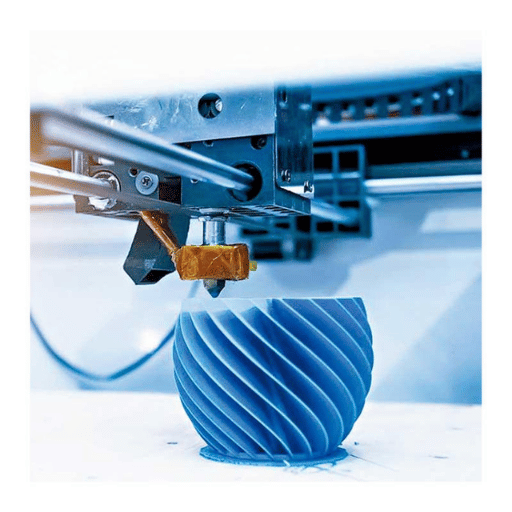
Not all 3D printing services offer the same value or quality. An initial lower quote can be delayed by rework costs associated with using the wrong process or tolerances. Eight evaluation criteria for selecting a quality 3D printing services provider from the many manufacturing services available professional 3D printing service source are listed below.

One of the most frequent questions we hear from engineering teams is whether buying a 3D printer makes sense or to stick with ordering external 3D printing services. Your decision hinges on print volume, technology requirements, and how important control of turnaround time is to your project.
| Factor | Outsourcing | In-House Printer |
|---|---|---|
| Upfront Investment | $0 | $200 (FDM) – $500,000+ (industrial SLS) |
| Per-Part Cost | Higher (service markup included) | Up to 94% lower at scale |
| Technology Access | All 6+ technologies available | Limited to purchased machine(s) |
| Lead Time | 2–10 days (including shipping) | Hours to 1 day (no shipping) |
| Maintenance | Provider handles all maintenance | Staff training + annual service contracts |
| Break-Even Point | N/A | ~2 years for industrial systems |
Analysis from UltiMaker and other independent calculator tools estimate that the break-even point, assuming continuous reliable production, for an industrial 3D printer is roughly 2 years. When teams are producing less than 10 parts/month, outsourcing the work will nearly always work out cheaper in total cost of ownership. When you need to produce more than 50 parts/month with reliable technology needs, an in-house machine begins to make sense once you consider the hidden costs of employee training, failed prints, break-down maintenance, consumables, and floor-space.
Most teams are best served with a hybrid approach: An in-house desktop FDM or SLA 3D printer for rapid concept checks (same-day turnaround), supplemented with a reliable professional service bureau for final production parts in SLS, MJF, or metal. This approach minimizes iteration time in product development while giving your team control of industrial 3D printing capabilities for quality-critical parts.

Even the best 3D printing service cannot compensate for a bad model. Think about design for additive manufacturing (DfAM) standards to maximize first-pass success, saving time and money on re-work and re-prime. Whether you are preparing a 3D file for rapid prototyping or custom parts production, these guidelines apply.
Your 3D CAD file will be prepared for printing according to your service platform’s protocols. The three most popular file formats are:
📐 Engineering Note
Minimum embossed font height required for different printing processes: FDM 2 mm (0.6 mm stroke width), SLA 0.1 mm, SLS 0.5mm. For identification markings on metal (DMLS) parts, account for 0.4mm deep, 1 mm high characters surviving post-machining. See ASTM F2971-13(2021) – Standard practice for reporting data for test specimens prepared by additive manufacturing.

Ready to Start Your 3D Printing Project?
Upload your 3d file and receive an instant quote from Le-Creator – 17+ years of precision manufacturing, AS9100 and ISO 13485 registration, wide material selection.
Le-Creator has built custom manufacturing facilities since 2008, specializing in precision CNC machining and 3d additive manufacturing. We produce over 10 million parts for aerospace, medical, military and commercial clients. The cost data, industry standards, and material properties referenced in this article come from independent third parties and are industry standards, not marketing claims. For relevant capabilities, we note them as one data point near others for comparison.