

Supportive, Professional, Client-Focused Service
From prototypes to full-scale production, we’ve got you covered.


Wire EDM vs Sinker EDM: Differences, Applications & How to Choose
The two processes of edm machining, wire edm and sinker edm, atomize material by controlled electrical discharges, but that is the only similarity. In a wire edm machine, a fine wire electrode moves through the workpiece, creating 2-D profiles. In a sinker edm machine, a shaped electrode plunges into the workpiece, creating 3-D cavities. Pumping the wrong kind of edm machine for your part design creates wasted time, higher costs, and unsatisfactory tolerances.
In this guide we compare and contrast wire EDM and sinker EDM on criteria of: edm process mechanics, what each EDM machine does and does not do, actual applications of sinker EDM and wire EDM uses, cost per part, and a decision flow chart that reveals which type of electrical discharge machine is appropriate for your part. If you are providing a quote for an insert profile or a die cavity, use the comparison chart below to make your choice.
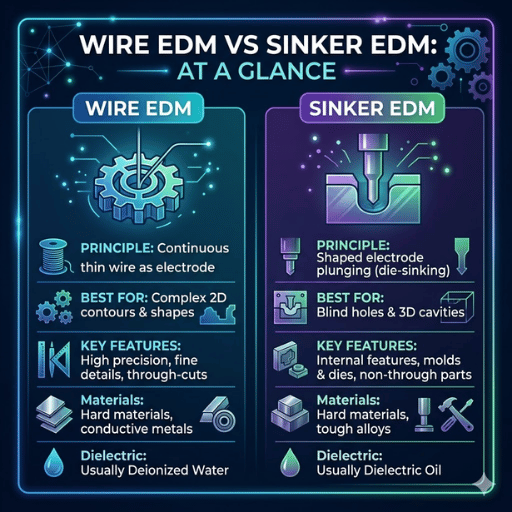
Before we discuss the physics, here is a quick, side-by-side summary. This chart encapsulates the main distinctions between sinker and wire EDM-criteria which most engineers research first and foremost-
| Attribute | Wire EDM | Sinker EDM |
|---|---|---|
| Electrode | Continuously fed thin wire (brass/copper, 0.1–0.3 mm) | Pre-shaped graphite or copper block |
| Geometry | 2D profiles (through-cuts only) | 3D cavities, blind pockets, textures |
| Tolerance | ±0.0025 mm (±0.0001″) | ±0.005–0.025 mm (±0.0002–0.001″) |
| Surface Finish | Ra 0.1–0.8 µm | Ra 0.4–3.2 µm |
| Cutting Speed | Moderate (20–150 mm³/min) | Faster roughing (50–500 mm³/min) |
| Automation | High — lights-out capable | Moderate — electrode changes may need operator |
| Best For | Dies, gears, profile cuts in hard metals | Mold cavities, forging dies, 3D features |
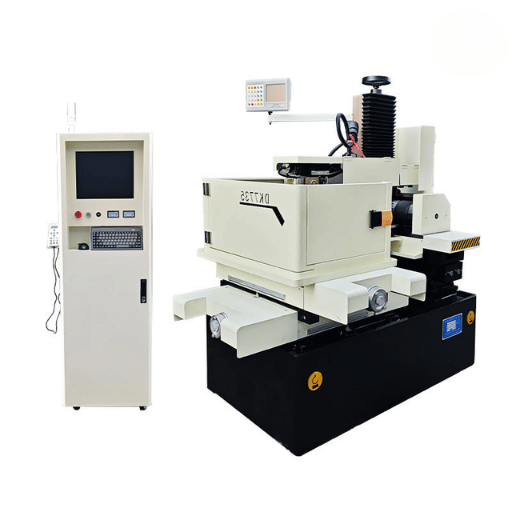
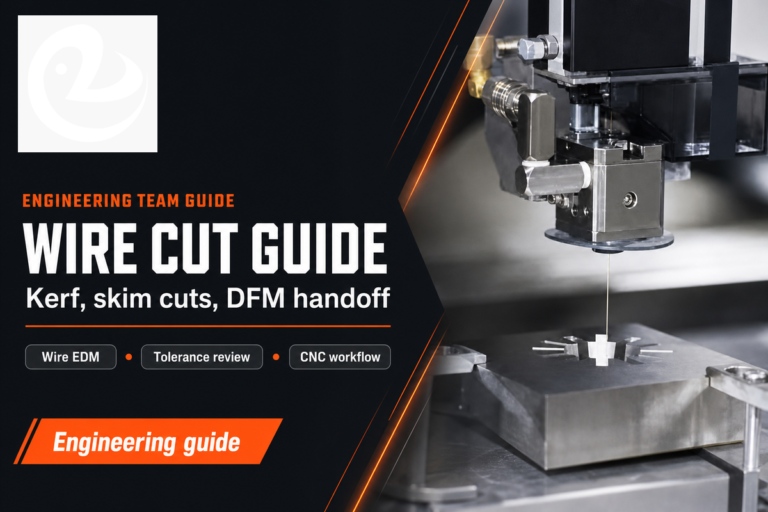
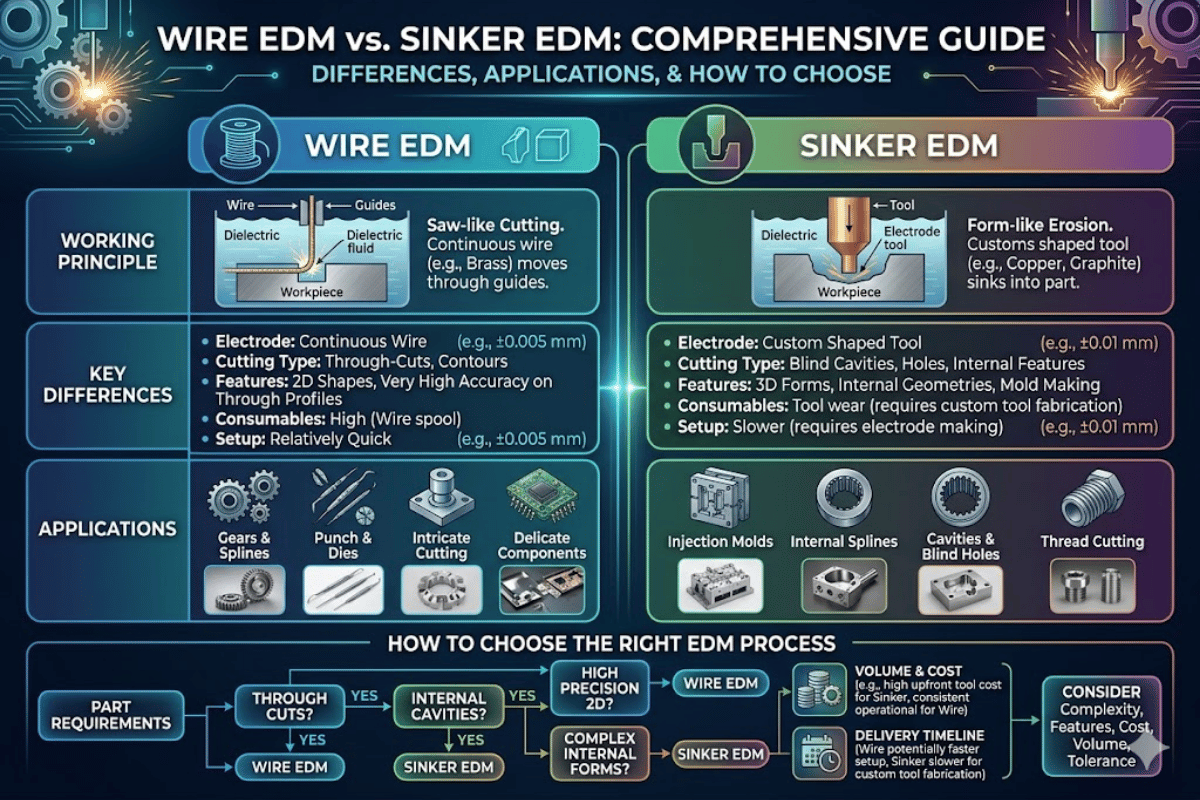
In a wire edm machine, a continuous wire electrode of brass or copper-coated steel (0.1-0.3 mm diameter) emerges from a supply spool and moves in front of a workpiece, the assembly sitting in a mineral oil bath. The wire acts like a bandsaw blade, slicing a profile from the material by electrical spark rather than the teeth. The wire is never touched by any solid cutting tool.
This diagram demonstrates the cycle of wire EDM operation. The wire electrode and workpiece are submerged in deionized water (the dielectric fluid). A CNC controller guides the wire relative to the work along X and Y axes, while two additional U and V axes positioned on the upper wire guide enable angled tapers up to 30. When the electric field across the gap between wire and workpiece reaches the spark breakdown voltage level, each spark produces a flash above 8,000 C and vaporizes a microscopic bit of material. Wall-to-wall, thousands of sparks occur each second, following the CAD-programmed path.
Because the wire moves constantly the electrode is always fresh and there is little or no wear, allowing high accuracy and tolerance stability throughout the machining operation. With the precision capabilities of a modern wire edm, it’s possible to achieve accuracies of 0.0025 mm (0.0001″ ) and surface finishes Ra 0.1 m after multiple skim passes. Le-Creator performs dedicated wire EDM services for production shops for parts requiring this degree of precision.
However, wire edm can only create shapes that are through holes-not blind cavities, pockets, or textured surfaces-that is where sinker edm is appropriate.

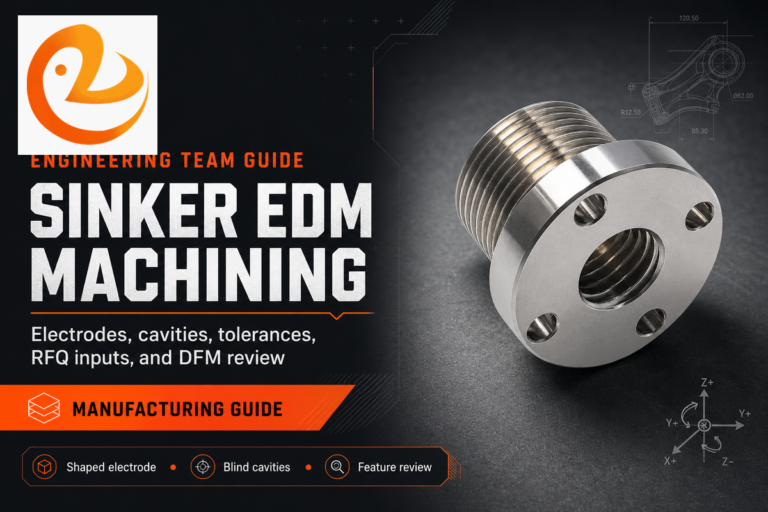
Sinker EDM- or ram EDM, die-sinking EDM, cavity edm, or volume edm- involves the use of a shape formed electrode (sometimes called tool) which is used to cut a mirror-image cavity into the work-piece. The electrode shape is usually graphite- (for quicker production and easier shape generation) or copper- (for finer surface qualities). Sinker EDM is capable of producing the three-dimensional geometries such as blind pockets, ribs, textured areas, undercut and contours, which are inaccessible using wire EDM.
The sinker EDM machine holds the electrode and work piece submerged in dielectric oil, composed of hydrocarbons. A servo-powered ram pushes a shaped electrode towards the work piece where a spark gap of between 0.01-0.5 mm is maintained. Electrical discharges across this gap erode the shape of the work piece exactly opposite the shape of the electrode.
The dielectric fluid washes away the eroded material from the machining zone and insulates the gap between sparks.
Sinker edm-machines have tolerances of 0.005-0.025 mm as well as surface finishes of Ra 0.4 m (fine finishing) up to Ra 3.2 m (roughing). VDI textures can be directly transferred onto the cavity surface of mold makers by sinker edm-machining with specific finishing conditions to avoid a second texturizing step. The sinker edm process can produce every electrically conducting material imaginable independent from the hardness, therefore these machines are the manufacturing method of choice for cavity machining of hardened tool steel molds approaching 60+ HRC.
Tradeoff: every job needs a custom electrode, which needs to be CNC machined out of graphite or copper to produce the work piece. For complex cavities we may require more than one electrode to produce a roughing and finishing electrode, which adds a further $200-$2,000+ in electrode manufacture. Electrode wear during machining adds to this cost for deep cavities.
The main difference between the two is the type of electrode and the ability to cut complex shapes. Wire EDM removes the part. Sinker EDM removes the part.
The following table describes the differences between wire and sinker EDM where it seems to matter most when quoting parts and choosing a process.
| Criteria | Wire EDM | Sinker EDM |
|---|---|---|
| 1. Electrode type | Continuously fed thin wire (0.1–0.3 mm brass/copper) | Custom-machined graphite or copper block |
| 2. Electrode consumption | Continuous feed — no rework needed | 1–15% wear per operation; may need multiple electrodes |
| 3. Geometry capability | 2D profiles — must pass through full thickness | 3D cavities, blind pockets, textures, undercuts |
| 4. Tolerance | ±0.0025 mm (±0.0001″) | ±0.005–0.025 mm (±0.0002–0.001″) |
| 5. Surface finish | Ra 0.1–0.8 µm | Ra 0.4–3.2 µm |
| 6. Material removal rate (MRR) | 20–150 mm³/min | 50–500 mm³/min |
| 7. Max workpiece thickness | 300–500 mm (limited by wire tension) | Limited by electrode reach and flushing |
| 8. Dielectric fluid | Deionized water | Hydrocarbon oil |
| 9. Internal corner radius | Min. = wire radius + overcut (~0.15 mm) | Sharp internal corners possible (electrode shape dependent) |
| 10. Taper capability | Up to ±30° with U/V axis | Draft angles built into electrode geometry |
| 11. Setup time | 30–60 min (fixture + threading wire) | 1–4 hrs (fixture + electrode alignment + orbiting test) |
| 12. Automation level | High — auto-threading enables lights-out operation | Moderate — electrode changers available on higher-end machines |
| 13. Electrode cost per job | $5–$30 (wire spool consumption) | $200–$2,000+ (custom electrode fabrication) |
| 14. Machine hourly rate | $60–$120/hr | $50–$100/hr |
| 15. Machine capital cost | $80,000–$500,000 | $50,000–$300,000 |
| 16. Operator skill required | Moderate — CNC programming + setup | Higher — electrode design + discharge parameter tuning |
To summarize: Wire EDM is the precision machine for through-cut profiles where tolerance and finish are king. Sinker EDm is the geometry machine for 3D shapes that no other machining process—including wire EDM—can approach.
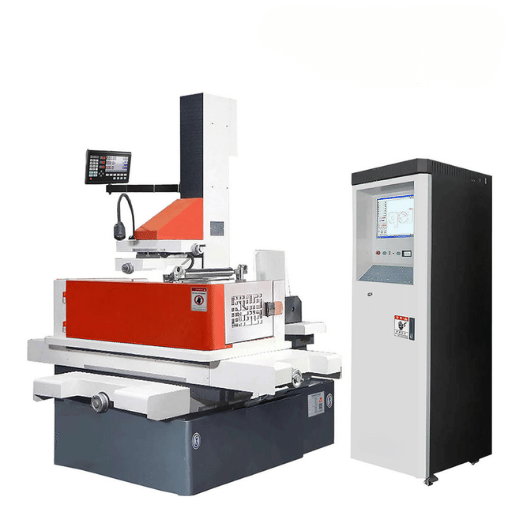
The most common application for wire edm is for parts that require a close tolerance cut all the way through a conductive member–preferably a hardened steel or some sort of exotic alloy that would easily destroy a regular cutting instrument. These are some of the wire edm applications:
Wire edm is appropriate for any part where the geometry is a 2D profile (flat or tapered) and tolerances below 0.01 mm are specified. For still-harder materials, EDM can cut 64 HRC with no accuracy loss-one feat that carbide or HSS cutting tools cannot produce
Sinker edm is better suited for 3D geometry that cannot be cut by wire EDM, milled, or any other form of conventional machining. Typical applications for Sinker EDM:
Sinker EDM is especially useful for any part where a surface texture must be added to a hardened surface, a blind cavity must be created, or an undercut is desired. EDM has broad application in moldmaking, die manufacturing, and aerospace industries-anywhere a hard conducting material is cut into complex 3D shape.
A third type of edm-hole drilling edm-is worth noting. Hole drilling EDM employs a rotating tube-shaped electrode to drill very small holes (0.1-6 mm) into any conductive material. This technology is most often used in: form starting holes for wire EDM, and in blind hole drilling of turbine blades. While it is not commonly called upon, hole drilling edm is an indispensable operational support for both wire and sinker EDM machines
Real-World Decision Scenarios:
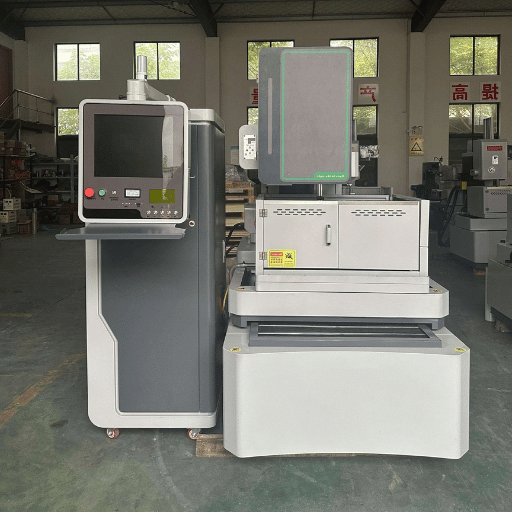
The costs of each process introduce the debate of sinker vs wire EDM. While the average hourly rate for wire EDM ($60-$120/hr) beats that of sinker EDM ($50-$100/hr), sinker EDM adds a hidden cost that wire EDM bypasses: electrode fabrication
For a simple cavity, a sinker EDMelectrode ranges from $200-$500 worth of graphite to machine,with elaborate electrodes costing more. A complex multi-feature electrode that has tight tolerances will go $1,000-$2,000+.If separate roughing and finishing electrodes are needed, as they typically are in most accurate mold cavities, this cost will double. Wire EDM, by comparison, spends $5-$30 in wire per depositregardless of complexity.
This makes the per-part economics straightforward:
Cost of Machine Capital also differs: as of this writing, a mid-range wire edm machine will cost $150,000-$350,000, while a comparable sinker edm machine costs $80,000-$200,000. High-end cnc capable of high degree of automation (auto-threading wire packs, robotic battery changers for sinker) shift both over $400,000. For a shop evaluating, consider whether you will use a lot of EDMed parts. If so, compare cost of ownership for multiple parts referencing your part mix and actual volumes.

When deciding on sinker edm vs. wire edm on an application, run through these three questions:
1. Does the geometry pass entirely through the workpiece?
If yes, choose wire edm. It provides tighter tolerances, superior surface finish, and lower cost per piece (no electrode cost). It can cut profile in any conductive material up to 500 mm thick.
2. Do you need a 3D cavity, blind pocket, texture, or undercut?
If yes, choose sinker. Only sinker edm machines can produce this feature. No wire EDM machines can create geometry that does not go through. Here the edm is the clear winner.
3. What is your production volume?
For one off parts and prototypes, wire EDM avoids the electrode overhead. For volumes 50+. In order for sinker to work, 50+ parts with the same cavity and “reusable” electrode amortizes the electrode overhead and its increased MRR shortens cycle time. Many shops that run both organ are routing jobs based on that.
The simplest answer to whether the edm can do the stainless machining task is that both wire and sinker EDM can accomplish it in any of the 304, 316 and 17-4Ph stainless grades- hardness and corrosion resistance can be ignored: electric discharge machining removes material by thermal and not mechanical means.
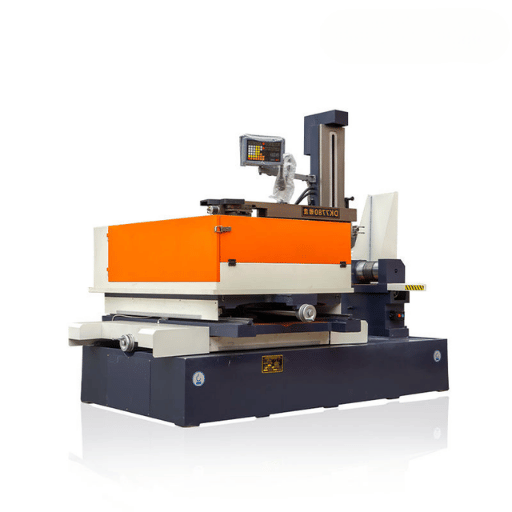
The electrode is the biggest differentiator between wire EDM and sinker EDM, the type of geometry they create is the second largest difference. Wire EDM uses a continuously fed fine wire to cut 2D profiles in the full thickness of the work piece. Sinker EDM uses a custom electrode that plunges into the work piece to produce 3D blind cavities, textures, and contours. Wire EDM cuts through, sinker cuts into
Wire EDM is more precise. USICHJIMOPa wire edm machine will hold tolerance of 0.0025 mm (0.0001 in) and will cut to Ra 0.1 m surface finish. Sinker machines are typically in the range of 0.005-0.025 mm and Ra 0.4-3.2 m surface finishes. Since a wire is continuously fed, any variation in electrode wear is minimized, leading to an advantage for Wire EDM in dimensional control.
It is technically possible that a sinker edge can be forced through the full thickness of a workpiece. However, it is not practical: the electrode wears during the process, locations and dimensions vary with depth and deep through cuts challenge electrode flushing. Electrodes are designed for and purpose-built for full-thickness through-cut operations.
Quite simply, welding wire EDM and sinker EDM can cut anything electrically conductor materials. Tool steels, instrument steels, cost steels, stainless steels, titanium, Inconel, tungsten carbide, copper, aluminum, and all similar conductor ceramics. So in terms of ease of machinability, if it is a conductor, it can be machined. Hardness is no issue, a 64 HRC tool steel can be machined at the same ease as a Soft aluminum, as long as it is a conductor. However; non-conductors like plastics, glaze glass or non-conducting ceramics are not EDM machinable.
The best I can tell, in general, sinker EDM machine is has a higher raw material removal rate (50-500 mm/min versus 20-150mm/min) and faster bulk removal so it is more efficient for making a rough shape. However, you can’t actually shape the work until you have spent hours if not days fabricating the electrode. While, a wire EDM can not start machining until the part can be reliably fixtured to the table, it can start immediately after the CNC program loaded. Depending on the profile, and necessarily the level of detail, wire EDM will generally have faster total turnaround time for through-cut profiles.
Le-Creator provides wire EDM, sinker EDM, and full CNC machining with tolerances to 0.0001″. Upload your CAD files for a free quote.