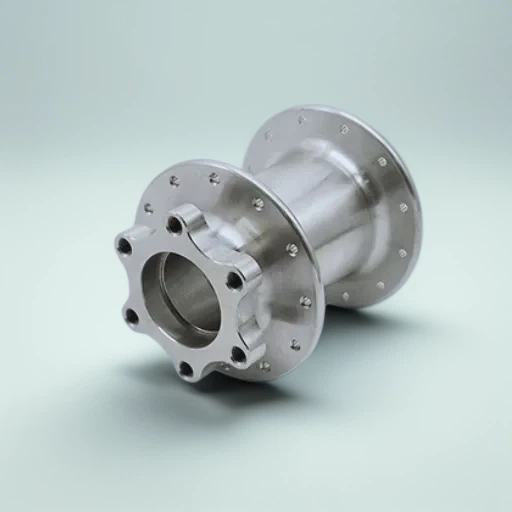
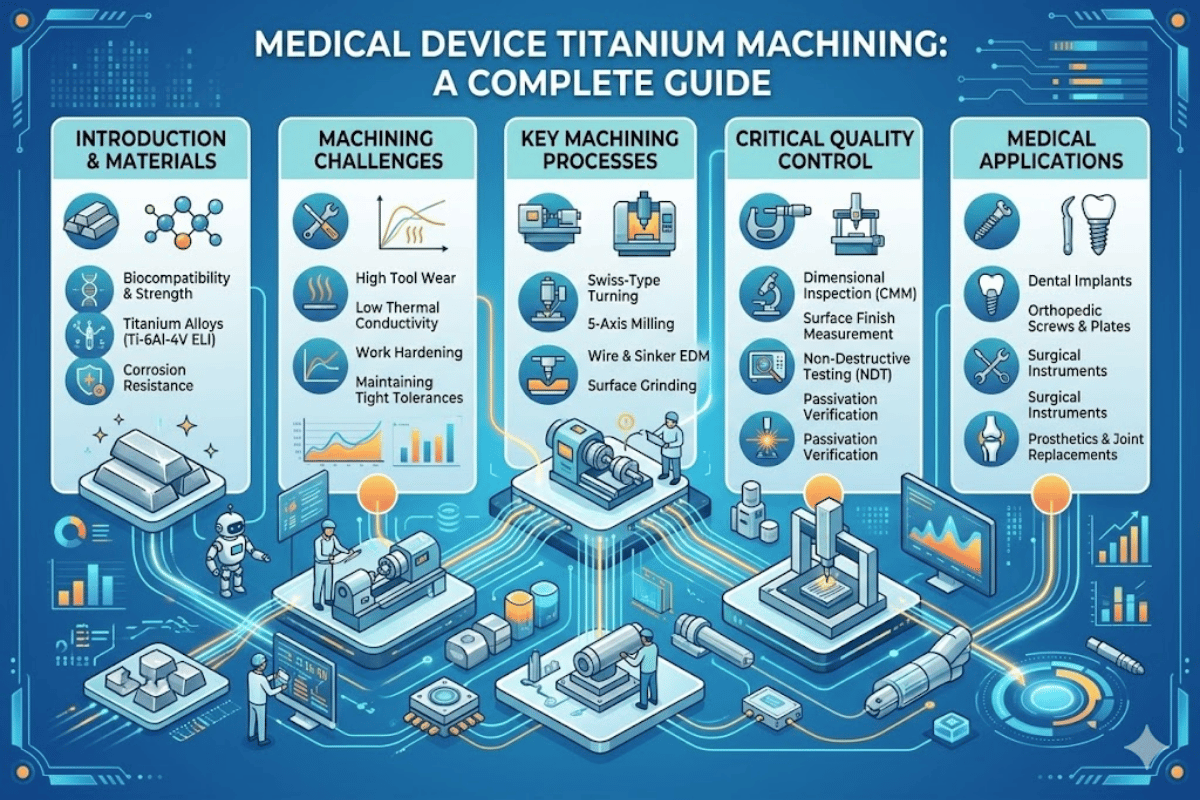
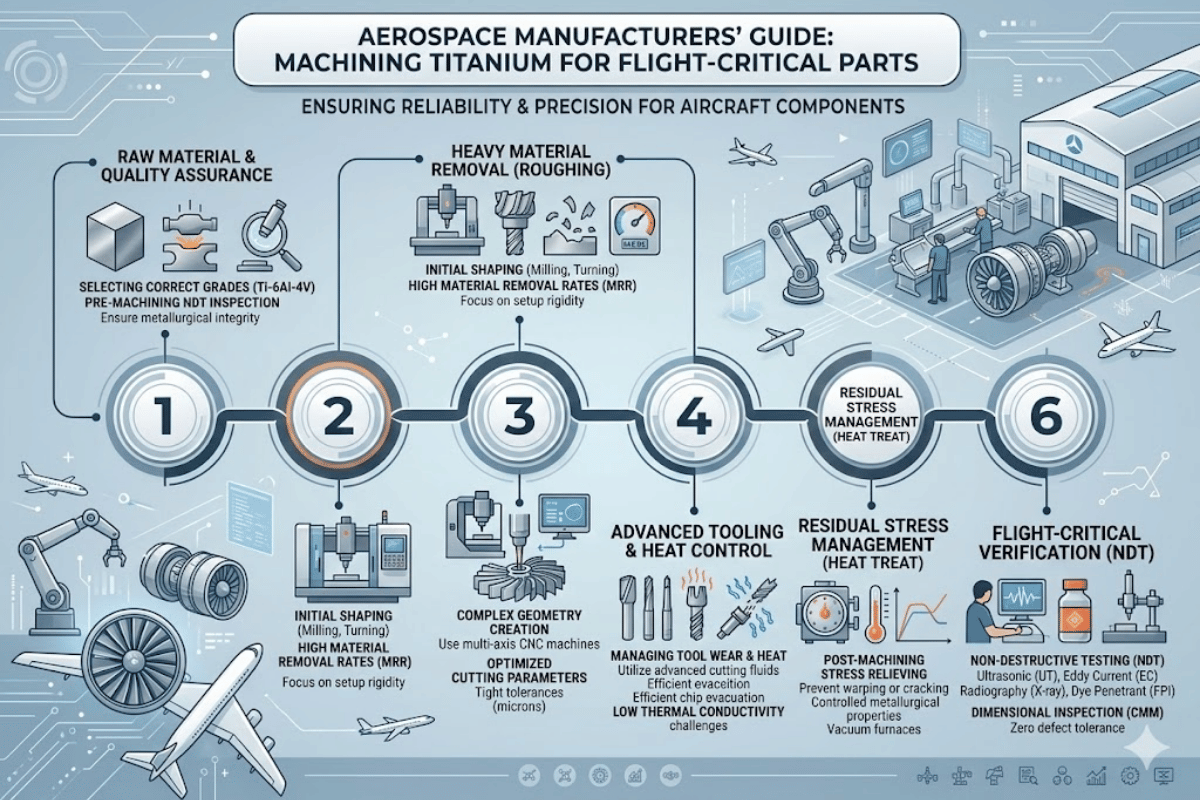
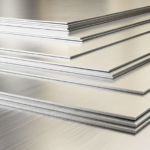
Aerospace-grade meticulousness with quick turnaround. Dedicate yourself to complex titanium machining in industries where there is the least room for error. For this we use 5-axis milling, Swiss turning, etc. in our AS9100D certified facility that precisely produces tight tolerance of Ti-6Al-4V parts along with full traceability with guarantee of quality.
Discover our gallery of custom CNC-manufactured titanium parts – crafted with precision, built to last, and created to meet your exact requirements.
Why Choose Titanium For Your Critical Components?
The distinctive compound of characteristics that titanium maintains puts it above any other materials for uses that require materials to significantly transport performance, reliability, and safety.
01
Superior Strength-to-Weight
Titanium is as strong as steel but weighing 45% less, so it is great for aircraft components, aerospace structures, and any other application where weight saving leads to improved performance and fuel efficiency.
02
Exceptional Corrosion Resistance
Natural to titanium is the creation of the protective oxide layer that provides excellent resistance to seawater, chlorine, acids, and any other harsh environments without the need for protective coatings.
03
Biocompatibility
Titanium is not poisonous and is not rejected by the human body, being the best choice for medical implants, surgical instruments, and dental applications for long-term bodily contact.
04
High-temperature Capabilities.
Resistance to fatigue and crack growth saves the time for structural components of an aero and aerospace application that have cyclic loading.
Titanium Alloys We Machine
All commercially pure and alloyed types of titanium are used among certified mill producers that also have complete proof for traceability.
Most Popular
Titanium Grade 5 (Ti-6Al-4V)
An Alpha-beta alloy with 6% aluminum and 4% vanadium
Equipped with advanced equipment and tailoring to the technical challenges of titanium machining, we deliver precision no matter how much geometry may be.
CNC Milling
3-axis, 4-axis, and 5-axis milling centers for working on the complex geometries and surfaces. Tight tolerances are controlled closely.
3-axis4-axis5-axis
CNC Turning
Precision turning of circular parts, shafts, fittings, and components that usually come with rotational symmetry.
Live ToolingSpin Spindle
Swiss Machining
Swiss-type turning with high precision for tiny diameter parts, medical components, and micro-features.
Micro PartsMedical
Wire EDM
Electrical discharge machining for intricate profiles, hardened materials, and complex internal features.
Fine DetailsHard Materials
Surface Finishing
Includes anodizing, passivation, polishing, bead blasting, and special coatings to meet functional and aesthetic needs.
AnodizePolishPVD
Quality Control
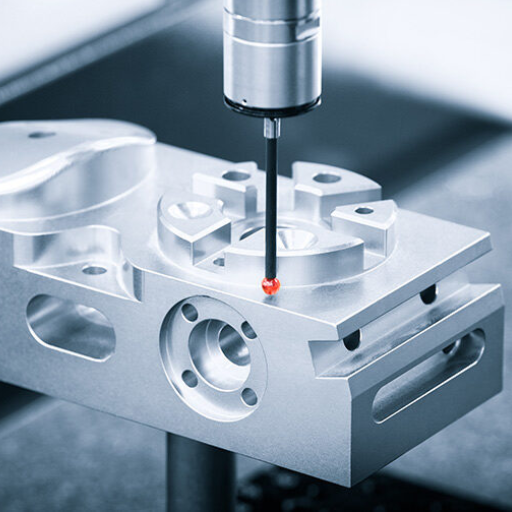
Our metrology capacities consist of CMM measurement, optical inspection, surface profilometry, and full documentation packages.
CMMGD&TNDT
Size Capabilities
Maximum Part Size
60″ × 40″ × 30″
Minimum Feature
0.005″
Turning Diameter
Up to 24″
Turning Length
Up to 60″
Swiss Diameter
Up to 1.25″
Precision Standards
Standard Tolerance
±0.005″
Precision Tolerance
±0.001″
Ultra-Precision
±0.0005″
Surface Finish (Ra)
16-125 μin
Mirror Polish (Ra)
4 μin
Titanium Prototype Machining Across Critical Industries
We have evolved our core competencies into industries that encompass the demanding requirements of precision, reliability, and compliance.
Aerospace & Aviation
Flight-critical components for commercial and military aircraft
✓ AS9100D Certified
Typical Components
Turbine Blades
Structural Brackets
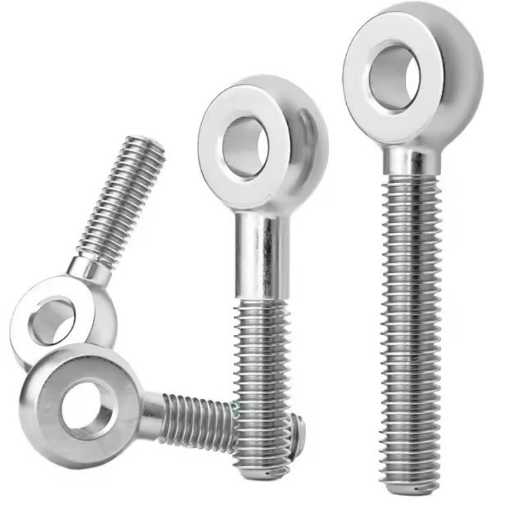
Fasteners
Landing Gear
Medical Devices
Biocompatible components for implants and instruments
✓ ISO 13485 Certified
Typical Components
Orthopedic Implants
Surgical Tools
Dental Implants
Bone Screws
Defense & Military
Mission-critical parts for defense systems and equipment
✓ ITAR Registered
Typical Components
Armor Components
Weapon Systems
Naval Fittings
Guidance Systems
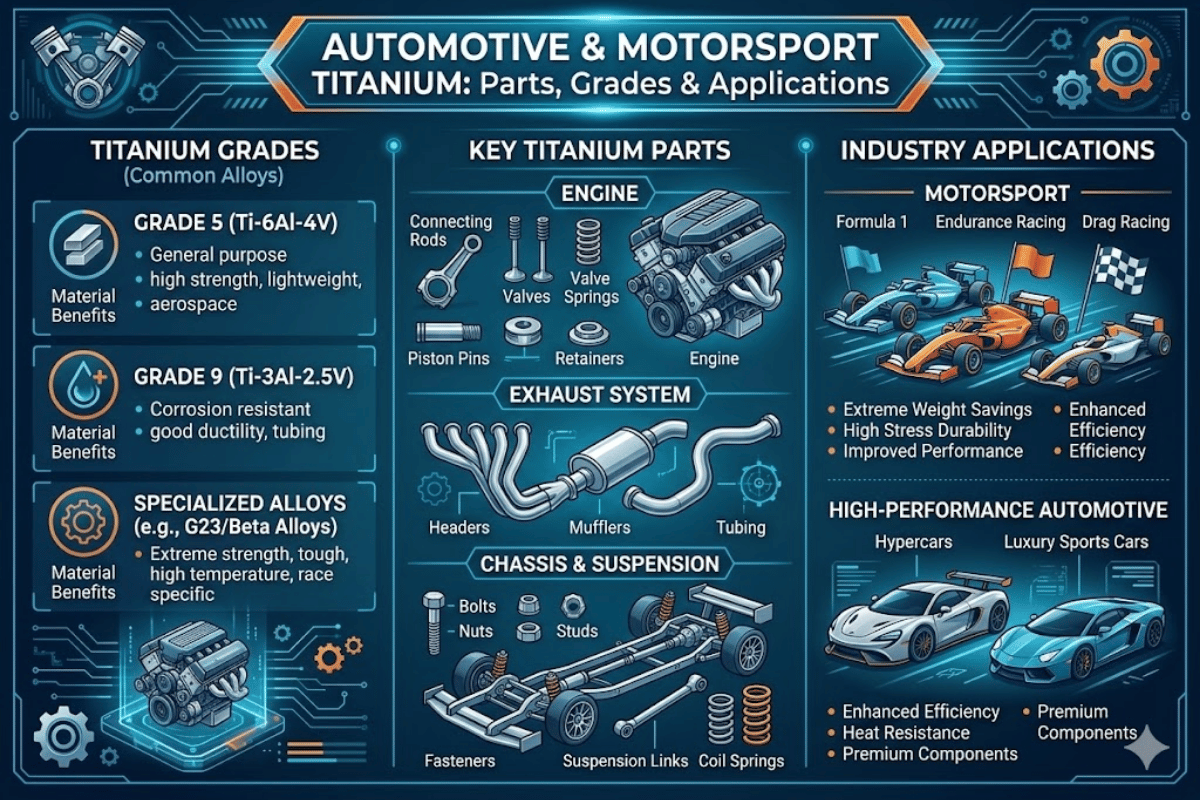
Automotive & Motorsports
High-performance components for racing and automotive innovation
✓ IATF 16949 Compliant
Typical Components
Exhaust Systems
Connecting Rods
Suspension Parts
Valves Parts
Interactive Tool
Titanium Grade Comparison Tool
Select titanium grades to compare their properties, specifications, and ideal applications for your CNC machining project.
Grade 1 (CP Ti)
High Ductility
Tensile Strength240 MPa (35 ksi)
Yield Strength170 MPa (25 ksi)
Elongation24%
Density4.51 g/cm³
Hardness120 HV
MachinabilityExcellent
ASTM StandardB265, B348, F67
Common Applications
Chemical ProcessingMarineArchitecture
Grade 2 (CP Ti)
Industrial Standard
Tensile Strength345 MPa (50 ksi)
Yield Strength275 MPa (40 ksi)
Elongation20%
Density4.51 g/cm³
Hardness160 HV
MachinabilityVery Good
ASTM StandardB265, B348, F67
Common Applications
Heat ExchangersDesalinationMedical Devices
Grade 5 (Ti-6Al-4V)
Most Popular
Tensile Strength895 MPa (130 ksi)
Yield Strength828 MPa (120 ksi)
Elongation10%
Density4.43 g/cm³
Hardness334 HV
MachinabilityModerate
ASTM StandardB265, B348, F1472
Common Applications
AerospaceTurbine BladesMedical Implants
Grade 23 (Ti-6Al-4V ELI)
Medical Grade
Tensile Strength860 MPa (125 ksi)
Yield Strength795 MPa (115 ksi)
Elongation15%
Density4.43 g/cm³
Hardness311 HV
MachinabilityModerate
ASTM StandardF136, F620
Common Applications
Orthopedic ImplantsDentalSurgical Tools
Grade 9 (Ti-3Al-2.5V)
Aerospace Tubing
Tensile Strength620 MPa (90 ksi)
Yield Strength483 MPa (70 ksi)
Elongation15%
Density4.48 g/cm³
Hardness270 HV
MachinabilityGood
ASTM StandardB338, B861
Common Applications
Hydraulic TubingBicycle FramesSports Equipment
Data based on ASTM B265, B348, F67, F136 standards. For specific project requirements,
contact our engineering team.
Free Calculator
Titanium Weight Calculator
Calculate the weight of your titanium parts instantly. Supports multiple shapes and all common titanium grades with accurate density values.
Select Shape
Titanium Grade
Unit System
Length
Width
Height/Thickness
Calculated Weight
0.55
kilograms (kg)
1.21 lbs
Pounds
125 cm³
Volume
4.43
Density (g/cm³)
📐 Formula Used
Weight = Length × Width × Height × Density
Visual Comparison
Material Properties Comparison
Compare titanium with other common engineering materials to understand why titanium is the preferred choice for critical applications.
📊
Strength-to-Weight Ratio Comparison
Titanium Grade 5
Aluminum 7075
Stainless Steel 316
Inconel 718
Ti
Titanium
Grade 5 (Ti-6Al-4V)
Tensile Strength895 MPa
Density4.43 g/cm³
Strength/Weight202 kN·m/kg
Corrosion ResistanceExcellent
Max Service Temp400°C (750°F)
BiocompatibilityYes
Al
Aluminum
7075-T6
Tensile Strength572 MPa
Density2.81 g/cm³
Strength/Weight204 kN·m/kg
Corrosion ResistanceModerate
Max Service Temp120°C (250°F)
BiocompatibilityNo
Fe
Stainless Steel
316L
Tensile Strength485 MPa
Density8.00 g/cm³
Strength/Weight61 kN·m/kg
Corrosion ResistanceGood
Max Service Temp870°C (1600°F)
BiocompatibilityLimited
Ni
Inconel
718
Tensile Strength1375 MPa
Density8.19 g/cm³
Strength/Weight168 kN·m/kg
Corrosion ResistanceExcellent
Max Service Temp700°C (1300°F)
BiocompatibilityNo
Data sourced from ASM Handbook, ASTM standards, and material supplier specifications.
Custom Titanium Parts Manufacturing | Precision Titanium Machining Services
An integrated process designed for efficiency, best quality, and 100% transparency from proposal to delivery.
01
Quote Request
Upload CAD files (STEP, IGES, SolidWorks), tell us your material grade, quantity, and tolerances, and a detailed quote will be customized within 24 hours (easily same day for standards).
02
Design for Manufacturability Review
Our engineers assess your product design and offer free DFM feedback, identifying potential problems and recommending changes to cut costs and improve quality.
03
Material Procurement
We purchase titanium only from certified mills with full tractability. The test results on material certificates are ensured for every lot to meet specifications.
04
Programming & Setup
Highly experienced CAM programmers generate toolpath strategies specially for titanium work, tool speeds, and cutting feed rates. High-pressure cooling and carbide tooling assist in admirable machining efficiency.
05
Precision Machining
Production on state-of-the-art CNC machines with remote monitoring and first article inspection guarantees that all parts satisfy the customers’ requirements.
06
Inspection & Finishing
Critical dimensions measured by CMM machines, surface finish verification, and any needed secondary operations (anodizing, passivation, polishing).
07
Documentation & Delivery
Complete documentation package provided, including COC, dimensional reports, and material certs. Professional packaging and tracking shipping achieves the delivery on time always.
Quality is the quality in everything we do. Our quality system is extensive and assures that every single titanium piece complies with the stringent tolerances.
CMM Inspection
Zeiss and Mitutoyo coordinate measuring machines for dimensional verification
Surface Analysis
Profilometers for surface roughness measurement to Ra 4 μin
Material Verification
Full XRF analysis and traceability from mill to finished parts
First Article Reports
Comprehensive documentation according to AS9102
NDT Services
Available dye penetrant, magnetic particle, and X-ray inspection.
AS9100D
Aerospace Quality
QMS certification for the aerospace sector
ISO 13485
Medical Devices
QMS certification for medical devices
ISO 9001
Quality Management
An international standard of quality
ITAR
Registered Defense
Compliance with U. S. defense exports
Case Studies on Titanium CNC Turning Services | Precision Machining Solutions
Demonstrated real-time effects of Titanium Machining Programs
✈️ Aerospace
Ti-6Al-4V
Aircraft Structural Bracket with ±0.0005″ Tolerance
Complex bracket with 47 critical dimensions. Previous supplier’s consistent failure resulted in the delivery of first-time FAI approval.
100%FAI Pass
18%Cost Saved
243Parts
“First-time FAI approval that exceeded our expectations.”— Senior Engineer, Tier-1 Aerospace
🏥 Medical
Ti-6Al-4V ELI
Spinal Fusion Cage Production at Scale
Scaled production of intricate spinal implants with 0.5 mm features while maintaining FDA compliance and traceability.
25K+Implants
99.4%Yield
0FDA Events
“Documentation that satisfied FDA auditors.”— VP Operations, Medical Device Co.
🛡️ Defense
Grade 2 CP Ti
Submarine Valve Bodies for Seawater Service
Replaced 316L stainless with titanium for 3,000 PSI seawater service. Zero porosity with 100% helium leak testing.
100%Leak Pass
4+ YrsNo Failures
48 MoService Life
“Absolute reliability 400 feet underwater.”— Program Manager, Defense Contractor
🏎️ Motorsports
Ti-6Al-4V
Racing Suspension Upright—And 41% Lighter
The aluminum uprights transformed into titanium but still passed the benchmark of withstanding 4G lateral load, applied in 18 days, achieving full 41% weight reduction!
41%Weight
+20%Back
18Days
“Lighter and stiffer than the aluminum parts”— Technical Director, Racing Team
What is titanium CNC machining and how does a cnc machine work for titanium parts?
Titanium cnc machining refers to the USA precision machining process where a cnc mill or multi-axis cnc machine is programmed in such a way that it can cut, drill, and finish titanium alloy workpieces into titanium parts that are intricate; the process of machining starts from a CAD model and CAM programming, and then the cnc machine runs the controlled feed and speed optimized for that titanium grade to produce accurately machined titanium parts, which have repeatability stoning accuracy and ensures that the machining service translates the design intent into custom high-strength, electro-corrosion resistant titanium-machined parts for demanding environments.
Which titanium grades (grade 2, grade 5, grade 1) are compatible with cnc machining titanium?
We machine the whole range of grade titanium, including grade 1 for excellent corrosion resistance and bio-compatibility, grade 2 for a balance between weldability and corrosion resistance, and titanium grade 5 (Ti-6Al-4V) for high-strength applications where a high strength to weight ratio and improved tensile strength are in demand; every grade of titanium behaves differently at machining; our experience in grades of titanium ensures that the machining of your titanium parts meets performance and regulatory requirements of the target application.
Why choose a titanium cnc machining service for precision titanium parts?
Opting for titanium cnc machining services provides complete access to expert understanding of titanium alloy behavior, precision machining equipment, and inspection technologies that will collectively ensure the thorough machining of titanium parts with superior performance characteristics, such as being lighter compared to steel along with possessing high strength and excellent corrosion resistance; lightweight titanium parts for aerospace, biocompatible medical implants, or chemical process-related corrosion-resistant parts have to be machined with intense focus to ensure allured final attainment with mechanical property requisites and required production volumes.
What mechanical properties matter when selecting titanium alloy for a project?
Consider among other for the key mechanical property includes tensile strength, yield strength, fatigue resistance, ductility, hardness, corrosion resistance, or weldability; in case of priority of high strength-to-weight ratio or biocompatibility or improved corrosion resistance or even machinability or weldability dependence, the approach towards selecting a titanium alloy: grade 1, grade 2, or titanium grade 5. Their motto in machining services is to guide you towards the right alloy for functional requirements as well as the machining process.
What precision tolerances and inspection methods are available for machined titanium parts?
Tight tolerances can be maintained with precision to within microns depending upon the part geometry and process. CMM inspection, optical inspection, surface finish measurement, and in-process gauging are some of the many ways to ensure that each machined titanium part meets its dimensional and surface quality criteria; In addition, these protocols exhibit good evidence that the titanium machined parts are being machined to a fine specification, all the while preserving basic mechanical properties such as tensile strength and surface condition needed for the application.
How do you handle machining titanium alloys and different titanium grades?
Different titanium grades require appropriate machining strategies. Grade 1 and 2 titanium are more preferred in cases where corrosion resistance and weldability do count, requiring machining parameters to preserve ductility and surface finish. Conversely, for Titanium Grade 5, tool materials and feeds have to be looked into to deal with higher strength and work hardening as well. Module directly ensures adapting tooling, cutting fluids, and machining parameters to suit each titanium alloy, in order to optimize cycle time, tool life, and final part properties for your application.
Which titanium alloy is best for corrosion-resistant or biocompatibility requirements?
The corrosion and bio-compatibility requirements enable titaniurn Grades 1 and 2 to be used while they are ucceptably resistant to corrosion, that is why they are found most frequently in medical implants and for chemical processing equipment. On the other hand, –when higher tensile strength, and a high strength to low weight ratio is aimed at Grade 5 titanium is being considered; our experts will help you to decide the appropriate grade of titanium to match the corrosion-resistant performance, bio-compatibility and mechanical requirements pertinent to the intended environment as well as certification requirements.
What are common applications and industries for precision titanium machining services?
Many sectors like aerospace structural components and fasteners, medical implants and surgical instruments, and chemical-processing equipment and valves, utilize high-strength custom titanium parts for industrial machinery, where a material needs to be lightweight and corrosion-resistant—the most important property of titanium, a material lighter than stainless steel, having the highest strength-to-weight ratio and the highest corrosion-resistant strength-is remarkable in areas demanding high performance, reliability, and long life.
What key titanium materials are applied for precision titanium CNC machining needs?
The industrial complex makes use of titanium materials like commercially pure grade 2 titanium and titanium alloy Ti-6Al-4V that comprises vanadium and aluminum. Grade 2 has a wider application due to the balance of corrosion resistance and toughness and flexibility. Titanium alloy Ti-6Al-4V satisfies the demands of high-performance titanium parts and possesses immense strength for the specified areas.
How does a titanium material machining process affect the lead-time for both prototype parts and production parts?
In comparison to softer metals, the machining of titanium tends to increase lead-time owing to its hardness, low thermal conductivity, and propensity to be work-hardened, Precision titanium cnc machining services reduce any proprietary delays by means of high-speed/ hard tooling, specific application of feeds and speeds, and material-specific processes to enable parts for prototypes and final production to meet the required lead-times in a highly competitive way, among others strict quality assurances.
Why have accuracy in titanium CNC machining services for high-performance titanium components?
Precision titanium CNC machining services are mass-customized to exploit the unique properties of titanium so as to fabricate complex pieces with tight tolerances. For high-performance titanium components such services simultaneously owe their performance to tool selection, coolant management, and process control, ensuring superior strength, corrosion resistance, and consistently superior quality in both prototypes and production parts.
Is commercially pure titanium able to see anodization? And how would this affect its corrosion resistance?
Yes, commercial pure titanium including titanium grade 2 and alpha beta titanium can be anodized to improve its surface properties and onto the surface of other beneficial aesthetic purposes, minus no compromise toward its resistance to corrosion; generally, anodized oxides amplify also the resistance to wear and could end up extending into any given color range, again, preventing the almost corrosion-free reliable performance transmitted by titanium through a matter of another rough threshold of temperatures.
What are the major challenges in meeting the titanium CNC machining needs for complex parts?
The majority of the challenges encountered are the need to manage the heat, owing to the very high-strength and work-hardening nature of the work material, the need to maintain very tight tolerances on thin walls or intricate features, and the selection of compatible fixtures, and coolants. Shops specializing in precision parts, therefore, utilize expertise in specialized tools and machining strategies to battle such adversities while maintaining considerably strict quality standards.
What does the choice of a material like pure titanium versus a commonly used titanium alloy mean for the final performance of the part?
For the part in question, the choice of material would influence strength, weight, corrosion resistance, and machinability. Commercially pure grade 2 titanium gives unparalleled resistance to corrosion and is significantly lighter and low formability, whereas widely used titanium alloy Ti-6Al-4V (aluminum and vanadium added) gives exceptional strength and fatigue resistance for more demanding applications. This choice depends on the particular application, temperature range, and required mechanical properties.
How do extreme quality controls operate for the provision of top-tier deterministic titanium machining services?
Such quality checks include verification of the materials (traceability of titanium materials), in-process inspections, CMM measurements on accurate parts, surface finish verifications, and post-production treatments such as anodize and passivation. Thick documentation and strict adherence to industry standards ensure that the prototypes and production parts fully comply with all functional and regulatory obligations.
Can titanium be any kind of material for the temperature range, or severe environments?
Yes, titanium and many titanium alloys are advanced material choices for both the extreme temperature range and corrosive/marine environments, as titanium has many unique properties such as high strength-to-weight ratio, good corrosion and impact resistance, and stability over a wide range of temperature variations. Proper choice of the titanium grade and post-machining treatment ensures long-term performance in harsh conditions.