

Supportive, Professional, Client-Focused Service
From prototypes to full-scale production, we’ve got you covered.


How Manufacturers Machine Titanium for Medical Devices — Grades, Processes, and Standards
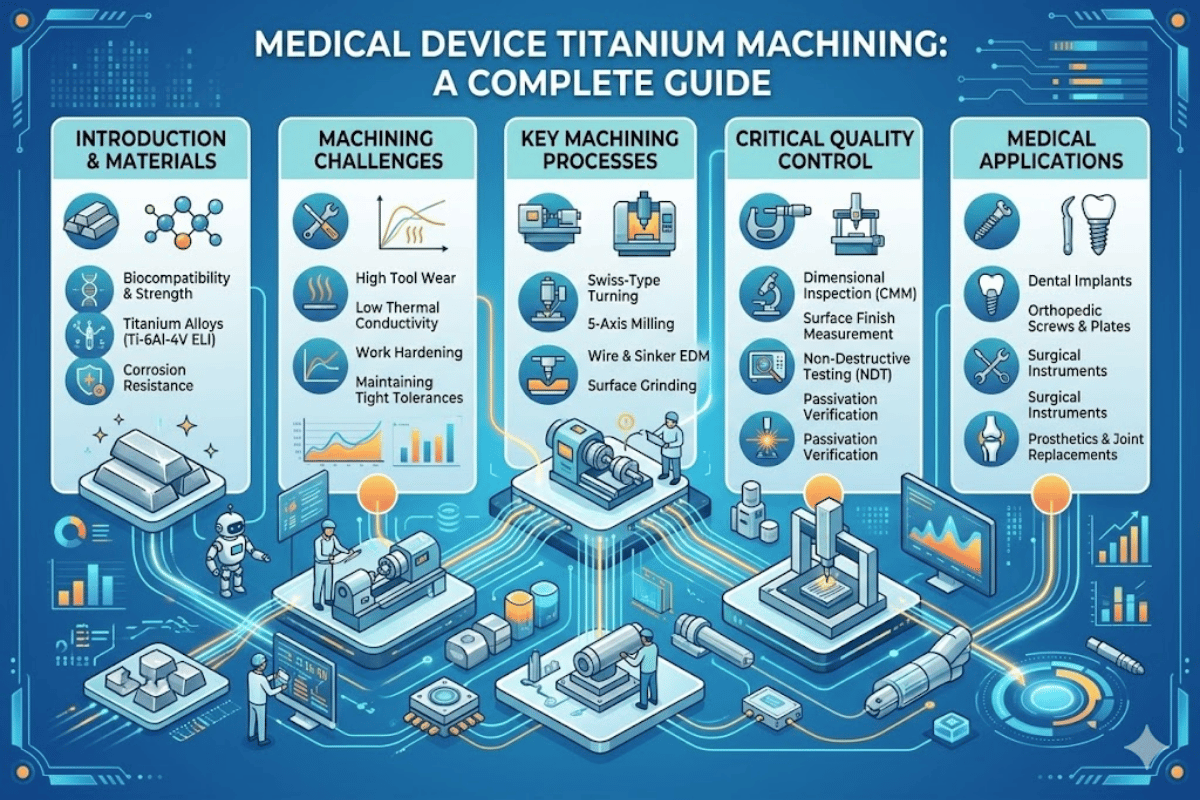
Titanium is at the heart of modern medical device manufacturing. Its unique combination of biocompatibility, corrosion resistance, and strength is hard to beat for applications spanning intervertebral fusion cages, dental implants, and bone screws. However, machining titanium for the medical device industry can be an exceedingly tricky proposition – the same physical qualities that make it so invaluable inside the human body present a challenge on the CNC machine.
This guide introduces the grades of titanium used in medical devices, explains the machining process that creates implant-grade components, and outlines medical device quality standards that your machining partner needs to achieve. If you are sourcing orthopedic implants or surgical instruments, this guide will help you make better procurement decisions.
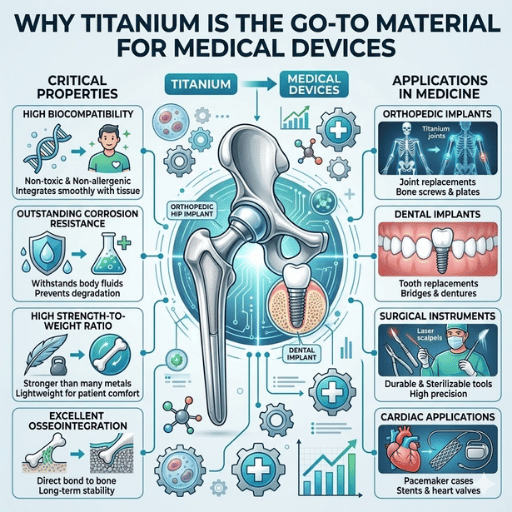
Titanium stands uniquely qualified for orthopedic implant applications due to its physiochemical properties. No other material performs as well across biocompatibility, corrosion resistance, strength-to-weight ratio, and elastic modulus simultaneously.
Titanium has been shown to have excellent biocompatibility with nearly perfect tissue tolerance — it is biocompatible with virtually all human tissue. When placed within a patient’s body, a thin sheet of oxide (titanium dioxide, TiO) that forms on the surface within milliseconds prevents immune rejection and allows osseointegration without any thick fibrous tissue barrier forming between bone and metal. Medical implants made of titanium remain functional for decades.
Titanium’s biocompatibility, especially when combined with its extraordinary corrosion resistance in aqueous, chloride-rich body fluids, ensures that metallic ions do not leach out into surrounding tissues over an extended period of time.
Grade 5 titanium (Ti-6Al-4V) has a combination of a tensile strength of 895-930 MPa and a density of just 4.4 g/cm^3 that provides significant design advantages. Patients with lower weight orthopedic implants like tooth implants still benefit because the weight savings — around 45% less than surgical stainless steels — puts less demand on surrounding tissues, one of the key properties of titanium that make it preferred in biomedical applications.
Source: Niinomi, M. (2011). International Journal of Biomaterials, National Institutes of Health.
Compared to stainless steel, titanium’s elastic modulus at 110 GPa (versus 180 and 210 GPa for stainless and cobalt-chromium respectively) provides closer matching to that of bone (10-30 GPa). Less “stress shielding” occurs and eventual osteoporosis around the implant due to skeletal resorption.
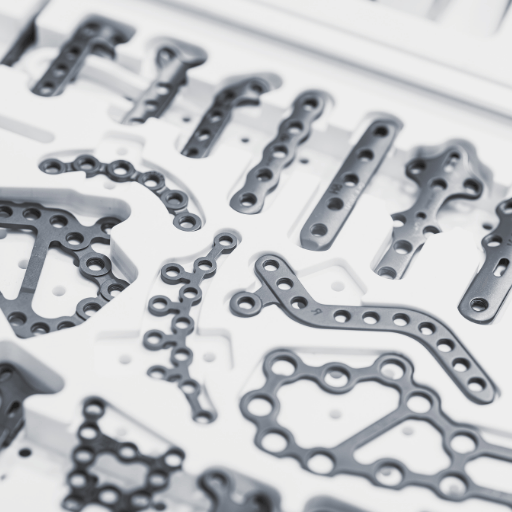
Since not all titanium is created equal, choosing the correct grade ensures adequate mechanical performance, biocompatibility, and regulatory compliance. For medical device manufacturing, both pure titanium and titanium alloys see use — grades 1 through 4 (commercially pure) and 5 and 23 (alpha-beta titanium alloy variants) tend to dominate.
| Grade | Designation | UTS (MPa) | ASTM Standard | Primary Medical Applications |
|---|---|---|---|---|
| Grade 1 | CP Ti (highest purity) | 240 | ASTM F67 | Craniofacial plates, mesh screens |
| Grade 2 | CP Ti (workhorse) | 345 | ASTM F67 | Dental implant abutments, bone screws |
| Grade 4 | CP Ti (highest strength CP) | 550 | ASTM F67 | Dental implant bodies, pacemaker housings |
| Grade 5 | Ti-6Al-4V | 895–930 | ASTM F1472 | Surgical instruments, trauma fixation plates |
| Grade 23 | Ti-6Al-4V ELI | 860 | ASTM F136 | Spinal fusion cages, hip stems, knee implants |
Tensile strength values per ASTM specifications. CP = Commercially Pure. ELI = Extra Low Interstitial.
Both have the same Ti-6Al-4V chemistry – 6% Al, 4% V. Where they differ is in interstitial elements (oxygen, nitrogen, carbon). Grade 23 (ELI/Extra Low Interstitials) limits oxygen to 0.13% max (0.20% in Grade 5). Reduced interstitials lead to lower solid-solution strengthening (which yields a small reduction in yield/tensile strength to 860 MPa vs. 930 MPa for Grade 5), an increase in fracture toughness, and better fatigue strength over millions of load cycles.
For load bearing implants that must endure hundreds of millions of cycles in-vivo – hip replacements, spinal cages, dental implants – both the ASTM F136 standard for Ti-6Al-4V and the MIL-T-9046 specification for ELI-grade titanium explicitly require an ELI-grade material. Greater fracture toughness translates directly into a reduction in potential catastrophic implant failures.
A common cost-driven error is to opt for Grade 5 when ELI-grade should be applied for an implant. Such a device may fail regulatory approval under ASTM F136 criteria.
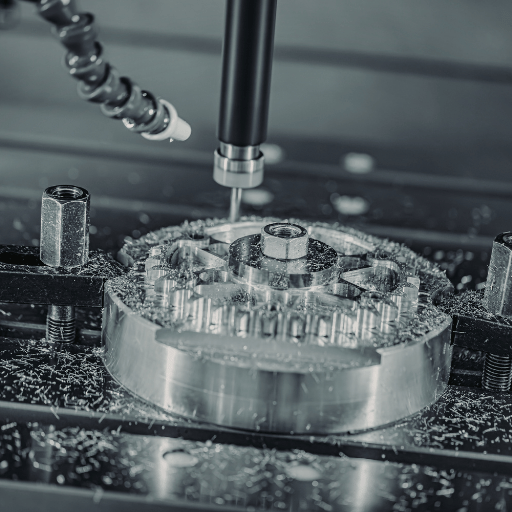
CNC machining titanium for medical-grade components is distinct from cutting aluminum, steel, or other metals. Because of the low thermal conductivity, heat does not flow away from the cutting edge with the chip, but stays concentrated in the tool tip. This unique property requires slower rotation speeds, more conservative feedrates, sharpening at the correct rake angle, and aggressive coolant flow.
Five-axis mills conquer the complex, delicate geometries seen in modern orthopedic implants. Curves on hip stems, converging screw holes on bone plates, contoured profiles on spinal fusion cages – all are achievable when precision machining on multi-axis platforms delivers a multitude of approach angles in one setup.
For Ti-6Al-4V, typical cutting speeds are around 30-60 m/min, with two or three fluted carbide cutters coated with TiAlN or AlCrN. Feed rates of 0.05-0.15 mm/tooth keep the cutting tool engaged above work hardening thresholds and reduce workpiece distortion.
Swiss-type turning centers are well suited to the production of high-precision, small diameter, heavy wall section titanium implants such as bone screws, dental implants, or surgical pins. Support through the guide bushing results in less deflection on high length-to-diameter ratio parts. Ten-station live tooling turret machines can perform milling, drilling, and tapping operations in the same cycle, slash cycle times 40-60% over sequential process flows.
Electrical discharge machining uses no mechanical forces to maneuver the titanium. As the workpiece (a dielectric insulator) and tool (a water-cooled copper wire) never make contact, forces present in conventional milling are not realized. Among available machining techniques, EDM is ideal for thin-walled titanium medical components and anatomically complex internal passages.
Medical titanium must have critical surface characteristics. Excellent osseointegration surfaces are achieved with a Ra of 1–2 µm; non-contact polished surfaces can achieve Ra below 0.4 µm to prevent pathogenic bacterial adhesion.
Passivation per ASTM F86 is mandatory for titanium medical implants. It removes surface contaminants and thickens the protective TiO₂ oxide layer to restore corrosion resistance after machining.
Key Machining Parameters for Ti-6Al-4V (Grade 5/23)
| Parameter | Milling | Turning |
|---|---|---|
| Cutting Speed | 30–60 m/min | 40–80 m/min |
| Feed Rate | 0.05–0.15 mm/tooth | 0.10–0.25 mm/rev |
| Depth of Cut | 0.5–3.0 mm | 0.5–2.5 mm |
| Coolant | Through-spindle, 70+ bar | Flood or high-pressure |
| Tool Coating | TiAlN or AlCrN | TiAlN or uncoated carbide |
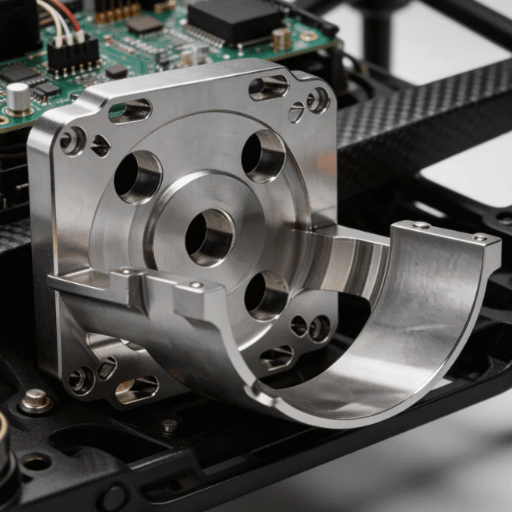
Titanium gets a bad reputation when machining. In fact- the characteristics that give titanium its’ good reputation in medicine- low thermal conductivity, high chemical reactivity when hot, flat springback- give real headaches to the factory. Know the problem- in the beginning- is the first step to solving it.
Most alloys including titanium also conduct heat well—the thermal conductivity of titanium is about 1/6 that of aluminum. As a result, up to 80% of the heat generated during machining remains in the cut—the cutting zone rather than being carried away by the chip during machining. This results in: increased tool wear, possible microstructural changes in workpiece surface (oxidation) and distortion of the workpiece shape due to the part thermally growing—sometimes significantly—over long cutting distances.
Aggressive coolant delivery solves this problem. Through-spindle coolant at 70 Bar or above provides a directed flow of fluid right onto the cutting edge to remove heat before it begins to damage the tool and/or workpiece. Several shops machining medical titanium with carbide tools have found that high pressure coolant really can double tool life when compared to flood coolant.
Titanium alloys are aggressive. Hard alpha-phase particles in the high strength alpha-beta microstructure of Ti-6Al-4V bombard cutting edges, shortening the tool life to less than that of most engineering alloys. Machining Ti-6Al-4V with a typical carbide insert gives a tool life between 15 and 30 minutes at recommended speeds, for example, twenty times less than machining stainless steel on the same insert.
Medical component machining shops that Machine titanium parts exclusively typically follow a very disciplined routine of tool replacement: they do not use an insert until wear is visually observable, as then the subsurface damage may be intolerable to a fatigue life implant.
When a cutting edge is held in contact with the tip surface (insufficient feed rate, dull cutting edge) the surface layer of the work hardens. On the next cut, the tools are working on a material harder than the initial stock. This increasing the wear rate—is a destructive positive feedback cycle.
Keep chip thickness greater than 0.05 mm will prevent this occurrence. Cutting edge should be always put into the fresh material which has not been cut before and avoid burnishing the work done. In addition, work geometry should take into consideration the elastic expansion of the workpiece when cutting loads are removed before final dimension checks.
Most shops that first try machining titanium make the mistake of using stainless steel cutting parameters. Titanium needs a lower cutting speed, a higher feed-per-tooth, and a much more aggressive coolant feed. Stainless steel cutting parameters will almost always lead to work hardening and premature tool failures.

Machining of titanium parts for use in the medical industry is more than just another manufacturing capability. Medical device parts require regulatory compliance, documented Quality systems, and traceability. A machining partner that isn’t properly certified will not be able to deliver parts for use in a regulated medical device—no matter how good their machining quality looks.
ISO 13485:2016 is the global industry standard for quality management systems for the medical device market. It includes design control, risk management, receiving control, process validation, and traceability. Certification to ISO 13485 is the proof that contract manufacturers machining Titanium OEM medical parts has passed an independent quality audit.
The US FDA’s Quality Management System Regulation (QMSR) by reference codified ISO 13485:2016 into 21 CFR Part 820 on February 2, 2026. Aligning international and U.S. federal quality rules simplifies global compliance: an ISO 13485 compliant manufacturer now meets U.S. federal requirements without maintaining parallel quality systems.
All titanium raw materials progressing down a medical device fabrication line must trace to a certified mill with documented chemistry reports, mechanical test results, and heat lot traceability. ASTM F67 (CP titanium) and ASTM F136 (Ti-6Al-4V ELI) define material composition, mechanical properties, and test requirements. Mill certificates accompany the raw material, and traceability follows each fabrication step to the finished medical device.
Medical titanium components generally require first article reports, dimensional report checks with calibrated CMMs, ultimate tensile and elongation, and final inspection paperwork. Dynamic inspection for residual alpha case, micro cracks, or residual stress from machining provides a final quality assurance protocol for implant areas.
| Certification | Scope | Why It Matters for Titanium Medical Parts |
|---|---|---|
| ISO 13485 | Medical device QMS | Required for any regulated medical device supply chain |
| AS9100D | Aerospace QMS | Indicates rigorous process control — many medical machining shops hold both |
| ISO 9001 | General QMS | Baseline quality system — necessary but not sufficient alone for medical |
| ITAR | Defense export compliance | Demonstrates handling of controlled technical data and secure facilities |
“Our staff has machined over 25,000 medical titanium implant parts at 99.4% yield without a single FDA recall event. Our trend line is built on ISO 13485 systems, not the talent of any singular employee.”
— Le-Creator Engineering Team
Learn more about Le-Creator’s titanium CNC machining capabilities, including available grades, equipment list, and lead times.
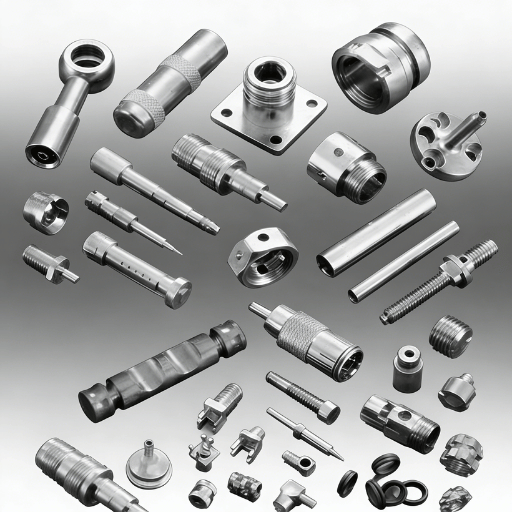
Going from a shop that can cut titanium to a company that can produce FDA-compliant medical titanium components is a bigger jump than most buyers expect. Cost/piece differences are not as relevant as the cost of an audit failure, discarded batch, or schedule delay.
Le-Creator holds ISO 13485, AS9100D, and ISO 9001 certifications with 50+ CNC machines including 5-axis milling centers and Swiss-type turning centers. If you need a quote for titanium CNC machining services — from single prototypes to production volumes — the team provides 24-hour DFM feedback on uploaded CAD files.

ISO 13485 certified. 50+ CNC machines. Grade 23 and CP titanium in stock. Send in your CAD drawing for quotation within 24 hours.
Le-Creator is an ISO 13485 certified precision CNC machining facility with 17+ years experience producing titanium components for the medical device, aerospace industry, and defense markets. Machining parameters and quality system details within this article reflect our production experience across 25,000+ titanium implant components. We wrote this guide to help medical device engineers and procurement specialists evaluate titanium machining options with solid technical grounding.