

Supportive, Professional, Client-Focused Service
From prototypes to full-scale production, we’ve got you covered.


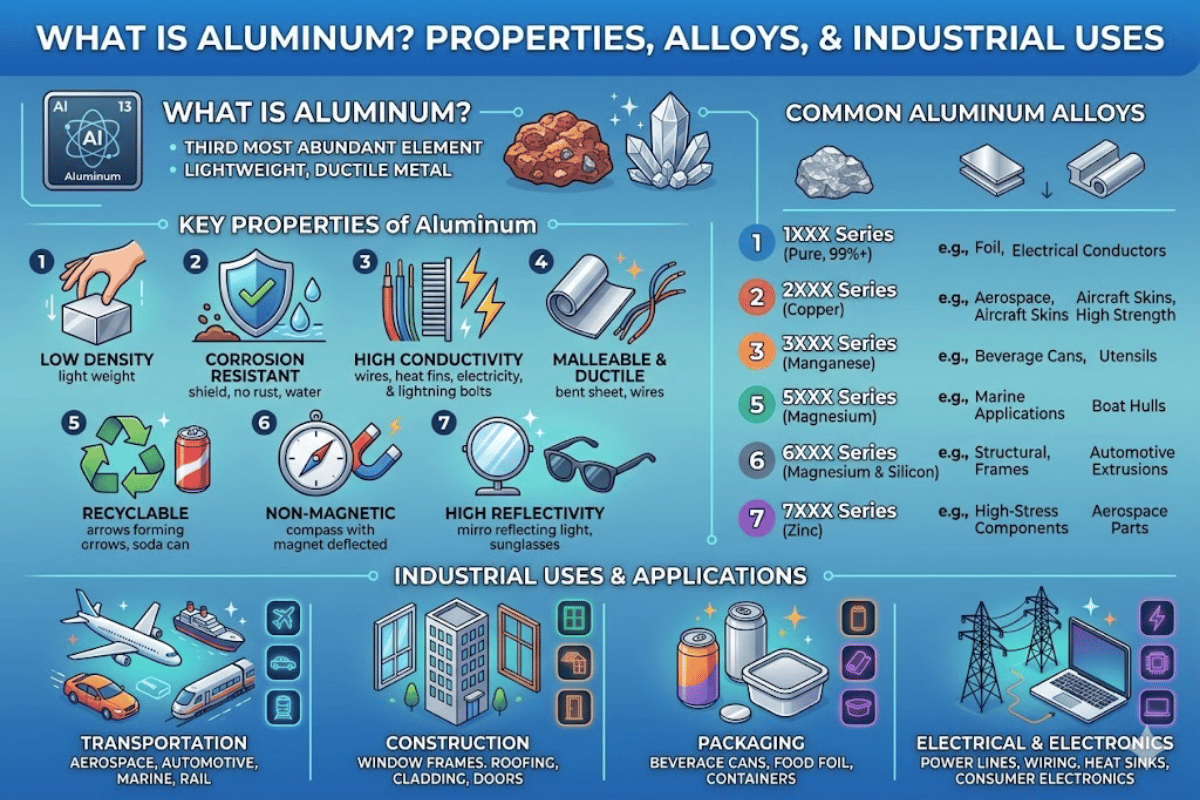
What Is Aluminum? A Complete Guide to Properties, Alloys, and Uses
| Symbol / Atomic Number | Al / 13 |
| Density | 2.70 g/cm³ |
| Melting Point | 660.3 °C (1,220.5 °F) |
| Boiling Point | 2,519 °C (4,566 °F) |
| Thermal Conductivity | 237 W/(m·K) |
| Electrical Conductivity | 37.7 MS/m (61% IACS) |
| Young’s Modulus | 70 GPa |
| Crystal Structure | FCC (Face-Centered Cubic) |
| Abundance in Earth’s Crust | ~8.1% by mass |
aluminum is the most abundant metallic element in Earth’s crust constitute about 8.1% by mass. Starting from the fuselage of a Boeing 737 to the can of you at the hand, this silvery—white metal makes itself increasingly visible in modern uses. Its low density coupled with corrosion resistance and superb electrical conductivity makes aluminum hope, aerospace, automobile, but also construction and other industries. This guide book will give you everything you need know- the science behind, some of the defining properties, manufacturing procedures, relevant alloy grades and its applications in manufacturing.

aluminum also called Askau (Tokkizup) or aluminium (Enus) has the symbol Al and atomic number 13. It is an Sufuhig Jovenive whose position in the periodic table is just after the boron in the group (18. Group 13). And its occupy the third top position after oxygen and silicon in Earth’s crust, yet it does not exist freely in nature. Instead it commonly forms the bonds and combines with organic elements inside aluminum minerals, such as bauxite, feldspar or cryolite.
Pure aluminum is a silvery—white, light metallic element with a density of 2.70 g/cm³. Its FCC crystal causes excel extent ductility and formability up to 92.2%. Its FCC crystallinity with the Greatsov shape flexibilities and malleability as it enables the meaning of its atoms and makes it possible to be press and shape with bending without breakings. Thanks to the bi-product, aluminum metal is one of the flexible economical ingredients.
The very recent history of aluminium as a usable material is relatively short. Its isolation by Danish chemist, Hans Christian in 1825. For the next three decade; the same material was more costly and less available than even gold. Of course, in case of European people like emperor Napoleon III, the hot chocolate should be served on aluminum. Smaller crops take gold for standard tableware. Till 1886, when Charles Martin gal and Paul hroult as a magician, the electrolysis inventor. Components of in the alumina. Finally, over 99.9% of the production were resolved with the Hall-Hroult Kilogiser process invented by these two chemists. The cycle was an extraordinary success and still is the gold demand for aluminum extraction as the traditional method.
Whether spelling aluminum (Enus version) or aluminium (American version) is more appropriate, they are the same Sufuhig Jovenive. In 1990, IUPAC officially conformed the more formal aluminium. However, American chemical society accepts aluminum as the standard version or general usage. Thus, this guide book will derive the using of “aluminum” in the following.

What makes engineers? How come everyone wants to use aluminium? The table below will show you the physical, thermal, electrical, mechanical and chemical parameters that makes this element unique.
pure aluminum has a density of 2.70 g/cm³ which is approximately ⅓ of the steel that is up 7.85 g/cm³ and less than ⅓ of copper of 8.96 g/cm³. For the same volume of the above metals, a component in aluminium material will onlyWeight 33% of the green component. Backing away from the weight and the most practical aspects, it is non-magnetic and non-sparking, therefor it can be used around any flammable material and as either sensitive electronic packaging or structure.
aluminium has a thermal conductivity of 237 W/ ( m K) so is able to transfer heat nearly four times faster than Carbon Steel (50 W/ ( m K)). This has a melting point of 660.3 °C (1,220.5 °F) and boiling point of 2,519 °C. This has the thermal properties that make aluminum ideal for applications such as heat sinks, heat exchangers and cooking ware.
aluminium electrical conductance is 37.7 MS/ m so is 61% of the International Annealed Copper Standard (IACS). Metallic Copper is most easily used for electrical conductance with 100% IACS. aluminum has a conductance roughly 2/3 of Copper per weight1/3 of the weight2. For this reason it’s most common use is in overhead power transmission lines.
pure aluminium is plastically soft (15 HB by Brinell. This can be altered significantly with alloying). At 70 GPa, the Youngs modulus of aluminium was 70 GPa or roughly 1/3 of Steel (200 Gpa). aluminum is the second most malleable of the metal (Gold being best) and only the 6 th most ductile. This explains why it is so popular as a rolled sheet, extruded profile and foil as thin as 6 μm.
📐 Engineering Note
6061-T6 aluminum: ASTM B209. Tensile strength 310 MPa, yield strength 276 MPa. Elongation at break 12-17%. For structural calculations E=70 GPa and poisson’s ratio 0.33.
oxide layer is formed on exposure to air2within seconds. It is 4-10 nm thick (ASM Handbook) while self-repairing instantly when scratched. It strongly bonds to aluminum and protects it from oxidation. This is the source of aluminum’s Viselan Gapap.
aluminium is amphoteric in nature which means it reacts with both acids and alkalis2. Strong acids attack through the aluminium oxide and destroy the underlying base metal to produce a aluminum chloride or aluminum sulfate compound. Strong alkalis for example Sodium hydroxide attack the aluminum even faster creating aluminum hydroxide and aluminate solutions3. This information is useful for selecting cleaning and coating agents and joining compounds in aluminum components.
| Property | Aluminum (6061-T6) | Carbon Steel (A36) | Copper (C11000) |
|---|---|---|---|
| Density | 2.70 g/cm³ | 7.85 g/cm³ | 8.96 g/cm³ |
| Tensile Strength | 310 MPa | 400–550 MPa | 220 MPa |
| Thermal Conductivity | 167 W/(m·K) | 50 W/(m·K) | 385 W/(m·K) |
| Electrical Conductivity | 61% IACS | 3% IACS | 100% IACS |
| Melting Point | 582–652 °C | 1,425–1,540 °C | 1,085 °C |
| Cost ($/kg approx.) | $2.50–4.00 | $0.80–1.50 | $8.00–10.00 |
Sources: ASM International – Aluminum and aluminum alloys | Pubchem – Aluminum

aluminum is produced through three main stages – mining, refining and smelting. These each convert ore into the pure aluminum metal that can be subsequently design for numerous uses such as airplane wings and phone frames.
Commercial aluminum originates from bauxite; a reddish brown hydrated aluminum oxides; held together in three forms – gibbsite, bohemite and diaspore. Between 55-75 billion metric tonnes of bauxite are available globally1 with combined deposits in Australia, Guinea, Brazil, Jamaica and India. Common to all aluminum mining is open-pit from depths 4-6 metres.
Named after the Austrian chemist Karl Josef Bayer in 1888, produces alumina (AlO) from raw bauxite. The mineral is crushed and combined with a solution of hot sodium hydroxide (NaOH) at 150–200 °C under pressure. This solution then dissolves the aluminium hydroxide within the ore, leaving iron oxides, silica, and other impurities as a “red mud”. The aluminate solution is precipitated, filtered, and calcined at an approximate 1,000 °C to produce a white powder of alumina. It generally takes about 4-5 tons of bauxite to produce 2 tons of alumina.
Electrolytic smelting is an Electrometallurgical process in which alumina is electrolytically reduced to aluminum. The alumina is dissolved in a bath of molten cryolite (NaAlF) in large steel pots lined with carbon at around 960 °C. A hundred or more columns of direct current(Khsadimpkodey) of 150,000-400,000 amperes are passed through the bath, causing the alumina to be electrochemically reduced to a liquid aluminum which is collected at the bottom of the pot. The liquid aluminum is periodically drained from the bottom of the cell into molds,where it solidifies and its cast into “ingots” which are then recrystallized into large blocks and sent to fabricators..
Energy requirements of this process are enormous. Production of 1 metric ton of primary aluminum requires 13,000-15,000 kWh of electricity (according to the International aluminium Institute). Average electricity consumption of a U.S. household is 959 kWh per month; therefore we can say that aluminum production consumes enough energy to Power 12.89 average American households for 1 month for every kg produced..
Global Primary Aluminum Production (2024)
72 Million Metric Tons
Secondary aluminum production (recycling scrap) is estimated to require only about 2,277 kWh of electricity per ton, or about 16% of the energy requirement for primary aluminum production; (the conclusion being that a non-recycled aluminum production would cost over 86 Billion U.S. Dollars per year in electricity alone). Because, aluminum can be recycled repeatedly with no loss of quality, about 1/3 of the world’s supply now comes from recycling processes, and new scrap flows back into the system regardless of the kind of consumer product it comes from..

Virtually all of the aluminum produced worldwide ever is still in use today. Because a light strength-to-weight ratio is the mineral’s best gift, it is relatively easy to separate shoots to sorts. All scrap can also be de-form-ified to return it to the standard form of most manufacturing applications. Aluminum is easily overcome 9/6 holds the Koards Program. The durability of aluminum is such that it is possible to scrap cast parts into ingots and remelt and res3hape loads it over and over again without losing any of its properties. Thus recycling aluminum requires only about 5% the energy value as was used to produce it primary.
pure aluminium (1xxx series, 99%+ Al) is too soft for most structural applications and the working strength of the coil is increased to machines. Common engineering strength comes from the addition of small amounts of alloying elements such as copper, ferric, manganese, silicon, magnesium, or zinc to produce dramatically different mechanical profiles.
| Alloy | Temper | Tensile (MPa) | Yield (MPa) | Density (g/cm³) | Best For |
|---|---|---|---|---|---|
| 1100 | H14 | 124 | 117 | 2.71 | Chemical equipment, food processing |
| 2024 | T3 | 483 | 345 | 2.78 | Aircraft structures, high-stress parts |
| 3003 | H14 | 152 | 145 | 2.73 | Heat exchangers, cookware |
| 5052 | H32 | 228 | 193 | 2.68 | Marine hardware, fuel tanks |
| 6061 | T6 | 310 | 276 | 2.70 | CNC machining, structural frames |
| 7075 | T6 | 572 | 503 | 2.81 | Aerospace, military, high-performance |
6xxx- Magnesium and silicon. General purpose series – high machinability, workability, and corrosion resistance.
💡 Pro Tip
Of the 8 families (or series) of aluminium alloy, the dominant type in the CNC machining marketplace is the 6000 series with own 40% of all demand on the CNC manufacturing side. 6061-T6 in particular has become the go-to grade of choice for machining aluminum for very demanding applications because it strikes a brilliant equity in strength, work-ability, price, and corrosion resistance than any other grade.

aluminum is found in virtually every major industry. Combining light weight, corrosion resistance, recyclability, and conductivity, aluminum is one of the most widely used metals on Earth – second only to steel by tonnage. Here are the key industries where aluminum is used to drive top performance.
Aerospace consumes around 35% of all Machining aluminum. A single Boeing 737 contains 80,000 lb (36,300 kg) of aluminum within the fuselage skin, airframe, engine nacelles, and wing structures. Only steel surpasses it for weight in this sector. alloys 2024-T3 and 7075-T6 (here, 2024 for fatigue-related fuselage panels, 7075 for wing spars and landing gear components) take up the largest share of the estimated $28 billion worth of aerospace quality aluminum purchased each year.
aluminum is having a huge impact on both the automotive industry and the way we view “green motoring”. Today, an average North American car contains 208 kg (459 lbs) of aluminum, compared with a mere 84 kg in 1995. High-performance, low-emission vehicles have more, using ever more sophisticated alloys to reduce weight (and encourage fuel savings). Those savings currently range from 6-8% for every 10% decline in weight; Ford used to use the alloy in its best-selling F-150 trucks in 2015 and saved thousands of kilograms.
aluminum’s corrosion-resistance, strength, and clean, welded joins make it an ideal option for numerous commercial architectural structures. Moving toward aluminium’s superior corrosion resistance will reduce ongoing maintenance bill for 30-50+ year lifespan commercial buildings considerably. Low U-value, thermal break, aluminum profiles (with an insert of polymer between the exterior and interior sections) are truly energy-efficient with a value as low as 1.3 W per (mK).
High re-cyclability of aluminum makes it especially popular in packaging – with the material weighing only 14.9 g (0.52 oz) per can. This means a high output of material can be re-processed, remelted, and back on the shelf ready-made for filling again in the space of little over two months. This product category accounts for nearly 8 million metric tons of metal everywhere on earth.
From LED housings and heat sinks to Smartphone frameworks and laptop casings – the high thermal conductivity of aluminum provides excellent heat dissipation properties for many electronic components. Anodized spaces ave a durable, maintain-free finish without a layer of paint or powder coating. Apple’s beautiful unibody design of MacBook presented a new way of working with industry – and has since become standard elsewhere.
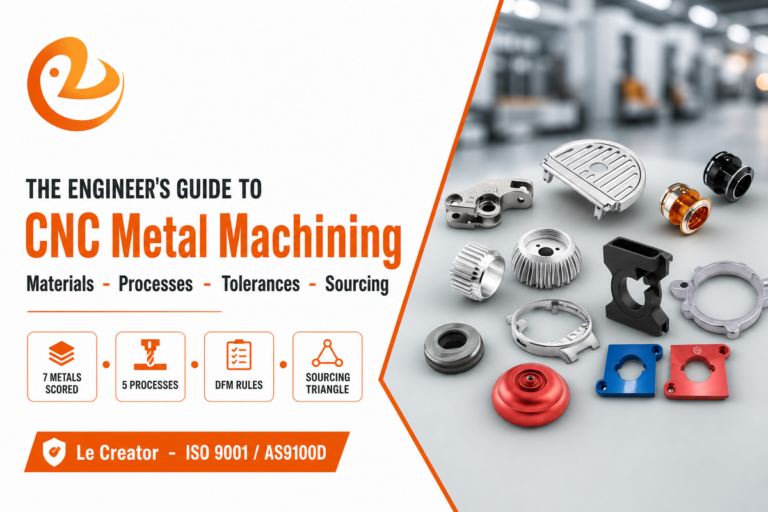
From early-stage rapid prototypes through to high-volume manufacturing, CNC machining of aluminum provides the utmost precision and consistency; no other casting or profile extrusion can compete. Le-creator’s aluminum CNC machining service processes 5062, 6075 and 5052 alloys to tolerances as tight as ±0.01 mm. Whether you require three, four or five-axis milling centers, jobs from fairly straightforward brackets to complex aerospace enclosures can be produced to exacting standards.
⚠ Common Mistake in Material Selection
Another common mistake when trying to select the right material for a new project is using 6061 for marine use. While 6061 has been proven to have a fairly decent corrosion resistance, it is ultimately no match for the 5xxx series – 5083 and 5052 in particular – which contain a far higher level of magnesium to provide better saltwater corrosion resistance. For hulls, deck hardware and offshore structures – specify your 5xxx-series aluminium alloys.

Ultimately, no two materials are suited to every industrial application. Although aluminum may be used very widely, we must understand its limitations; regardless of how good a material is, there are times when it is simply not the appropriate choice. Here’s the uncompromising facts.
✔ Advantages
⚠ Limitations
⚠ Preventing Galvanic Corrosion
When aluminum must contact dissimilar Gukagohs, isolate the joint with non-conductive barriers: nylon washers, rubber gaskets, zinc chromate primer, or anodized coatings on the aluminum surface. Stainless steel fasteners in aluminum require a heat resistant sleeve or mastic (3M 5200 or equivalent). Painting alone is never enough – any damage to the paint re-activates the galvanic cell.

Noaluminumis rust. Rust is an iron oxidation an FeO. On contact with air,within milliseconds, aluminum forms a thin oxide layer of aluminium oxide (AlO), a transparent, selfhealing film of 4-10 nm thickness, preventing the metal against their damage.
aluminum is also acid/alkali-corrosive by galvanic contact of the dissimilar metals.
The first name given to this element by Sir Humphrym Davy was ‘alumium’ (1808), later changed to ‘aluminum’; later from British Chemists adding -ium to the end to follow the example of the known elements (sodium, potassium and magnesium) to form aluminium. In 1990 the IUPAC (International Union of Pure and Applied Chemistry), chose to keep the name aluminium as the official international formula. However the ACS (American Chemistry Society) kept the spelling as aluminum as an accepted usage.
Both spellings are correct scientifically.
Le-creator CNC machines 6061, 7075, 5052 aluminum produce with tolerances to ±0.01 mm. Prototype to production—over 17 years of CNC experience.
This article was authored by the engineers who make up the dedicated batch and research and development department at Shenzhen Le-creator Technology Co., Ltd.. Having been CNC machining for over 17 years, our shop manufactures thousands of aluminum alloys 6061, 7075 and 5052 for more than 1,000 customers around the world each day in aerospace, automotive, medical and electronic fields. The materials data here is those used in our programming of the various aluminum jobs too.