

Supportive, Professional, Client-Focused Service
From prototypes to full-scale production, we’ve got you covered.



CNC machining is one of the most fundamental aspects of modern manufacturing, whereby designs are transformed into precise products. However, success in this area depends more on the experience of the machinist than on the accuracy or compatibility of the file type. The most common file formats are in the names of STEP, IGES, or DWG. They have a variety of essential roles in fostering smooth communication between design and machining. So do their specifications differ much in moving through the same target of genesis and use in a project? The present argument throws light upon these key file formats in-depth, their features, pros, and cons, and applications to inform the designer, the engineer, or the manufacturer regarding the better utilization of the CNC machining technology. Through this guide, you will get to know how selecting the appropriate format can greatly distinguish the eventual appearance and impact of your designs.
The correct CAD format must be chosen if CNC machining is to match compatibility, precision, and quality during the manufacturing process. The CNC machine and the software might need different files, so they can interpret the details of a design. The best options are the STEP, IGES, and STL, among which STEP is commonly recommended for its capability to sustain geometrical data and compatibility aspects. Proper format selection steers clear of mistakes, allowing for reduced machining and downtime, setting the requirement for accurate design compliance.
CNC machining is an elementary dictatorship of computer-controlled machinery, thus introducing precision into part and component manufacturing. The core processes usually include milling, turning, and drilling, each bringing unique features to the fore. Milling minimizes the material using rotating cutting tools; turning rotates the workpiece on a lathe and at the same time purges it against cutting tools. Drilling usually delves into the practice of producing holes with constant accuracies. The technology offers new possibilities for more advanced five- and six-axis machining. With the multifarious future in 2025 standing guard, CNC machining is exhibiting seamless AI-driven optimization and integration of real-time monitoring of data, which gather and optimize efficiency levels and minimize waste, making it essential in countless industries such as betterment, needless to mention, on keys like aerospace, automotive, and healthcare.
File formats significantly dictate the accuracy and efficiency of CNC machining processes. The two foremost standard formats, STL (stereolithography) and STEP (Standard for the Exchange of Product Data), offer certain benefits in tors like… STL files are used extensively for 3D printing and CNC due to their simplicity but often do not represent geometrical precision. Hence angles and lengths have inaccuracies and the such. In this case, STEP files could give a very precise representation of any geometrical model that in turn is conducive to efficient relationships between the design software and CNC machines.
File format is an issue that can make significant improvements to machining performance by preventing mistakes from the outset in generating the toolpaths, ensuring subsequent exact reproduction of a design file. Nonetheless, poorly optimized files and/or inappropriately coiled files can lead to longer lead times, material waste, and cost overrun. As an alternative, both AMF and 3MF formats are being used progressively, because they both support detailed high-resolution files and metadata-based precision and quality control.
Key Insight: Thus file organization and optimization of these files enable shorter processing time, quicker workflow, as better communication between the design and the production teams, thus improving on production outputs at the end. Hence, the proper file formats are crucial in improving the process and reducing the costs and producing higher-quality CNC machining.
Various file formats are compatible, but not all CNC machines or CAD/CAM software will cooperate, which will result in slow work and finally some file conversion is needed.
The translation of files from one format into another generally leads to the loss of data or details required for maintaining precision on the machined part.
Either it’s hard to move or work on larger or more complicated files, which can lead to slow machines or errors. In this context, being forced to save overriding the current recommended record size is quite common.
Since the use of multiple file formats implies lack of standardization, achieving consistent workflow output through different classes of machinery and varying teams will ultimately make these files become critical.
Another drawback is that accreditation is also a challenge.ultipurpose beginners into industrial milling or the CAD are not uncommon.
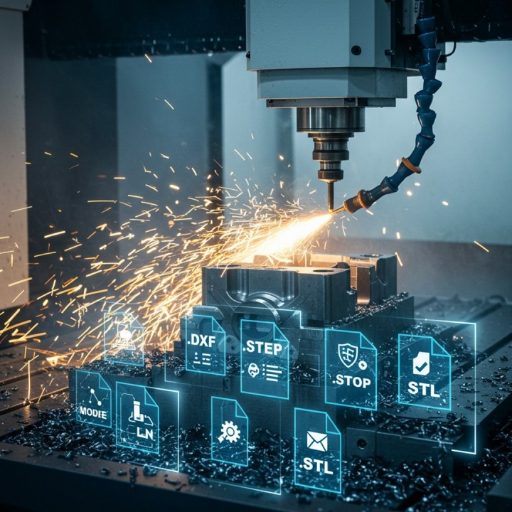
The file format referred to commonly as STEP (Standard for the Exchange of Product model data) finds wide acceptance in CNC machining as a most universally compatible and easy-to-use format. It is a neutral CAD format that would facilitate the transfer of 3D models back and forth between CAD/CAM systems. A STEP file takes with itself full geometrical and design data, thus ensuring high precision and maintaining the original model’s integrity in a file exchange. One of the situations where STEP becomes the wish of every manufacturer or engineer working with various tools and workflows.
IGES is the standard format for CAD data and involves visualization for 2D or 3D CAD models. Most frequently in the CNC machining industry, IGES files are used to share 2D and 3D design data in compatibility. Introduced as one of the earliest standards for CAD data exchange, IGES files contain information such as wireframe, non-manifold models, solid bodies, and annotations, making them one of the best in the versatile GI export data forms. One of the key features of IGES is the ability to be operated in many CAD systems for use by manufacturers and designers to ensure interoperability. Still, there are instances when IGES files can sometimes stumble upon erroneous precision and problematical compatibility with modern file formats like STEP. Despite its drawbacks, IGES is still an important tool for industries needing accurate data exchange for CNC processes.
DWG is a widely accepted file format which is employed mainly in the operation of the CNC machining. This particular type of file format was initially designed by Autodesk and has been primarily used for two-dimensional and three-dimensional drawings, rendering it a methodologically favorite among architects, engineers, and machinists. Its great strength lies in its accuracy and versatility among the various CAD programs, even being capable of wielding intricate designs without any major drawback. DWG bids well as a repository of copious design data, consisting of layers, scales, and notations, to empower manufacturing exercises while being a feasible candidate to keep the CNC on track with the rightful commands. With a resilient construction, its applicability renders it as an industry standard.

Make certain your CAD data format works well with your CNC software before you begin work, to avoid any translation errors and maintain precision.
The file format should hold all the critical design features (such as dimensions, layers, and annotations) for perfect machining process accuracy.
Go with a file format that provides the best possible balance between the level of detail and file size so that the process is smooth but the design rich as well.
A good format is one that enables modification as per design changes or machining requirements.
To enable teamwork and interaction with other tools and workflows, you should employ a commonly recognized format such as DXF or DWG.
When it comes to CNC machining, be sure to export your CAD drawings in the most common formats like STEP, IGES, or DXF to ease compatibility.
Eliminate any unnecessary detailed information or features that won’t further any machining process. This will speed up the file processing and lower the risk of errors.
Verify that the units of measure are right in your file, for example, inches or millimeters, and that the scale is in step with the machining requisites.
Please verify for any gaps, overlapping lines or redundant geometry in the design. A clean and accurate geometry is vital for accurate machining.
Include any vital annotations, with your preferred tolerances, material specifications, toolpaths, so as to speak better with the machinist.
Result: The above practices can be followed to guarantee frictionless migration of the designs made using CAD to CNC machining. This way, errors and delays might be prevented.
It becomes crucial to choose the right file format to ensure compatibility and precision. With that said, a few file formats are widely used in CNC machining applications. These file formats include:
This file format is also appropriately used in 3D printing and additive manufacturing processes because it represents the outer surface of a 3D object in a simple triangular mesh. However, the file format can lack information on material properties and internal structures, thus limiting its use in some more complicated CNC techniques….
This is the most versatile and preferred file format for CNC machining. These files usually support the exact geometric representation and interoperability of 3D models while passing across various software platforms. Besides, they are also primarily good for high precision machined parts and complex assembly applications.
IGES, the initial graphics exchange specification among CAD software, is used rarely. Often, problems arise in sharing files from software to software. For example, IGES triumphs in representing a surface or a curve and the problems begin for assemblies, which is a sort of likeness of the CAD conditions itself. The data-limited IGES format trails behind STP in this regard.
DXF thrives when it comes to 2D CNC machining applications such as laser cutting, waterjet cutting, and engraving. This format stands the test of time as a representation for CAD data.
G-code may be made in CAM with software, hence, it is at its best as the operating medium for CNC machinery. It is the vehicle that orders where the machine should serve with respect to the tool that increases or decreases speed.
Conclusion: With proper selection of the correct type of file, the manufacture would be more efficient, controlled, and have less room for errors.
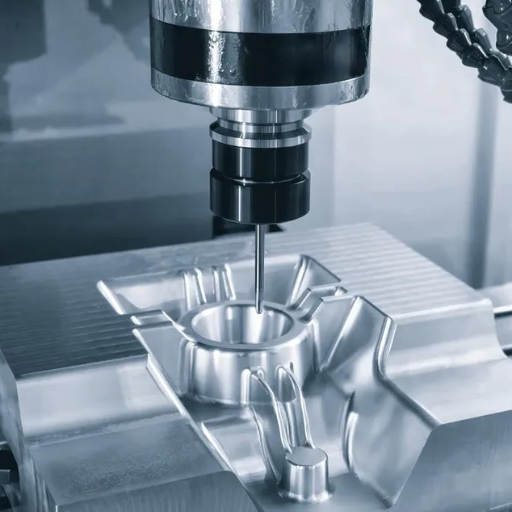
While considering the role of file formatting in toolpath generation and file compatibility for CNC machining, the right selection of the file format is a must if smoother operations must be achieved. CNC machine workflows are often reliant on the formats of STL, DXF, and STEP to pass design data to CAM software for toolpath creation. Each file format has its strengths: STL files are perfect for 3D printing and machining surfaces, which is distinct from being used by DXF primarily for 2D profiling tasks. STEP files prove beneficial for complex assemblies owing to their adherence to parametric data.
CAD-CAM-CNC machine file compatibility allows proper interpretation of toolpath data, removing any possible room for error or lost data amidst translation. A file format mismatch would, for example, lead to scaling problems, incorrect geometry, or dispersion of details. A CAM system that can handle an array of formats will reduce reliance on converter tools. From using the most current file and format standards, much more significant machine process integration can be ensured by the designer that is bound to save time and curtail expensive mistakes.
In the CNC production, the choice of the file format has an impact on the resultant precision and quality. As the file format is taken into account, it provides for arranging and rendering the modules of design data such that they can be used with the machining tools. Some of the common forms of file formats used are STL, STEP, and IGES , each corresponding to separate purposes such as STL for 3D printing. It inclined more toward tessellation and therefore on occasion causes an enhanced loss in precision. Opposite to this aspect, STEP and IGES work best with complex geometry.
These errors may result in a poor surface finish, dimensional distortion, or absent features in the design since it is unprecise and unavailable when formats are not compatible with each other. For example, if a CAD file conversion between software platforms fails to transfer all the information, it may show in defective parts. In order to uphold the best possible result in production quality, hence, it is very important to make use of CAM software, which will involve using the most up-to-date file format provisions, and avoid the loss of data while performing file conversion. The companies are able to obtain high standards of accuracy, less waste, and achieve really tight tolerances during CNC operation by using the latest formats plus make sure that files are compatible throughout the file processing to turn out impeccable machining products.
Interchanging files among incompatible formats could cause missing data, or changed geometry and it will give the machining errors as a result.
Mismatch in the compatibility may lead to the wrong interpretation of dimensions marked on the feature accumulation that completely do not match with the specifications.
Several design features; like complex curves or fine detail might not have been able to lay down the approach in a right way, resulting in a need for a redo.
Designs are gone wrong, and so they have to be redesigned. A more pragmatic approach is needed to automate these protrusions because today, software lacks the capability.
Any ill-fit between CAD software and computer numerical control (CNS) software can exacerbate the cooperation between sculptors (designers) and machining tool users, consequently addressing both time management and quality issues.
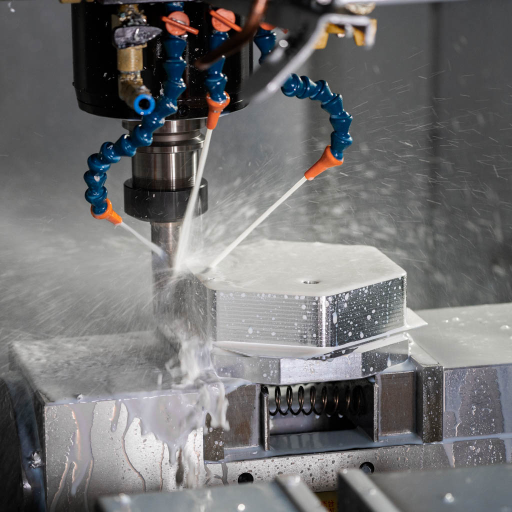
Uploading file formats that the CNC machining software does not support typically end up giving errors or, worse, a complete rejection of the file. Always make sure before you upload about the acceptable file type.
When the tolerance information is not specified, manufacturers may not have an idea of the tolerance and may machine the parts wrong, resulting in them not fitting the intended specs.
Complex or intersecting geometry without explicit definition can lead to mistakes during the machining process and the production of flawed or imprecise parts.
Designing without keeping the limitations of the material in consideration can render a design impossible to mill or render the final product unfeasible altogether.
Missing crucial detailed annotations like thread specifications or surface finishes may delay production and result in parts that do not meet the intended functional requirements.
For any production workflow, preparing files well in advance is crucial. The CAD models must be precise and neat of superfluous or overcrowded geometrical entities. Major dimensions and tolerances therein must also be correctly denoted, hence ensuring that misunderstanding is kept to an absolute minimum. Make sure that the file format you choose will fit into manufacturer systems. 3D models usually have options such as STEP or IGES formats. Choose 2D drawings only in the context of completely annotated meaning, [explaining] material types, surfaces, and any inherently unique processing instructions. At the dawn of implementation, seeking healthcare with the production team paves the way for them to follow the entire spectrum of any minor issues, thus, solving them beforehand and disallowing delays, ensuring that the final products meet the designed specifications.
Standardize the files and program codes to make them compatible with all CNC machines. It’s possible to run standard recognized formats like G-code, which are almost universally acceptable by all CNC systems. It would help avoid problems specific to machines by clearly defining tool lengths, cutting paths, and their respective operation sequences. Hardware capabilities have to be matched with the requirements for the job, which might entail verifying spindle speeds and maximum-axis limits. Testing the program in simulation software ahead of unleashing it for the real machine ensures consistency and reduces downtime from inconsistencies and equipment damage. Properly documenting the whole project and posting regular updates in lock-step with the machine operators will further entrench compatibility and enhance operational efficiency.
The Impact of a Three Axis Computer Numerical Control (CNC) Shaping Machine on Designing
A CAD/CAM/CNC Curriculum for High School Students
The Application of Parametric Software into the Undergraduate Computer-Aided Manufacturing Environment
Blending Engineering Modeling, Industrial Design, and Physical Prototyping in Product Design
A CNC file is a design or set of instructions of digital nature that is used to steer CNC machines with a view to invoking the creation of a part. The commonest file formats for CNC machining purposes, the wide range and varied standard may be available to have native CAD files (SolidWorks, Creo, NX), neutral formats as STP (STEP) and IGES, mesh formats as STL, and 2D exchange formats as DXF. Specific benefits to these formats are notably reliant on the CNC machining job, the types of CNC machine (milling, lathe, cnc router) that the files are operating on and if precise geometry (solids/STP) or surface/mesh data (STL) is required for further CAM and 3D printing workflows.
While one format-states the three-dimensional model as a triangulated mesh, STL is often used for 3D printing, while the STP format is designated as a neutral format that retains the original geometric topology, assembly structure, and features of CAD programs that are exchanged by the CAD systems for precise machining, including CNC manufacturing.
DXF can be used for 2D profiles, cutting paths, laser, plasma, waterjet, and router jobs where vector outlines drive the toolpath. For 3D milling or multi-axis machining, you’ll usually use 3D cad files or neutral format files (STP/IGES) or native cad files that are exported from your own cad software packages. DXF is perfect for fixed simple geometry and is supported well across many diffrent cad applications and CAM packages.
Each standard format of CNC machinery would have to match its compatible software very honestly in creating tools, molds, and dies. Nonetheless, the key difference is MS Excel often stores quality assurance data and its personalized programs may make an evaluating process work easier. Out of four CAD files like IGES, SAT, STEP, or X_T/X_B, which one makes a successful start for FEA analysis to designers?
Distinct CAD systems present self-standing CAD files that harmoniously couple with their very CAD/workflow. When it comes to working across different CAD packages, the demand is more for neutral formats (STP, IGES) and common CAD file formats (DXF, STL). The choice of CAD format would depend on whether one would require editable parametric data, exact solids for precision machining, or lightweight meshes preferable for visualization as well as 3D printing. The knowledge of target CAM system and CNC machine types shall aid selection of the correct CAD and exchange format for deployment that secures the success of CNC manufacturing.