

Supportive, Professional, Client-Focused Service
From prototypes to full-scale production, we’ve got you covered.


POM CNC Machining: A Practical Guide to Machining Delrin and Acetal Parts
If you’ve been tinkering with precision plastic parts, you’ll have come across the legendary POM – known by some of its trade names as delrin, Celcon or just beaten by the original name acetal. From insulin pen mechanisms to parts of a car’s fuel system, this engineering thermoplastic is ubiquitous for a reason – it machines to clean standards, is extremely accurate and resilient to wear in a way that few other plastics can claim to be.
However, simply chucking stock in a POM CNC machining center will not lead to top-notch results. It is the details of grade selection, cutting parameters, heat management, and dimensional behavior following machining that determine whether your finished components make the grade—or become waste.
This handout summarizes our experience from machining thousands of pom parts in medical, automotive and electronics usages: selecting the right grade, calculating the feeds and speeds, achievable tolerances and when CNC machining surpasses injection molding in your case.
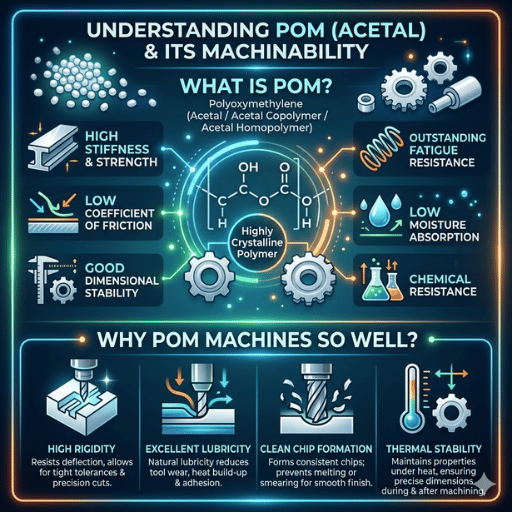
POM, well polyoxymethylene, is a semi crystalline engineering thermoplastic, also known as acetal or by the DuPont trade name Delrin. Often known as polyacetal in the older technical literature, but it’s related to the same family of high performance engineering plastics as Nylon and PBT–but some better features for CNC machining.
Original material was patented and commercially adopted by DuPont in 1960 under the name of Delrin homopolymer. Celanese later added a copolymer production to the range as Celcon. POM is still one of the most widely machined plastics in the world, with global consumption over three million metric tons per year based on market research data.
What makes POM so much loved is its unique combination of properties: high stiffness makes POM resistant to deflection by the cutting forces. low friction makes a non-welding chip formation, and excellent dimensional stability maintains the size of the component close to its programming dimensions once the cutter has left.
Its extreme crystallinity; between 75 and 85 percent results in a crystalline, rather than gummy and stringy chip formation; as opposed to amorphous plastics.
As per the ASTM D6100-17 specification the POM shape also needs to satisfy specifications for: Tensile strength Elongation at break Tensile modulus Flexural modulus Izod impact Porosity In accordance with these specifications engineers now have a standardized baseline for material qualification in precision CNC machining applications.
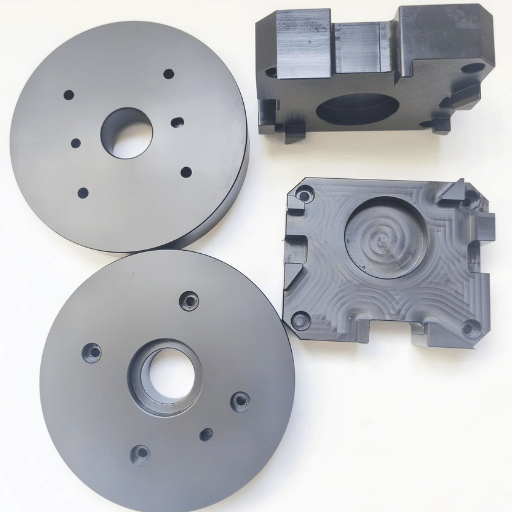
Not all POM is created equal, The two major grades, pom-h (homopolymer) and POM-C (copolymer) are close enough in performance that selecting the wrong one will mean mechanical failure in service. POM-H, available as a delrin brand has about 15 percent higher tensile strength and stiffness. POM-C, known as Celcon or Hostaform, sacrifices some mechanical strength for greater chemical resistance and lower porosity.
Within our own production, the pom-h maintains tighter tolerances on all gear parts and bearing surfaces where dimensional accuracy under load is critical. Whereas POM-C shows the obvious advantage in parts subjected to hot water lines , cleaning chemicals or slightly acid conditions.
| Property | POM-H (Homopolymer) | POM-C (Copolymer) |
|---|---|---|
| Tensile Strength | 70 MPa | 61 MPa |
| Elastic Modulus | 4,623 MPa | 3,105 MPa |
| Elongation at Break | 25% | 40–75% |
| Chemical Resistance (pH Range) | pH 4–9 | pH 4–13 |
| Hydrolysis Resistance | Up to 60°C | Up to 85°C |
| Centerline Porosity | Higher (visible in thick rods) | Lower (better for sealing surfaces) |
| Creep Resistance | ~10% higher load capacity | Standard |
| Cost | Higher | Lower (75% of global POM sales) |
Our Grade Selection Framework
In addition to these two standard grades, there are speciality versions of POM for certain specific purposes POM-C GF25 (25% glass filled for higher stiffness), POM-ESD (anti-static for electronics assembly) and POM-LF (low-friction, PTFE filler for slide bearings).
When you cnc machine pom then the mechanical properties directly affect how it behaves under cutting forces, how well it holds dimensions, and how long finished parts last in service. Here is a comparison of POM with the other plastics most widely specified for precision CNC machining parts.
| Property | POM | Nylon 6/6 | ABS | PEEK |
|---|---|---|---|---|
| Tensile Strength (MPa) | 60–70 | 70–85 | 40–50 | 100–110 |
| Flexural Modulus (GPa) | 2.6–3.0 | 2.5–2.8 | 2.0–2.4 | 3.5–4.5 |
| Coefficient of Friction | 0.20–0.35 | 0.30–0.40 | 0.35–0.50 | 0.35–0.45 |
| Water Absorption (24h) | 0.20% | 1.2–1.5% | 0.20% | 0.10% |
| HDT at 1.8 MPa (°C) | 110–136 | 65–100 | 88–100 | 152–160 |
| CTE (×10⁻⁶/K) | 110–130 | 80–95 | 80–100 | 47–54 |
| Machinability | Excellent | Good (stringy chips) | Good | Good (abrasive) |
Because of POM’s combination of low friction, self-lubricating properties and wear resistance it is ideal for moving parts such as gears; bearing and slide mechanisms – applications where nylon soaks up excess moisture and ABS does not have the fatigue life needed. Its low water absorption (0.20% compared with nylon 1.2-1.5%) just means high dimensional stability even in a moist environment. That is why POM is used in precision parts requiring constant fit in varying seasons and climates.
Worth noting: the coefficient of thermal expansion of POM (110–130 × 10⁻⁶/K) means a 100 mm POM workpiece at 20 C would expand by about 0.13mm at 30 C. For tolerance requirements tighter than 0.05mm, this affects the need to machine and inspect in a temperature-controlled room. Tests conducted on the POM materials by Mitsubishi Chemical Advanced Materials show that the respective copolymer and acetals maintain dimensional stability to within specified limits (ASTM standards).
POM beats ABS in tensile strength (60–70 MPa vs 40–50 MPa), stiffness, and fatigue life. ABS bonds more easily with adhesives and accepts paint better. Pick POM when mechanical performance and wear matter; pick ABS when cosmetic finishing or chemical bonding is the priority.
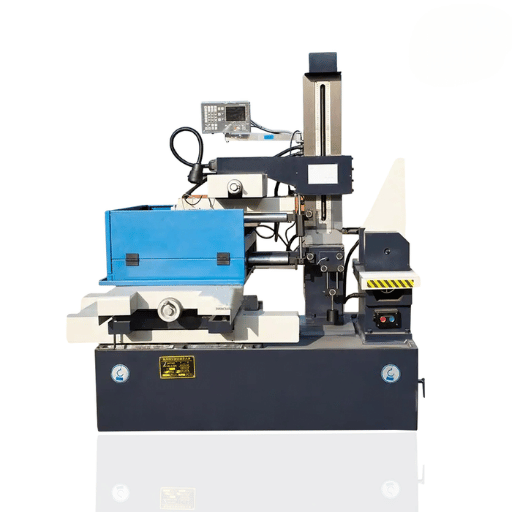
POM is easy to machine and one of the simplest engineering plastics to work with — but “simple” does not mean “forgiving.” Poor parameter choices cause surface melting, gummy chip formation, or in the worst case, thermal decomposition that releases formaldehyde gas. Here are the machining parameters our team uses when running POM on CNC milling and turning centers.
| Parameter | Recommended Range | Notes |
|---|---|---|
| Surface Speed | 150–350 m/min | Carbide tooling; start at 200 m/min |
| Chip Load per Tooth | 0.05–0.15 mm/tooth | Too low → heat buildup and melting |
| Depth of Cut (Roughing) | 1.0–3.0 mm | POM handles aggressive cuts well |
| Depth of Cut (Finishing) | 0.2–0.5 mm | Light passes for Ra ≤ 0.8 µm |
| Flute Count | 1–2 flutes preferred | Better chip evacuation than 4-flute |
| Parameter | Recommended Range | Notes |
|---|---|---|
| Spindle Speed | 1,000–2,000 RPM | Adjust based on diameter |
| Feed Rate | 0.10–0.30 mm/rev | Higher feeds produce cleaner chips |
| Depth of Cut | 0.5–2.0 mm | Remove material evenly from both sides |
| Tool Geometry | Rake 5–10°, Relief 10–15° | Positive rake reduces cutting forces |
Use sharp, polished carbide cutters. Carry out Machining with positive rake angles. Use high-speed steel (HSS) cutters as these will suffice for low-volume production work, but use carbide for better-tool life, surface finishes and tool wear.
Use single-flute or two-flute end mills rather than four-flute tools, these will clear chips more effectively as the POM chips tend to clog the valleys of the cutters re-melting:
For coolant, the accepted industry standard in turning POM is high pressure compressed air. This will break off chips immediately, it prevents heat from building-up in the workpiece and the unit is dry. A water soluble coolant is also effective, but flood coolant is not necessary due to the low water intake of POM (0.20%).
Oil based coolants can also be avoided as they tend to mark the surface.
Running POM without coolant at more than approx 300 m/min surface speed leads to surface melting and gummy chips – and this is a problem encountered in around ¼ of the outsourced POM jobs that we receive for rework. Overheated material also gives off formaldehyde gas above 220°C. If you notice a harsh, pungent smell when machining then stop right away and make sure you increase the extraction.
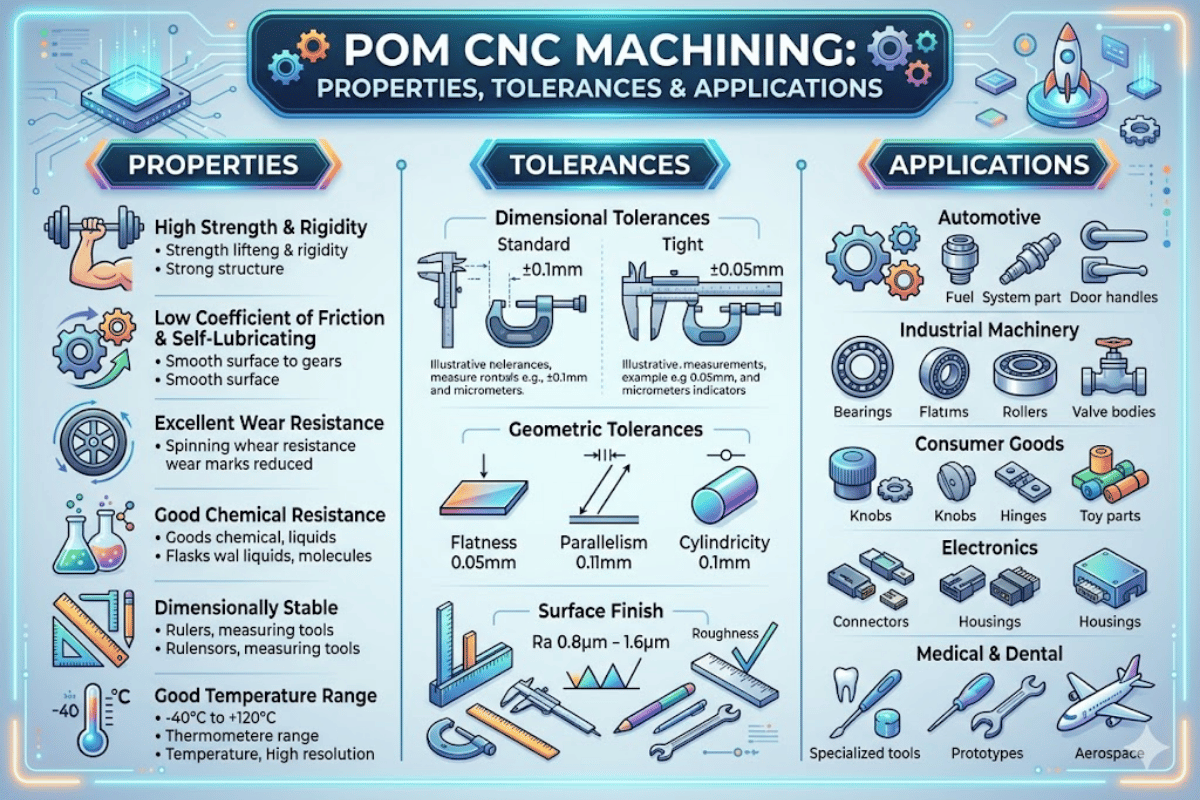
POM’s tolerances are equivalent to many metals—and substantially better than most other plastics. Standard, our pom parts molarod has 0.05 mm on features smaller than 50 mm. Achievable tolerances for precision bore fits and mating parts are 0.02 mm using finish reaming or fine boring, combined with temperature-control machine situations.
| Feature Type | Standard Tolerance | Precision Tolerance |
|---|---|---|
| Linear dimensions (<50 mm) | ±0.05 mm | ±0.02 mm |
| Linear dimensions (50–150 mm) | ±0.08 mm | ±0.05 mm |
| Bore diameters | ±0.03 mm | ±0.01 mm |
| Flatness (per 100 mm) | 0.10 mm | 0.05 mm |
| Thread (M3–M10) | 6H/6g | 5H/5g |
| Finish Method | Ra Value | Typical Use |
|---|---|---|
| As-machined (standard) | Ra 1.6–3.2 µm | Functional parts, non-contact surfaces |
| Fine machined | Ra 0.8 µm | Bearing surfaces, sliding contact |
| Polished | Ra 0.4 µm | Sealing faces, medical components |
| Vapor polished | Ra 0.2 µm | Optical clarity, cosmetic surfaces |
pom parts can distort by 0.02 to 0.05 mm during the 24-48 hours after machining, as internal stresses relax. For precision POM parts within 0.03 mm tolerance, plan on a period of stabilization prior to final inspection. Some shops have success relieving stress by oven-annealing POM blanks at 160°C for 1-2 hours prior to machining, a step we’d recommend for all components with tight tolerances.
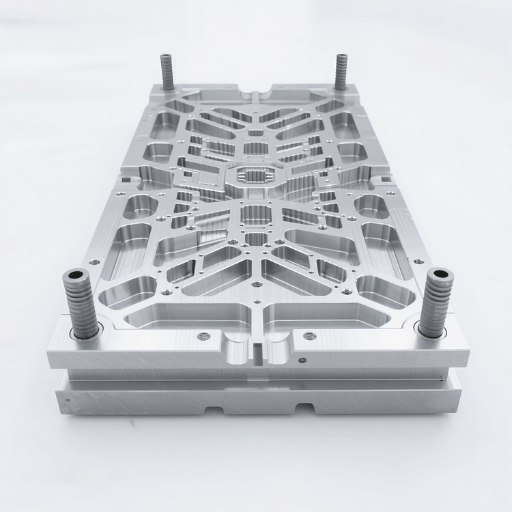
POM’s unique blend of mechanical strength, low friction, and chemical resistance make it suitable for the broad range of plastics used for CNC machined POM components. Here are typical pom plastic parts we machine most often: insulin pen mechanisms for medical OEMs, conveyor guide rails for food-grade processes, and electrical connector housings rated to UL94 HB flame performance.
Gears, fuel system parts, window regulator components, seatbelt mechanisms, and interior trim attachments all use POM. Its excellent wear resistance and fatigue life make it ideal in applications where these parts see hundreds of thousands of cycles without lubrication—saving significant maintenance costs in the process.
Drug delivery systems (insulin pens, inhalers), surgical instrument handles, diagnostic cartridge casings. Medical-grade POM meets the requirements of FDA 21 CFR 177.2470 and has been included in both FDA Drug Master File and FDA Device Master File registries. ISO 10993 testing and USP Class VI biocompatibility tests provide additional assurance of their safe use in contact with patients.
Conveyors chains, guide rails, scraper blades, and valve seats. Food-grade POM-C adheres to existing FDA regulations for food contact rules, along with EU Regulation 10/2011 involving direct contact with food materials—which is becoming increasingly important for export components.
Connector shells, switch housings, blower bearings, and thin-gauge insulators. Excellent dimensional stability across a broad temperature and moisture range eliminate shifts in connector pin placement, while its low moisture absorption reduces swelling that can alter electrical clearances.
Pump impellers, valves, cam followers, and custom POM bushings. These plastics are viable replacements for metal when weight savings, corrosion-resistance, or lubrication-free operation can be expected to justify the changes—often at 30-50 percent less finished part costs.
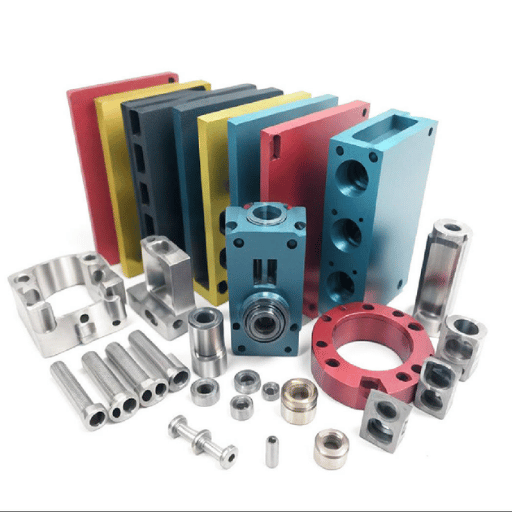
injection molding is capable of CNC machining POM, but is better suited to meeting the project profiles of the larger-volume needs typically identified by injection molding customers. Tolerance specification, component volume, lead times, and part budget are weighed against each other to make the decision.
| Factor | CNC Machining | Injection Molding |
|---|---|---|
| Upfront Cost | Low (no tooling) | $5,000–$50,000+ (mold cost) |
| Per-Part Cost (10 units) | $15–$80 | Not viable (mold cost dominates) |
| Per-Part Cost (1,000 units) | $10–$60 | $1–$5 |
| Per-Part Cost (10,000 units) | $8–$50 | $0.50–$3 |
| Lead Time | 3–10 business days | 4–8 weeks (mold fabrication) |
| Achievable Tolerance | ±0.02 mm (precision) | ±0.05–0.10 mm (typical) |
| Design Changes | Update CAD file (hours) | Modify or remake mold (weeks) |
| Material Waste | Higher (subtractive process) | Lower (near-net-shape) |
In our opinion, CNC machining should be employed for efforts less than 500 parts or those requiring tighter tolerances than 0.05 mm. For steady designs with batch size 1,000 parts or more, however, it is better to employ injection molding. The threshold of economic viability for simple shapes is 300-700 parts, while the same threshold ascends to 5,000 parts for complex POM shapes that require costly multi-cavity molds.
Many of our customers employ a hybrid process: CNC-machined POM parts serve as the prototype and test article, then injection molding handles the production runs. This way, form and function is validated on machined POM parts before $10,000 or more are committed to mold tooling. The CNC prototype uses the same POM grade as the final molded part, so material properties carry over directly — unlike 3D-printed prototypes that only approximate final performance.
Getting an exact quote for CNC machining and injection molding based on your expected volume is very useful for a cost comparison. For POM parts, the CNC-to-molding crossover is frequently lower than for metal and plastic parts because POM machines quickly and acetal mold tooling needs special venting to handle formaldehyde off-gassing during the injection molding process.
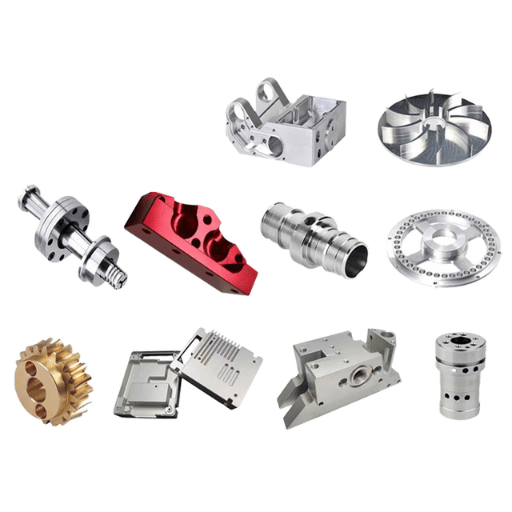
From prototype to production – save on your Lecreator’s POM machining service cost with firstpass yields of 98%+ and inspection on 100% of jobs.
This guide is based on Lecreator’s 17 years of experience machining POM in the medical, automotive, and electronics fields. It provides machining parameters and tolerances data based on our production records machining POM-H and POM-C across over 80 CNC machines at our Shenzhen plant. All of the specifications cited reference ASTM, FDA, and ISO standards – the indicated specifications were confirmed at the time of publishing.