

Supportive, Professional, Client-Focused Service
From prototypes to full-scale production, we’ve got you covered.



CNC-machined aluminum components are highly respected for their precision, durability, and adaptability to a wide array of industries, including aerospace, automotive, and electronics. However, when faced with harsh environments, the inherent characteristics of aluminum may not offer enough corrosion protection or wear resistance. Enter electroless nickel plating—the answer to this very problem. This advanced process greatly enhances the surface of CNC-machined aluminum for added longevity, enhanced corrosion resistance, and a sleek finish.

Electroless nickel plating is a chemical deposition technique in which a layer of nickel alloy is deposited on a substrate in the absence of an electric current. This process involves the controlled chemical reduction of nickel from an ion solution during the immersion of a part into a bath medium containing nickel ions and a suitable reducing agent, often a hypophosphite. The reaction results in the uniform deposition of nickel ions onto the surface, creating a durable, even coating.
The standout feature of electroless nickel plating is its ability to provide uniform coatings, even around complex geometries and hard-to-reach areas. Unlike traditional electroplating, which can deposit excessively on one area and minimally on others, electroless nickel plating ensures consistent coat thickness across all surfaces.
Electroless nickel plating is resistant to various forms of corrosion, making it excellent for harsh environments involving moisture, chemicals, or continuously fluctuating temperatures. The process not only protects the substrate but also enhances aesthetics, giving parts a smooth and shiny surface. This combination of performance, protection, and appearance makes it popular in aerospace, automotive, electronics, and manufacturing industries.
Provides consistent coating thickness even on complex geometries, internal cavities, and hard-to-reach areas without relying on electrical current.
Functions as a protective shield enhancing substrate longevity and resistance to moisture, chemicals, and temperature fluctuations.
Improves surface hardness, reduces friction, prevents abrasion, and prolongs part lifespan for precision finishes and low-friction applications.
| Industry | Applications | Key Benefits |
|---|---|---|
| Automotive | Engine parts, fuel systems, transmission components | Withstands wear, rust, chemicals; extends utility lifespan |
| Aerospace | Landing gear, actuators, hydraulic systems | Resilient deposition for extreme pressure and temperatures |
| Electronics | Connectors, circuit boards, delicate components | Improves electrical conductivity, protects against oxidation |
| Marine | Boat components, underwater equipment | Superior protection in moisture-rich environments |

Electroless nickel plating is a chemical process that deposits a uniform layer of nickel-phosphorus or nickel-boron alloy onto a substrate. Unlike electroplating, it doesn’t require external electrical current; instead, it employs a controlled chemical reaction for deposition, enabling uniform coating of complex shapes and surfaces.
Process Note: The substrate is thoroughly cleaned to remove contaminants including grease, dirt, and oxide coatings to ensure better adhesion. Components are then immersed in a plating bath containing nickel salts, a reducing agent (typically sodium hypophosphite), and other additives and stabilizers.
The chemical deposition process relies on a reducing agent (sodium hypophosphite) for nickel placement on surfaces without external electric force. The main chemical constituents include:
The process involves the reduction of nickel ions (Ni²⁺) to form metallic nickel. The reducing agent undergoes oxidation, releasing electrons that facilitate nickel deposition onto the substrate surface. The substrate acts as a catalytic surface to initiate the autocatalytic reaction, and once begun, deposited nickel becomes a catalyst, allowing uniform reaction across all exposed areas.
Initial cleaning of the substrate to remove contaminants such as dirt, oils, or oxidation. Degreasing, acid cleaning, and surface activation are typical techniques employed.
For non-metallic substrates or those requiring stimulation, a catalytic layer (typically palladium) is applied to create an active surface for chemical ion adsorption.
The substrate is immersed in the plating bath containing nickel salts and reducing agent. Uniform deposition of nickel ions occurs onto the substrate surface without external electrical power.
Temperature, pH, and bath composition are carefully controlled to maintain consistency. The coated product is rinsed, dried, or heat-treated as needed to improve adhesion and functional characteristics.
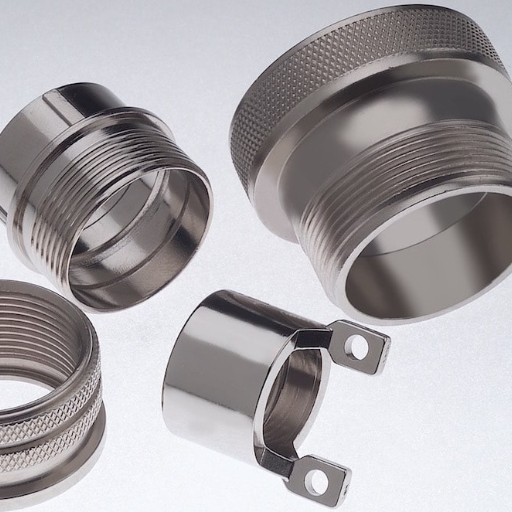
For CNC-machined aluminum parts with intricate geometries, electroless nickel plating excels at providing even coating without the flaky layers produced by other techniques. Unlike electroplating, which requires an external electric field, this process coats all surfaces uniformly—including internal cavities, sharp corners, and complex shapes.
Critical Advantage: Uniformity is especially prized for components requiring precise tolerance and high performance. The homogeneous coating eliminates weak spots that could develop from uneven application, particularly in harsh environmental or mechanical stress conditions.
The uniform coating provides comprehensive protection against chemical, thermal, and humid conditions. The superior wear resistance comes from the inherent hardness and durability of the coating, making it ideal for components experiencing friction or repetitive mechanical stress.
| Property | Uncoated Aluminum | Electroless Nickel Plated |
|---|---|---|
| Corrosion Resistance | Moderate | Excellent |
| Surface Hardness | Low-Medium | High |
| Wear Resistance | Limited | Superior |
| Coating Uniformity | N/A | Exceptional |
| Maintenance Requirements | High | Minimal |
The nickel-phosphorus alloy introduced to the aluminum surface renders it more robust and wear-resistant, enabling components to withstand mechanical stress during long-term use. This improvement particularly benefits high-performance applications in aerospace and automotive industries where components face extreme temperatures and abrasive conditions.

Issue: Incomplete surface preparation leaves aluminum oxidation layers that interfere with plating adhesion.
Impact: Poor adhesion, coating failure, and reduced component protection.
Issue: Variations in coating thickness across component surfaces due to improper bath parameters, varying geometries, or inadequate agitation.
Impact: Inconsistent protection and potential failure in under-coated areas.
Issue: Defects in the plated layer from trapped air, bath impurities, or suboptimal environmental conditions.
Impact: Compromised protective qualities and aesthetic appearance.
| Quality Control Test | Purpose | Methods |
|---|---|---|
| Thickness Testing | Ensure uniform coating thickness | Micrometer measurements, X-ray fluorescence |
| Adhesion Testing | Verify bond strength | Bend tests, thermal shock testing |
| Surface Inspection | Detect defects and irregularities | Visual inspection, profilometer assessment |
| Corrosion Resistance | Test performance in harsh environments | Salt spray testing, environmental exposure |

The process of cleaning and degreasing is a crucial first step. All contaminations including oil, grease, and debris from machining operations must be thoroughly removed to ensure uniform plating adhesion. Chemical cleaning solutions that dissolve residues without affecting the aluminum substrate are typically used. A clean, impurity-free surface is the best assurance against defects in the final plated product.
After thorough cleaning, aluminum parts must undergo surface activation. Activation involves etching or mild acid treatment to remove the natural oxide layer on the aluminum surface that could disrupt nickel bonding. This phase ensures a uniform, durable coating that resists peeling or flaking over time.
Components are rinsed with fresh water to remove any remaining chemicals that might cause contamination during plating. After rinsing, components must be thoroughly dried before chemical plating begins. Moisture from incomplete drying can disrupt nickel adhesion and quality, compromising the final result.
Selecting the right plating service is crucial for optimal results. An electroless nickel coating on CNC-machined aluminum provides durability and corrosion resistance, making it ideal for enhancing component performance across various industries.
Find a company specializing in aluminum plating, as the process requires special preparation and application tailored to this metal’s unique properties.
Ensure the supplier adheres to industry standards and offers effective quality assurance procedures with documented certifications.
Look for experience with complex CNC-machined parts, especially regarding difficult geometries, specific tolerances, and functional attributes.
The service must include comprehensive inspection and post-plating tests to ensure adhesion quality and surface finish requirements.
Assess turnaround times, pricing structure, and customer support. Timely delivery is crucial for maintaining production schedules.
Post-plating inspection and testing determine the quality and strength of plated components, ensuring proper coating adhesion and desired finish achievement.
A: It is a finishing method that involves deposition of a nickel plate alloyed with either phosphorus or boron onto a workpiece surface without using electricity. For aluminum, this process includes cleaning, activation, and immersion in a plating tank to obtain uniform nickel plating, improving corrosion resistance and hardness.
A: Electroless nickel plating offers numerous advantages: thin and even coating, exceptional wear resistance, uniform coverage despite complex geometry, minimal effect on dimensional control, and extended service life through corrosion inhibition. Compared to conversion coatings or anodizing, this process often results in better performance, higher quality, and more uniform appearance.
A: Yes. Since aluminum is naturally non-conductive for direct metal deposition, it requires pre-treatments including cleaning, etching, zincating, or catalytic activation. Once activated, the part is immersed in a tank with a reducing agent that deposits nickel uniformly—including on complex or recessed features—without electricity.
A: Electroless nickel provides uniform thin layers and robust build-ups for wear resistance. Thickness typically varies from 10 to 400 μm as required. Design engineers must account for this in tight-fitting machined parts, particularly for precision aluminum components with strict thickness tolerances.
A: Electroless nickel on aluminum offers corrosion resistance, excellent wear resistance, higher surface hardness, and enhanced lubricity. The perfectly uniform coating provides extended life cycles, improved properties, and consistent appearance across metal surfaces.
A: Yes. Plating aluminum requires specialized equipment and tank construction for activation and electroless nickel chemistry. Essential components include tanks for cleaning, etching, activation (zincating or palladium catalysts), and the main electroless tank. Continuous filtration, temperature control, and chemical analytical equipment ensure consistent deposition and contamination prevention.
A: Passivation following electroless nickel plating adds further corrosion resistance and finish balance. While the plating itself is corrosion-resistant, passivation minimizes oxidation and enhances appearance, providing additional properties based on the environment the machined aluminum part will face.
A: Yes. Electroless nickel is versatile and, with correct pre-treatment, can be applied to steel, stainless steel, copper, brass, plastics (after special activation), and aluminum. Each substrate requires specific pre-treatment chemistries and activation, but electroless nickel plating deposits a uniform alloy coating that enhances performance and aesthetics for all materials.
A: Common failures include adhesion deficiencies, blistering, and non-uniform nickel layers, typically caused by poor cleaning/activation, tank contamination, or suboptimal bath control. Minimize failures through thorough surface preparation and activation, consistent tank chemistry control and maintenance, and comprehensive quality inspection with documented confirmation of required properties.
Exceptional coating consistency on complex geometries and hard-to-reach areas
Superior corrosion and wear resistance for extended component life
Rigorous testing and inspection ensure consistent, high-quality results