

Supportive, Professional, Client-Focused Service
From prototypes to full-scale production, we’ve got you covered.



One other aspect of importance in the process of making precision aluminum CNC parts is the surface finish or roughness of the parts because it affects the performance, reliability and quality of the end product. Whether we talk about precision components of aerospace, automobiles or consumer electronics, there are certain surface roughness requirements that must be met to guarantee the satisfactory performance of the products and customers as well.
Key Question: What are the specific requirements of these “surface roughness”? Are they real requirements? This paper covers the basics of surface finish and its influence in the generation of aluminum CNC parts and the generally applied limits in different sectors. After reading this paper it should become clear to you how can you satisfy the very stringent requirements of manufacture in the present age without compromising on quality.

Surface’s texture and irregularities on a machined part is generally known as surface roughness in CNC machining process. This is one of the most important aspects that determines the ability, aesthetic and overall performance of the component in question. This is because if the surface is too rough or too smooth, the functionality of the part might be affected because it will either be easy to fit with other parts or reduces its frictional and wear resistant ability or even coating adhesion.
The roughness of a surface is usually expressed in terms of certain parameters, among which, for example, Ra (average roughness) which measures how flat a surface is and whether or not this level of flatness is within the acceptable levels. Erosional control is also achieved by turning the best tool possible matching the job at hand, minimizing or maximizing cutting conditions, and if need be polishing or grinding a given surface in order to reduce the roughness of that surface.
Any surface finishes that can be measured at a tiny scale of a component are called surface roughness and these are not smooth. It is an essential in a mechanical part and it takes into account such factors as friction, lubrication, adhesion and the performance of the part as a whole. In sectors such as aviation, the motor-vehicle industry or the manufacture of machinery used in medicine, detailed Surface Roughness Standards for Aluminum CNC Parts are adhered to by companies in order to prevent the components produced from providing normal service requirements.
Surface roughness plays a crucial role because it influences how an element comes into contact with its surroundings and with other components. For example, medical implants require surface roughness within the desired tolerance range to enhance biocompatibility and promote adequate osseointegration in human tissue. In the same vein, the surface texture of automotive engine components is continually optimized to reduce friction between rubbing surfaces, thereby preventing unnecessary energy loss in the fuel.
With the advancement of manufacturing technologies, however, it is possible to achieve exceptional surface quality on processed parts in accordance with technological or legislative requirements. All of the above activities present clearly the importance of why surface roughness must still be controlled and why its roughness measured in the various industries.
Surface roughness has a significant impact on both the performance and the overall quality of a machined part. “Performance” here refers to their mechanical function, while “quality” refers to their functional and aesthetic values. It has been proven that wear as a result of friction can be minimized in components with courteous surfaces. This is most important in parts that must be put into motion.
Smoother surfaces minimize wear in moving parts, crucial for components in motion.
Certain roughness levels enhance adhesive processes and paint applications.
Rougher parts concentrate stresses, accelerating fatigue and shortening component life.
In recent years, however, industries have advanced surface metrology and high-tech CNC processes to control and adjust surface roughness to meet defined component properties and maximize performance.
Ra (Arithmetic Average Roughness) and Rz (Maximum Height of the Roughness Profile) are two of the best known, widely applied parameters of surface roughness in most industries.
Defined as the average of the height profile above or below the centerline. Used to reflect the surface texture over the length measured. Easy to use and suitable for brief evaluations.
Measures vertical height difference between the largest peak and smallest valley over 5 consecutive sampling lengths. Better definition of extreme surface variations.
When focusing on roughness, Ra is useful but not so much as Rz which handles the differences between high peaks and low valleys which are critical to the shape or beauty of a certain product. Both serve different purposes and one has to opt for the right one depending on the given circumstances. When discussing polished surfaces required for manufacturers in accuracy equipment, the use of parameters such as these becomes a multiple requirement.

There are special devices for measuring roughness, like profilometers, in relation to the tracing the profile of the surface followed by calculation of surface roughness parameters (Ra, Rz etc.). In some industry sectors, even more modern means are used with contact or contactless means depending on the level of requirement for precision of measurement and materials used. It is vital in the manufacturing process of a product or even use of a specific technology as it has an impact on functionality of different products or machines and services.
Selection Criteria: Any of these methods is selected accordingly to characteristics of the material in use, desired exactness and goal of the task.
Surface roughness can be measured accurately, given the specific demands of the task, only if the measuring device is appropriately selected.
The machined surface’s texture and irregularities present as surface roughness in CNC operations define these texture levels of finish. The values are critical to achieve the short term and long term objectives of the design, these include the performance, aesthetic and use of the object. A smoother finish implies less ‘roughness’ value which may have implications on friction, wear, or even the ability to seal under certain conditions.
Moreover, the surface may be improved to a desirable condition suitable for certain applications. Such processes include pre-painting, anodizing and tool refurbishment by coating if necessary. Careful consideration in the choice of the required surface roughness means that the finished product fulfills its intended purpose to the satisfaction of the end-user and does not result in excessive manufacturing costs.
Surface Roughness Standards for Aluminum CNC Parts are often used to establish dimensional tolerances and manufacturing sizes. Some of the best examples of these reconstruction surface roughness standards are ISO 4287, and ASME B46.1, where they include properties of the surface like Ra (average roughness), Rz (peak-to-valley regulation), etc. The standards help the manufacturers to make sure of the proper application of the surface finishes whether it is meant for friction, durability, or aesthetics.
Key Documents: ISO 4287 and ISO 25178
Coverage: 2D and 3D surface textures
Characteristics: Height, spacing, and combined measurements
Application: Universal and multileveled, designed to support advanced manufacturing techniques globally
Key Document: ASME B46.1
Coverage: Traditional surface roughness parameters
Parameters: Ra (average roughness) and Rz (mean peak to valley height)
Application: Predominantly used in North America for classical engineering practices
ISO and ASME standards are common in various disciplines yet each has its strength in certain regions or several industries. Comprehending the differences is vital for ensuring accuracy, satisfaction of requirements and high-quality production of engineering applications worldwide.
Surface finish is one of the most important considerations when examining CNC finished pieces, and the roughness average (Ra) is a key index. It is the mean of the absolute values of the surface irregularities in relation to the center line, in microns or microinches. By definition therefore, higher Ra equate to a lower quality of machine work.
The smaller the Ra value, then the smoother the surface, and it is required for those with easier leakage surfaces, transparent eye wear, or applications like aerospace engineering that need lower friction than normal.
However, in some cases, texture is a necessary feature for bonding purposes, and coatings that depend upon friction can benefit from higher values of Ra.
It is necessary to assess the use, type of the material and relevant industrial practices to find the appropriate degree. In optimizing Ra levels for sectors like the aerospace, medical gadget, and motor engineering industries, these parts need intricate engineering, and most of the time an Ra requirement has to be met to achieve safety, performance and legislative standards. While integrating cost and feasibility, the manufacturing process must produce the desired finish with the given output material, this compels an adequate understanding of Ra values as an imperative factor to facilitate the manufacturing of effective CNC components.
| Finish Type | Ra (µm) | Ra (µin) | Process |
|---|---|---|---|
| Mirror Finish | 0.05 – 0.1 | 2 – 4 | Polishing |
| Fine Grinding | 0.2 – 0.4 | 8 – 16 | Grinding |
| General Machining | 0.8 – 1.6 | 32 – 64 | Milling, Turning |
| Coarse Machining | 1.6 – 6.3 | 64 – 250 | Rough Turning, Drilling |
| Sandblasted Surface | 3.2 – 12.5 | 125 – 500 | Abrasive Blasting |
This chart provides a quick guide to typical Ra values for different surface finishes and processes, helping manufacturers select the desired finish for specific applications.
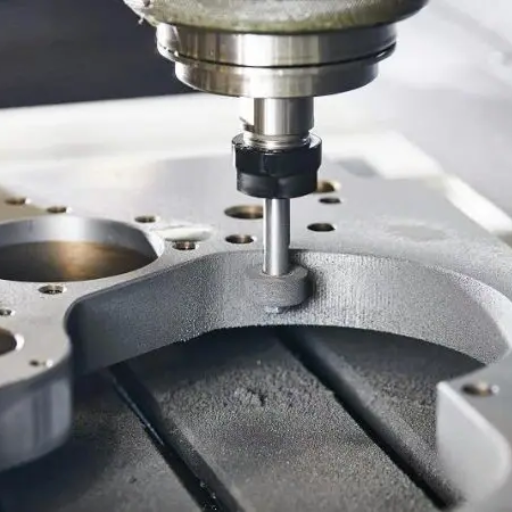
Instances where CNC machining is applied often involve controlling the exact parameters for achieving the exact surface finish in CNC machining. For example, cutting tools are needed to have high efficiency and this is attained through optimisation of machining factors like feed rate, spindle speed and depth of cut. Moreover, it is imperative to think about the strength of the materials in use.
It is essential to apply these elements to ensure that the surface Ra values required for a specific application are met.
1
Employ any computer numerical controlled (CNC) machines or other advanced precision technologies to achieve consistent quality of surfaces and maintain effective control of deviations.
2
Use grinding, polishing, or sanding techniques on surfaces to smooth and reduce roughness as required.
3
Ensure that the appropriate cutting tool, the sharper the better, specifically designed for material of the process is being used to avoid defects.
4
Use oil, lubricants, and various coolants as they reduce or almost eliminate the friction and heat-induced errors.
5
Particular properties are obtained by coating the surface with different types of coatings, such as oxidation or plating to obtain more freedom for the final finish.
6
Use portable measuring instruments such as profilometers to keep checking on the quality of surface roughness, maintaining its control to terminate any inconsistent issues.

The choice of a particular type of surface finish is also greatly influenced by the particular needs of an application or the material in use together with the exogenous factors. Take, for instance, the designing of a medical device. Here, one would use a super clean finish to eliminate bacteria and allow sterilization while for bone ingrowth implants, a rougher finish is much more ideal.
Electronics
Conductive smooth finish application to improve the work of components in terms of circuit boards and reduce signal losses
Aviation
Textured aircraft panels to reduce friction or sustain exposure to high temperature areas
In selecting a finish for a surface, the foremost considerations should be the nature of use (e.g., friction, wear or aesthetics), the intended purpose of the part, or sectoral rules or industry applicable safety standards. Resorting to sophisticated methods such as laser texturing or precision machining provides uniform perfection and carries out exact work for each application case. Combine this with lessons learned through manufacturing data trends about finishes and assure they will stand the test of time, not only today but in the future.
Surface roughness plays an important role in the effectiveness of a product and is linked with various parameters including friction, wear resistance and the ability of a surface to form a seal. Smooth surfaces are known to be characterized by low friction coefficient which is advantageous in mobile parts whereas in some cases a rough surface is preferable in order to facilitate good bonding or coating.
Low friction coefficient in smooth surfaces is advantageous for mobile parts and moving components.
Rough surfaces are preferable to facilitate good bonding or coating adhesion in certain applications.
Surfaces affect fatigue properties and corrosion behavior, impacting longevity and functionality.
When designing a component it is also necessary to achieve the required surface roughness for a particular application in order to maintain the function and the performance over a long period of time.
The evolving surface roughness standards for aluminum CNC parts, as well as the techniques and processes associated with them are related to the increased necessity for precision and efficiency in manufacturing.
The use of automation and Artificial Intelligence (AI) in machining has become a common practice to conduct processes and achieve prescribed surface roughness levels.
Improvements in measurement methods, particularly optical and laser-based methods, enable practical assessment of surface roughness and its impact on performance.
Environmental considerations are also prioritized, as more participants address environmentally appropriate machining, specifically adapted to green principles, with the aim of minimizing material loss and optimizing energy consumption.
All these actions tend to aim at ensuring the proper functionality, efficiency, and enhancement of the manufactured goods that are used in various sectors whose demands are constantly changing and improving.
Understanding and implementing proper surface roughness standards for aluminum CNC parts is essential for achieving optimal performance, quality, and reliability in modern manufacturing. By carefully considering the application requirements, industry standards, and available technologies, manufacturers can ensure their products meet the highest quality standards while maintaining cost-effectiveness and efficiency.
Effect of Machining Feed on Surface Roughness in Cutting
Optimization of Surface Roughness in CNC Turning of Aluminium 6061 Using Taguchi Techniques
Investigation of the Impact of Cutting Parameters on Surface Roughness