

Supportive, Professional, Client-Focused Service
From prototypes to full-scale production, we’ve got you covered.



Copper CNC Machining is grounded in a crucial combination of high precision and the most advanced materials, and as such, one is able to use it in a variety of sectors. Copper is known for its great heat and electrical conductivity strength combined with durability and low hardness, as a result, it is a key raw material in many applications, from the electronic industry to aviation. However, what is so special about copper and what is the role of CNC machining in exploiting its abilities? That is exactly the purpose of this article – to outline why copper is necessary, how copper can be machined, as well as list the domains of its usage. This complete work is meant for everyone – specialists in the field or those who are interested in the modern way of manufacturing. Be prepared to learn how the copper CNC machining process can enable development and accuracy in the present day production processes.
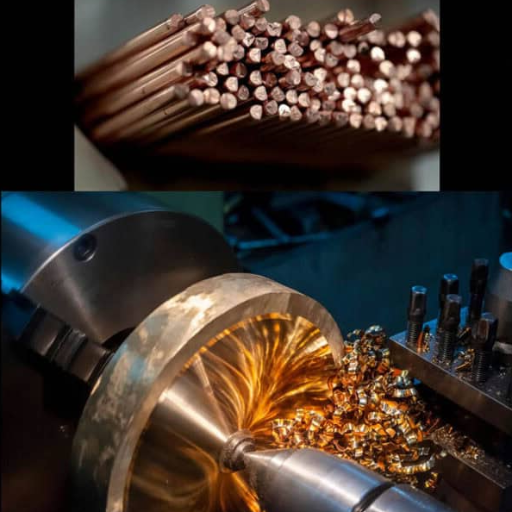
Copper and its alloys are of great significance in production thanks to their decent heat and electric conductivity, anticorrosive properties, and long-term use without wearing out. Among well-known copper-based alloys are brass which is a blend of copper and zinc, bronze which is a mixture of copper with tin and a few other metals. These are major alloys for numerous products including electrical gadgets, pipes, and even ornaments since they perform their intended purposes without being too expensive. Such wide application means that industries from building and electronic use a lot of them as well.
Copper CNC Machining is a highly preferable fabrication method as various advantageous characteristics of copper can be exploited in practical manufacturing such as non-corrosiveness, high thermal and electrical conductivities, as well as high machinabilty. Examples of everyday copper alloys that are used in CNC Machining are:
Copper CNC Machining alloys allow for machining excellence in a variety of application scenarios. They are also vital in detailed engineering processes that take place in such areas as aeroplanes, land vehicles, telecommunications and even buildings.
Just like aluminum, steel, brass, (especially steel and brass) and titanium, copper is unique in its own structural conductivity, electrical conductivity, ability to sustain high temperatures, resistance to erosion and corrosion, high machinability.
This brief comparison demonstrates the benefits of copper, with particular emphasis on the fact that copper is predominantly known as being conductive and that it can be easily worked on. As each metal has its own qualities that are adaptable to different functions, there is no universal preference of one over others.
CNC machining techniques for copper include milling, turning, and drilling, tailored to the physical characteristics of the material. The high ductility and thermal conductivity of copper necessitate careful tooling and cooling so as to come up with accurate results and to prevent deformation in the material. Milling applications are most effective for achieving geometrical reflective patterns around component contours, while turning is always used for creating circular components. If accurate hole diameters are to be acquired, then the application that may be used is drilling. Tools coated with products like carbide are used to avoid wear rates during the cutting, somewhat smoothening the machining. Operators still have to be very careful of feed speeds to optimize their efficiency and maintain their surface finish quality.
To effectively machine copper with CNCs, one should take into account the peculiar properties of copper, including its high ductility, thermal conductivity, and tendency to adhere to cutting tools. Some additional best practices might include:
This approach increases efficiencies, maintains quality of the machined components, and prolonged the life of the tool manufacturers involved in machining copper. Again, advances in CNC technology and tools helps to improve drastically the efficiency of machining processes.
Correct selection of tools and equipment is fundamental when machining copper to achieve good results. High-speed steel and carbide tools are often used because of their strength and capability to hold an edge. To minimize charging and hence offer a neater surface and maintaining tolerances, mentioned tools should possess a polished or coated surface.
In light of this current machinery technology and with this wonderful capability, copper would not be part of the machining field if it were not for CNC machining. Also, careful management of the coolant will help in temperature reduction and prolonging tool life, which is always to the machinist and his machine interest. Using the right tool with proper equipment maximizes productivity and maintains quality standards.

The conductivity of the copper electrically and thermally is approximately the best for many industrial uses. The thermal conductivity of this metal is around 398 W/m·K, which makes heat transfer and dissipation efficient. At about 100% IACS (International Annealed Copper Standard), that is approximately 5.8×10⁷ S/m, and the electrical conductivity isn’t an exception either. These properties illustrate the energy transduction and temperature control abilities of copper that are required in durable applications such as heat exchangers and electronic devices.
The ductility of a material plays a significant role in machining operations, as it directly influences the ease with which a material can be formed, stretched or deformed without cracking. Where ductile materials like copper and aluminum are concerned, they are the easier-going ones to work with, causing minor cutter wear/tear while offering average cutting and shaping behavior. With the latest findings placed before us, the materials displayed higher ductility can result in better chip formation, thereby giving a continuous and mostly manageable flow of material during the cut. Such materials, however, could be counterproductive if they are too ductile and produce long, stringy chips for any machine to handle properly; something a special tool might have to be designed to take care of. Optimization of cutting processes would typically involve balancing material ductility with cutting parameters, type of the device, and style of coolant to obtain high precision, long life, and lower degree of waste from an arsenal of tools.
When making copper products, the surface property plays a paramount role in getting the proper mechanical behaviour of the components and its aesthetic quality. The surface finish requirement for copper parts produced by CNC machining is usually presented in roughness, measured in Ra units (average roughness). Usually, the values of Ra attained on the surface are in the range of 5 to 60 µm among the images and ISO 9000-1991. In the very high precision application, extremely tight tolerances of 0.40 µm Ra may be specified, whereas looser surfaces of 3.3 µm and even up to 1.60 µm Ra will work just fine depending on the product.
Manufacturers do employ techniques such as fine-tuning the cutting parameters and using very good tooling and cutting fluid to reduce any type of waviness. For a better finish, polishing should be undertaken or any involved-off processes such as chemical or electro-plate finishing may be employed in case of a shiny one. It is then understood that having these standards will not only guarantee the functional compatibility of the copper parts, but also their durability and resistance to environmental factors.

The ability to elongate and swell in copper is a disadvantage during machining. Such a property presents a problem of tool sticking to material and a short tool life. It also makes it hard to hold the tolerances in check. An approach to counteract this is possible through the use of optimized cutting parameters and innovative cutting techniques.
In some cases, treatment of the tools by coating with wear-proof materials and implementation of sharp high-speed steel (HSS) tools, carbide tools, or the grind tape can decrease this ductility and improve tool life. The cutting edge, which increases weariness due to the ductility of copper alloys at high speed, can improve it continuously at reduced speeds provided that feeding is adequately high. Use of high-quality, water-based cutting fluids is also very important to enhance lubrication, decrease temperature, and eventually guarantee clean chips.
Another solution provided by the advancement of CNC technology is adaptive-control systems that adjust parameters in real-time based on material feedback. When adopted in combination with proper maintenance of CNC machines, these technologies greatly combat the impact of the use of ductile copper with precise and efficient machining results.
Essentially, the wear on tools during copper machining is due to the significant reasons identified in the softness and conductivity of copper. These properties offer a poor environment to cutting and therefore contribute to quick blunting of the tool. The chipping off and sticking of the material are primary causes that can work with the same regularity of machining accuracy. Increase of cutting velocity and scarcity of appropriate cooling conditions can only increase wear and reduce the tool’s life Span.
The use of tools having high wear resistance, the appropriate carbide or coated kind is a good idea to deal with the problem. Application of cutting emulsion will facilitate both cooling and lubricating, thus reducing thermal stress on the tools. The optimization of cutting parameters just slightly—speed, feed rate, and depth of cut—can serve as a two-pronged relief on tools. Regular in-service inspection of the tools and changing timeously can ensure adequate performance and maintain machining costs.

Copper components are crucial in the automobile sector due to their extreme mechanical strength despite having excellent electrical conductivity and thermal properties. They usually work in the wiring systems, connectors, and other electric motor components to provide reliable power supply to vehicle electrical systems. Then again, copper also lends its mighty hand in terms of enhancing motor efficiency and battery output, which are essential in an electric and hybrid car application. Excellent heat co-conduction and manufacture of heat exchanger and radiators ensure an efficient cooling mechanism designed to the well-being of the vehicle engine.
Copper is of paramount importance in aerospace manufacturing because of its excellent electrical conductivity, hardiness, and resistance to corrosion. It is of immense use in electrical systems, for making electrical wires and connectors truly efficient in the transmission of signals and power through the aerospace material. Copper alloys, such as aluminum bronze and copper-nickel alloys, are lightweight and able to withstand heavy loads, hence making them prime materials for the structural components such as landing gear and fuel systems. Also, the filament’s thermal management capabilities are essential in the case of cooling systems as they help manage temperature levels at various aerospace platforms, right from avionics to propulsion systems. Copper’s versatility further enhances its importance in the production and safe operation of sophisticated aerospace technology.
CNC machined copper, particularly when concerning the excellent electrical and thermal properties, plays an essential part in modern electronics. It is very useful for the making of different components like circuit boards, heat sinks, and connectors, which guarantee good electric power and heat removal among appliances. Such a precision in machining process is necessary to precisely cut a mould on the thin-walled components serving for modern electronics in facilities like smartphones, computers, and industrial machinery. Therefore, with copper machined with such precision, the best performance and reliability life according to acceptable standards can be truly promising, making the metal an indispensable raw material for electronics manufacturing.
CNC Programming Handbook: A Comprehensive Guide to Practical CNC Programming: This handbook provides an in-depth look at CNC programming and machining, including practical applications relevant to copper machining.
CNC Machining Handbook: Basic Theory, Production Data, and Machining Procedures: A comprehensive reference on CNC machining centers, their capabilities, and machining procedures, applicable to copper materials.
CNC Machines: This document explains the fundamentals of CNC machining, including motion control and programming, which are essential for understanding copper CNC machining.
Dimensional and Geometrical Form Accuracy of Circular Pockets Manufactured for Aluminum, Copper, and Steel Materials on CNC Milling Machine Using CMM: A study focusing on the accuracy and surface quality of CNC-machined copper, providing insights into material-specific challenges and solutions.
Most frequently, this material includes material selection, preparation, and precision CNC milling and CNC turning, with processes like electropolishing and testing. Experienced companies that provide these kinds of services furnish advice on the ways to select pure copper, oxygen-free copper (electrolytic copper), and C101 and C110 (alloy 110) based on needed electrical conductivity, corrosion resistance, and mechanical properties. As a result of this service, the products ensure that dimensional perfection and surface quality ensure for situations occurring in electrical applications for bus bars without loss of conductivity.
CNC milling of pure electrical copper presents great results due to higher electric conductivity. However, considerations must be made while machining the copper: Copper is softer and at the same time more ductile than steel; it can gall or smother if cutting parameters are not set correctly, and it requires extremely sharp tooling to facilitate good chip evacuation. To provide a superior finish thickness and size accuracy, one will definitely need to adjust feed rate, optimize speed, and firmly fix down the work piece. If the job has unsure tolerances, or is pretty complex, it is feasible to evaluate alloys up to alloy 110 (C110) or C101, thanks to better rigidity and machinability properties.
One characteristic shared by all coppers is that they are difficult to machine with precision due to their high ductility and very high thermal conductivity. Consequently, machining shops have to work with precision machining lubrication, tooling, and feeds to get copper, while oxygen-free or high conductivity coppers can be chosen to compromise their machining properties. Favorable copper machinability may be realized only by varying the material properties in brass bodies which still have good cutting edge retention and a less pronounced propensity to gall.
To obtain good adhesion to copper, silicon dioxide or certain data may want to use titanium, while aluminum can be evaporated onto gold or copper with intermediate chromium layers. Such deposition methods might preclude copper from being deposited, which is relatively easy to oxidize in comparison to vacuum-deposited metals.
Basically, material selection advice considers the electrical and thermal requirements against machinability and structural needs. As much as pure copper and oxygen-free copper have the best conductivity, they are more suited for the needs of busbar and electrical contacts and difficult in accurate machining. Alloys like C110 (alloy 110) or C101 may offer improved mechanical strength or better machinability. Experts will thus suggest the best option by attempting to strike a balance among high conductivity, good machinability, and structural integrity for the application at hand.