

Supportive, Professional, Client-Focused Service
From prototypes to full-scale production, we’ve got you covered.


3-Axis vs 5-Axis CNC Milling: A Complete Comparison Guide
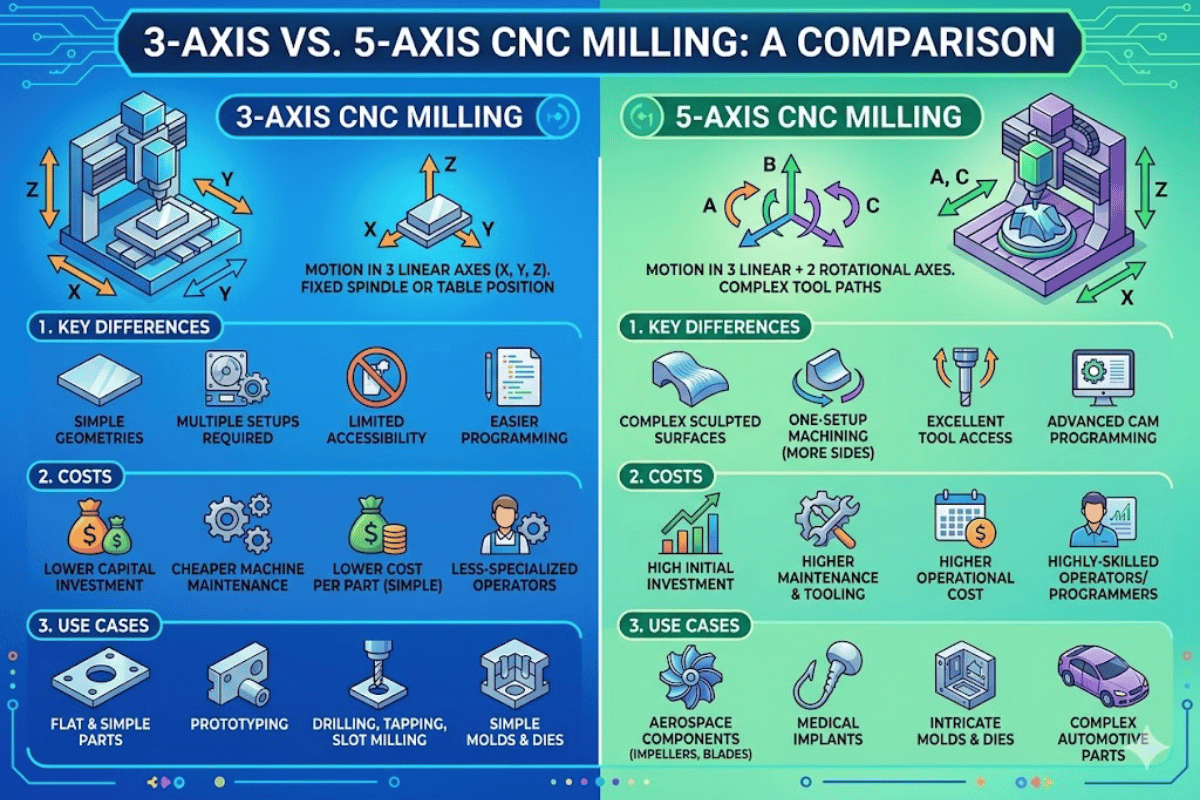
How an axis machine operates: comparing 3-Axis to 5-Axis
Selecting the right axis machine for your part (3 or 5) is one of your most important manufacturing decisions. The wrong machine choice can mean paying for capability you do not need or forced multiple setups that wear out tolerances and increase cycle time. This comparison explains the difference in how each machine operates, at what part cost crossover between the two, and how your part geometry dictates which is right for you.
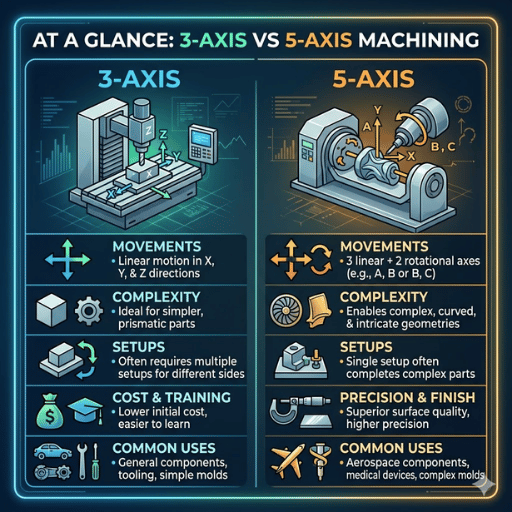
| Criteria | 3-Axis CNC Milling | 5-Axis CNC Milling |
|---|---|---|
| Axes of motion | X, Y, Z (three linear axes) | X, Y, Z + two rotational axes (A/B or B/C) |
| Geometry capability | 2.5D and prismatic shapes | Complex geometries, compound curves, undercuts |
| Setups required | 2-6 per part (reposition for each face) | 1-2 (single setup for most parts) |
| Typical tolerance | ±0.025 mm (±0.001 in.) | ±0.013 mm (±0.0005 in.) |
| Surface finish | 0.8-1.6 µm Ra | 0.4-0.8 µm Ra |
| Cycle time (complex parts) | Longer (multiple setups) | Shorter (continuous machining) |
| Machine cost | $50,000 – $150,000 | $200,000 – $500,000+ |
| Hourly shop rate | $50 – $85/hr | $85 – $150/hr |
| Best for | Flat, blocky parts; high-volume simple milling | Sculptured surfaces; aerospace and medical parts |
The bottom line: A 3 axis CNC machine can complete most milling operations with lower cost. A 5 axis CNC machine will be the right choice when your part geometry requires tool access from multiple angles or if avoiding multiple setups reduces the per part cost below what a 3 axis can provide.
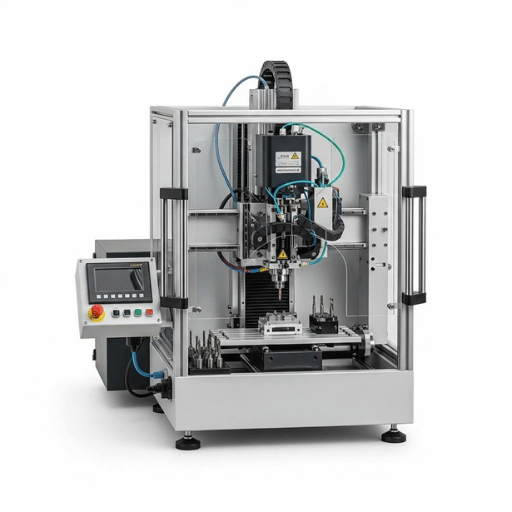
A 3 axis CNC machine moves the cutting tool (or the workpiece table) along three linear axes: X (left-right), Y (front-back), and Z (up-down). The workpiece is mechanically fastened to the table and the cutting tool is moved in the three axes in order to cut away metal.
The biggest limitation of a 3 axis CNC machine is that the tool always approaches the workpiece from one side – usually directly from above. Any features on the sides or bottom of a part, or parts with compound angles, require that the workpiece be unclamped, reoriented, re-etched, and run again. Every reposition adds registration error and increases cycle time.
If your prismatic parts – enclosures, brackets, plates, and housings with features that can be cut from the top – a 3 axis CNC mill is the lowest cost option.
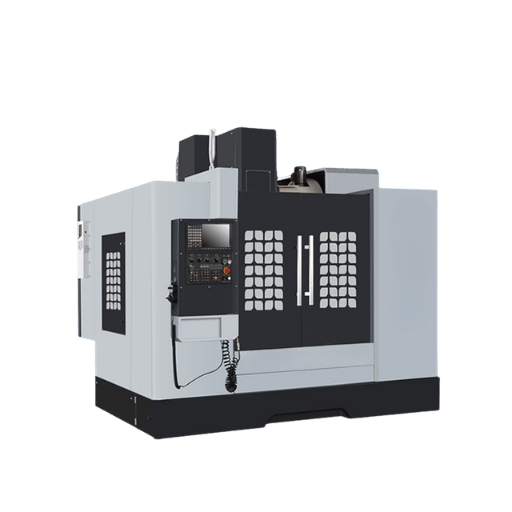
A 5 axis CNC mill adds a pair of rotational axes to the three linear axes. The rotational axes rotate the workpiece (table-table fixture configuration), the spindle head (head-head fixture configuration), or both (head-table), allowing the cutter to approach the workpiece from any angle.
Not all 5 axis is the same. Knowing the differences between 3+2 positional machining and full simultaneous 5 axis machining will keep you from paying for features you do not need.
3+2 positional machining: The 5 axis mill locks the two rotational axes in a predetermined position then mill using the 3 linear axes. The 5 axis head repositions between operations. This is a common method of machining angled flat surfaces such as valves bodies or aerospace brackets with angled bolt holes.
Simultaneous 5 axis machining: All 5 axes simultaneously under CNC program control. The cut tool maintains a continuous, consistent contact with a complex 3 dimensional surface. Impeller blades, turbine blades, and orthopedic implant geometries tend to be typical components that require this capability. Surface finish on complex shapes is best using the simultaneous 5 axis approach since the cutting tool can be tilted for consistent chip load and to avoid the flat spots that ball end mills leave on complex curves.
The 5-axis CNC is fundamentally the only machine where every face of a workpiece can be accessed in one fixturing. The fewer fixturings there are, the less the error buildup, the more precise the limits on associated features, and the faster the overall machining time- especially with parts that on a three axis machine would need 4 or 5 repositionings.
The criteria that are important when choosing the right kind of machine for any project are expanded by the following table offering 15 further needed points.
| Criteria | 3-Axis CNC Milling | 5-Axis CNC Milling |
|---|---|---|
| Axes of motion | 3 linear axes (X, Y, Z) | 3 linear axes + 2 rotational axes |
| Geometry complexity | 2.5D prismatic; limited to one tool approach direction per setup | Full 3D complex geometries, compound curves, sculptured surfaces |
| Number of setups | 2-6 (must reposition for each face) | 1-2 (single setup covers most or all faces) |
| Tolerance (general) | ±0.025 mm | ±0.013 mm |
| Tolerance (cross-setup features) | ±0.05 mm (each reposition adds error) | ±0.013 mm (machined in one setup) |
| Surface finish | 0.8-1.6 µm Ra | 0.4-0.8 µm Ra (optimized tool tilt angle) |
| Undercut capability | Requires special tooling (lollipop cutters) or EDM | Direct tool access through axis rotation |
| Thin-wall capability | Limited — multiple setups risk deflection | Superior — single-setup reduces re-clamping stress |
| Cycle time (simple parts) | Lower (no rotary axis overhead) | Comparable or slightly longer |
| Cycle time (complex parts) | Longer (multiple setups, repositioning) | 30-60% shorter (continuous machining) |
| Programming complexity | Straightforward 2.5D CAM | Advanced 5-axis CAM (collision checking required) |
| Operator skill level | Intermediate | Advanced |
| Machine footprint | Smaller | Larger (rotary table or trunnion adds size) |
| Fixturing cost | Multiple fixtures per part (one per setup) | Single fixture, but may need specialized 5-axis vise or tombstone |
| Material waste | Standard | Potentially lower (near-net-shape approach angles reduce stock) |
| Production volume fit | High-volume simple parts | Low-to-medium volume complex parts; prototyping |

A new 3-axis CNC machine costs between $50,000 and $150,000 depending on table size, spindle speed, and CNC brand. A 5-axis CNC machine costing about comparable $200,000 to $500,000 is available, depending on the market, for high-precision machines with direct-drive rotary axes and linear motors. This initial purchase cost differential is the one main reason 5-axis shop hourly rates are higher, the shop has to repay the investment.
Industry average shop rates for 3 axis milling are $50-$85 per hour. Five axis CNC milling is generally billed at $85-$150 per hour. The range is less in more competitive markets and increases significantly for specialized aerospace or medical work.
The per part cost crossover is the point at which, for the same part, 5-axis milling costs less than 3 axis. Thus:
For parts with more complex shapes that generally take four or more setups on a 3 axis machine, 5 axis milling is sometimes no more expensive per part even when using a higher hourly rate. Looking at flat plates and simple brackets the figure is clear, 3 axis is definite cheaper.
CAM programming of 5 axis work is significantly longer and demands specialized software (purchasing licenses for full 5 axis tool path modules often adds $5,000-$15,000 to the CAM package price). Programming a new 5 axis part might take two to four times longer than programming a similar 3 axis part. This upfront cost has the most impact on one-off prototypes and reduces for larger quantity runs.
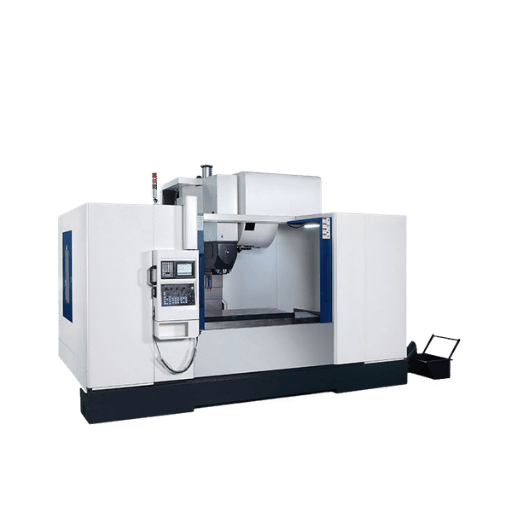
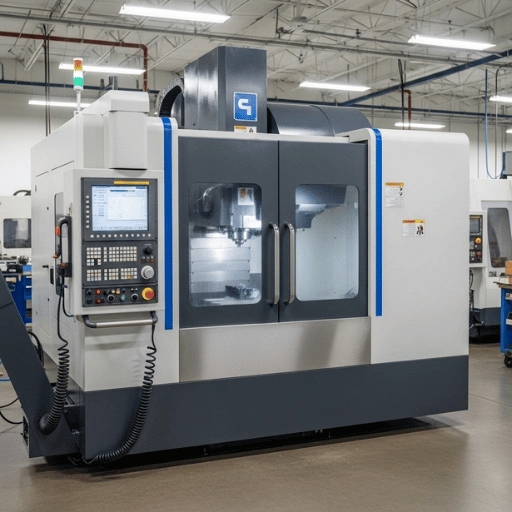
3+2 axis milling (also called positional 5-axis) uses a 5-axis CNC machine but locks the two rotational axes at a fixed angle before cutting with the three linear axes. The machine repositions the rotational axes between operations rather than moving all five axes simultaneously. This approach handles angled features and undercuts without full simultaneous 5-axis programming.
Not always.While the hourly machine rate for a 5-axis CNC machine will usually be higher, it can result in a lower overall part cost for complex shapes by removing the need for multiple setups, less fixturing and a shorter cycle time. 3-axis milling is still the overall lower cost choice for simple, prismatic parts.
A 3 axis CNC mill can produce angled surfaces, but not tilt the tool relative to the workpiece without a tilted fixture or ball-end mills programmed toolpaths. It can usually produce features that require tool access from more than one direction but it will need to reposition the part manually to do so, which will increase setup time and move the part out of tolerance.
The principal industries that exhibit use of 5axis CNC machining are: Aerospace, medical devices, energy (turbine components), automotive (complex engine and transmission parts) and mold and die manufacturing. These industries produce parts that require complex 3-D surfaces for aerodynamics or optimal tensile properties that are best produced with simultaneous multi-axis cutting.
Assess the part first: if it can be machined on a 3 axis mill without repositioning, then do it with a 3 axis mill. If it has commercial features such as complex angles, contours or undercuts, then 5axis machining will give better results in less time. Volume also factors in: for the highest volume, simple parts, a 3 axis machine should minimize the cost per part, for the higher value complex parts, then the lower setup time for 5 axes make it pay for itself.
Looking for a quote for precision milled parts – 3 or 5 axis?
Related: 5-Axis CNC for Complex Aluminum Components · 5-Axis Carbon Fiber Machining · All CNC Machining Services