

Supportive, Professional, Client-Focused Service
From prototypes to full-scale production, we’ve got you covered.



PEEK for Precision Components: How to Decide When It Wins (and When It Doesn’t)
Why choose PEEK for your precision components? Because the answer counts: this high-performance thermoplastic runs continuously to 260°C, holds tolerances of ±0.0005″, and survives aggressive chemicals that wreak havoc with aluminum and stainless steel — but it also costs 10-100× per kilogram more than commodity engineering plastics. Used properly, PEEK triumphs; used improperly, it bleeds budget for no gain. Here follows an outline of how properties, grade choice, machining needs, real-world applications, and PEEK’s points of overkill fit together in the engineer’s decision.
| Chemical Name | Polyether ether ketone (PEEK) |
| Tensile Stress (Yield, 2³°C) | 98 MPa (ISO 527-2) |
| Fle×ural Modulus | ³,800 MPa (ISO 178) |
| Glass Transition (Tg) | 150°C (ISO 11³57-2) |
| Melting Point (Tm) | 343°C (ISO 11357-3) |
| Continuous Service Temp | 260°C (UL 746B RTI Electrical) |
| HDT @ 1.8 MPa (Unannealed) | 152°C (ISO 75-2/Af) |
| Density | 1.30 g/cm³ (ISO 1183) |
| Water Absorption (24h) | 0.45% saturation (ISO 62) |
| Achievable CNC Tolerance | ±0.0005″ ultra-precise / ±0.001″ precision / ±0.005″ standard |
Values taken from Victre× PEEK 450G technical datasheet. Filled grades (GF30, CA30, HPV) may e×hibit different values – see grade selection discussion below.
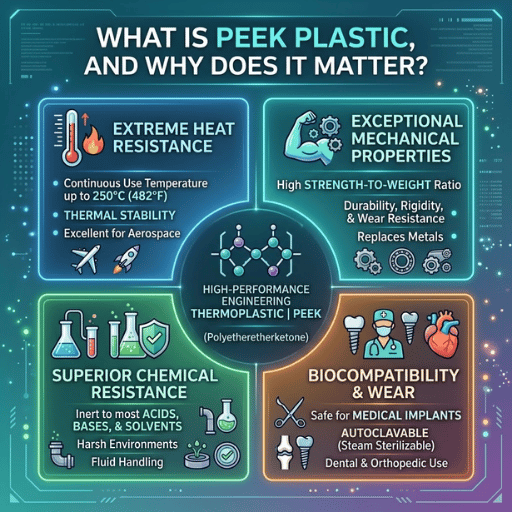
PEEK pronounced just like the letter “K” and officially polyetheretherketone is a crystalline high-performance plastic in the polyaryletherketone( PAEK) family. The regularity of the ether and ketone in the main chain which join the aromatic rings imparts PEEK with high-temperature stiffness and long-term chemical stability when it is used in applications where corrosive fluids are present. Conventional plastics engineers position PEEK as a high-performance class above engineering level plastics such as polyamide or polycarbonate.
The unique combination of properties that makes PEEK a high-performance plastic rather than just another engineering thermoplastic is comprised of many contributing factors. Polyamides react to some solvents; polycarbonates respond to impact; PTFE tests to temperature. PEEK can handle them all while remaining dimensionally stable. For some examples ofwhereA high-performance polymer like PEEK tends to show up in the design specifications, look here.
The price premium and high temperature processing needed for PEEK gave engineers its use in applications where it was really required-including just what one doesn’t. Artificial joints, wafer-chucker parts, high-altitude avionics case parts, and oil-well sensorsuse high-performance polymers where in-body degradation or high-calorie high-velocity environments threaten.
Choose correctly, and PEEK earns its keep with problems requiring simultaneous high services, aggressive medium resistance, and high mechanical loads. One missing, and other plastics probably have it beatyou just might not realize it.

The benefits of PEEK are measurable with six properties that can each be verified to an ISO test method. They are listed below, followed by descriptions of the particular design insight they offer the engineer.
PEEK continues to perform in mechanical characteristics ranges where most plastics flunk out: tensile and flexural strength to continuously at significant parts of the temperature. Zero fillers,and virgin resin grades of PEEK hold on to a recorded flexural modulus limit of 3650 MPa (ISO 178) to 125 C, while polyamide 6/6’s ranges of tensile strength and modulus range away when the temperature reaches 70 C. It’s this long-term stability that enables PEEK parts to survive in turbine inlets, semiconductor chambers, and oil-pumping filter brackets where ambient temperature far surpasses 200 C.
PEEK is hydrocarbon- and organic solvent-resistant and stable to most acids and alkalis without dimensional change. Its power lies in its minimal chemical reactivity: none of the chemical limitations actually matter, except concentrated sulfuric acid at elevated temperature and aggressive halogenated solvents at elevated temperature. It is this chemical stability that allows PEEK to be used in valve seats for oil-and-gas control, sealing elements in chemical process-plant pumps, and chromatography phases in laboratory instrumentation. The significance is this: aluminum 6061 corrodes under those exposures; stainless alloy 304 resists corrosion but rusts in chloride-rich service.
At 1.30 g/cm³, PEEK weighs less than half what aluminum 6061 (2.70 g/cm³) and one-sixth what stainless steel 316L (8.0 g/cm³) does, yet can be produced to hold and deliver a tensile yield of 98 MPa and flexural modulus of 3,800 MPa in unfilled grade. Reinforced grades push this tensile strength up to 270 MPa with carbon-fiber reinforcement. The upshot is strength-to-weight ratios below those of many metals: aerospace brackets, lightweighted transmission components, robotic end-of-arm tooling where every gram reduction reduces cycle time.
PEEK’s moisture gain at saturation (ISO 62) is on the order of 0.45% – a tenth of polyamide 6/6. That combine with creep resistance at elevated temperature helps give PEEK its suit of dimensional stability that will pass tolerances under humid manufacturing environments and thermal cyclic conditions. For the engineer wishing to specify a 0.001″ guide dimension on a delicate PEEK bushing, it is property that will help decide whether the part meets spec or drifts out within a few months.
Modified grades of PEEK — particularly the HPV grade reinforced with PTFE and graphite – can achieve self-lubricating behaviour with coefficients of friction much below oil-filled Engineered Plastics. That low coefficient of friction makes PEEK a standard choice in bearings and other sliding components subject to continuous load. For closed-running applications where greasing is prohibitively difficult (e.g. food-contact, vacuum operation, semiconductor cleanroom activity), self-lubricating PEEK can outperform bronze or filled-PTFE solutions.
Per some modified grades – PEEK-OPTIMA, Zeniva – pass ISO 10993 tests of biocompatability for systemic toxicity, sensitivization, and cytotoxicity, qualifying them for implant interaction. PEEK can be engineered to match the elastic modulus of cortical bone – 10-30 GPa – unlike titanium 102-103 GPa, minimizing the effects of stress shielding in load-bearing applications. This biocompatability, combined with the radiolucency that allows X-ray diagnostics without metal artifact, makes PEEK very popular with spinal fusion cage manufacturers these days.
📐 Engineering Note
When specifying PEEK against a polyamide or acetal alternative, ask for the ISO 75-2 HDT value at 1.8 MPa. A maximum of 0.45 MPa oversells lower-grade plastics; you won’t believe the 1.8 MPa performance until you see it in service.
PEEK isn’t one material, it’s a family of materials with differing properties. Comparing material grades to pick a grade is more common than choosing the base resin first. The five grades detailed below capture about 90% of precision component applications, and the following pattern will be evident whether the parts are intended for use in medicine, aerospace, or anything in between.
| Grade | Key Upgrade | Best For | Trade-off |
|---|---|---|---|
| Virgin PEEK 1000 (unfilled) | Balanced baseline; best machinability | Medical implants, electrical insulators, general use | Lowest stiffness in family |
| PEEK GF30 (30% glass-fiber) | Stiffness ↑, dimensional stability under load | Structural housings, load-bearing brackets | 50-70% faster tool wear vs unfilled |
| PEEK CA30 (30% carbon-fiber) | Tensile to ~270 MPa, modulus to 28 GPa, lighter than GF30 | Aerospace structural parts, robotic arms | PCD tooling required; brittle chip behavior |
| PEEK HPV (PTFE + graphite + carbon) | Self-lubricating; low friction, high wear resistance | Bushings, seals, sliding components, dry-running bearings | Lower tensile than reinforced grades |
| Medical Grade (PEEK-OPTIMA, Zeniva) | ISO 10993 + USP Class VI compliance, full lot traceability | Spinal cages, cranial implants, dental abutments, surgical instruments | 2-5× cost of standard grades; cleanroom machining required |
Choose by failure mode: go GF30 if the part will bend, go CA30 if the part will be heavy, go HPV if it will wear/seize, go medical-grade with complete traceability if it’s going inside a body. Virgin PEEK is the best option when none of those failure modes dominates – and that gray area is where we want to push the baseline before starting to pay the reinforcement premium.
“Customers frequently default to use medical-grade PEEK for non-implant parts, because it’s often seen as a safer regulatory grade for plastics. In general, virgin PEEK 1000 reliably holds tolerance and passes the application, so you’ll save 60-70% on raw material cost. Match the grade type to the actual expected failure mode, rather than the deep comfortable gray zone of procurement.”

PEEK exerts its influence in five industrial sectors where its unique compound of properties really does resolve a problem no commodity plastic can address. The list of custom grades is different in each market, and the samples listed below are the parts lists which illustrate what sorts of materials each industry actually sources. The case studies are representative of the precision PEEK projects we developed within the last two years.
The stability, radiolucency, and ability of PEEK to withstand repeated autoclave cycles make it the plastic of choice for producing cranial reconstruction implants, reusable surgical devices, dental abutments, and spinal fusion cages, etc. The elastic modulus of virgin PEEK roughly mimics that of cortical bone, providing clinical benefits over titanium that result in reduced stress shielding. Surgical devices machined from PEEK endure multiple steam sterilizations with no loss to constituent strength, while replacing metal handles that generated heat through conduct ion to the surgeon’s hand.
📐 Case Study — Medical Endoscope Components
A medical device OEM approached us with a 22% reject rate on machined PEEK endoscope components – certain parts were leaving the machining process outside of specification. We applied a multi-tiered controlled annealing process (150200 °Celsius) prior to final finishing passes, and brought the rejects down to 0.8% in four successive runs, with per-unit cost reduced 18% due to lower re-work throughput. The lesson learned here: when working with PEEK, annealing form-cycle becomes a process variable, not just finishing procedures.
In aerospace design, PEEK is being substituted for aluminum 6061 in brackets, connectors, fluid seals, and interior aeronautical components – any application where less weight means less fuel consumption. Carbon-fiber fortified PEEK(CA30) can even balance aluminum’s stiffness performance with half the weight to cut a design weight budget in half, and its superior chemical stability with jet fuel and hydraulic fluids removes the corrosion failure mode typical of aluminum.
📐 Case Study — Aerospace Bracket Conversion
A tier-one aerospace manufacturing company needed us to modify aluminum bracket systems to PEEK CA30 to meet an overall weight goal. Finished brackets eliminated all aluminum fittings and were 42% lighter for the same delivered stiffness. The biggest bonus: tool cost declined 93%, again via the lower rigidity requirements of PEEK compared to aluminum to produce allowable tolerances, both savings evidently combined in the quote per piece.
The semiconductors industry requires polymers that maintain tight tolerances, withstand harsh process chemistry, and do not shed metal ions into the wafer environment. PEEK excels in all three areas. Typical uses are wafer carriers, end-effectors, ESD-safe handling components, chamber parts exposed to process gas, microfluidic tubing for chemical delivery systems. It is the thermal cycling stability that allows PEEK to hold flatness specifications that PTFE or polypropylene cannot.
📐 Case Study — Semiconductor Wafer Handling
A semiconductor equipment OEM targeted 0.05 mm flatness on a wafer handling component that ran in an ISO Class 6 cleanroom. We brought our cleanroom-isolated PEEK cell and produced a finished part that was 0.03 mm flatness, held that tighter dimensional tolerance, and produced no detectable metal ion contamination on post-machining bioburden testing. Local tooling segregation and dedicated PEEK fixturing eliminated the cross contamination risk that a shop working on shared equipment cannot fully mitigate.
Downhole tools and surface equipment in oil and gas service be subjected to high pressure, high temperature, and aggressive fluid chemistry simultaneously – precisely the set of conditions PEEK is designed to work in. Typical applications are valve seats and backup rings, pump components, compressor parts, and sealing elements where elastomers have high temperature limitations and metals are limited by harsh chemistry. The combination of high mechanical properties and chemical stability is what makes PEEK the ideal choice here.
Automotive applications- especially in electric vehicle powertrains where weight reduction and high temperature environments converge- are driving PEEK usage into motor gears, thrust washers, sensor housings, and electrical connector bodies. The 11.6% CARG(e) in automotive PEEK applications, driven by EV lightweight programs, represents one of the most rapidly-growing applications segments of this high-performance polymer.
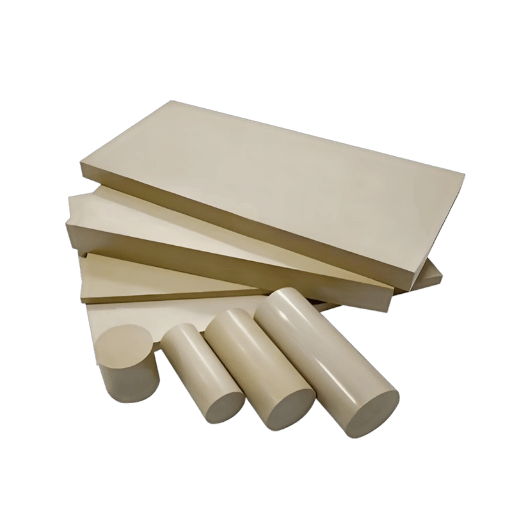
Machining PEEK is not as difficult as machining titanium- it is difficult differently. The issues with PEEK are that it is softer than metals, harder than commodity plastics, and isolates heat poorly (thermal conductivity of about 0.29-0.32 W/m·K, ISO 22007-4). The heat that cannot escape through the chip goes into the workpart and results in hot spots above its glass transition temperature, causing warpage and dimensional instability. The four parameters that separate a PEEK part that will hold 0.0005 tolerances from one that just looks acceptable before Friday are annealing, speeds & feeds, tooling, and coolant.
Residual stress present in extrusion- or molding- grades arrives with PEEK stock. Cutting into a stressed part relieves stress differently than cut into the stress-free original, resulting in twisted parts. Typical annealings involve a ramp at 10C/h (around 200-250C for 3-4 hours minimum, or 4 hours of soak per inch of wall thickness of thick sections) and a slow cool. Heavy roughing is followed by a tight-tolerance finishing pass, which uses intermediate annealing to eliminate part movement that inevitably occurs if you do not re-anneal between operations. Annealing after roughing before finishing is the most common problem in out-of-tolerance PEEK parts.
Engineers on machining forums frequently post: “working on machining PEEK and getting PEEK warpage in the middle of the job.” What’s the most useful troubleshooting comment, echoed time and again by senior machinists on Practical Machinist threads? If your PEEK is warping, you are burning it – time for heat to be the issue, not the housing tolerance.
| Operation / Grade | Cutting Speed | Feed | Tooling |
|---|---|---|---|
| Turning, unfilled PEEK | 300-800 SFM (100-300 m/min) | 0.004-0.025 IPR | C-2 carbide |
| Turning, GF30/CA30 | 120-180 SFM (50-120 m/min) | 0.004-0.012 IPR | PCD inserts (mandatory for production) |
| Milling, unfilled PEEK | 270-450 SFM (82-137 m/min) | 0.002-0.008 in/tooth | 4-flute carbide, climb milling |
| Milling, reinforced PEEK | 165-395 SFM (50-120 m/min) | 0.002-0.008 in/tooth | PCD or DLC-coated carbide |
The real, practical answer is: PEEK is asemi difficult material, with most of its difficult in heat management and tool selection. Unfilled PEEK cuts or machines with sharp, C-2 carbide, especially with good coolant – 0.8-1.6 mRa finishes are standard, and 0.001 tolerances are reliable in production. Reinforced grades change the calculations: carbond and 30% glass fibers added to PEEK cut tool life times by50 to 70%, so investing in PCD (polycrystalline diamond) tooling makes obvious economical sense for any volume above prototype. Medical-grade PEEK for implant applications adds another dimension: contamination prevention — dedicated equipment, validated coolant cleanup or dry machining, with full lot traceability under ISO 13485.
The decisions you make around coolant medium are more important than you might realize. Most operations benefit from the use of flood coolant water-soluble or petroleum-based, extending tool life, providing better surface finish, and improving dimensional accuracy. For implant-quality precision parts, however, dry machining using cold-air cooling delivers the best results, without risking to contaminate the polymer surface with the coolant. The right choice becomes clear: will the component be implanted or must it simply carry tolerances?

The quickest way to determine if PEEK or another alternative should be your choice is to look at the properties of each material you might consider, across the parameters that really influence the application. The table below summarizes the four options most relevant in comparing with PEEK in precision components.
| Property | PEEK | PTFE | PA66 (Nylon) | Aluminum 6061 | SS 316L |
|---|---|---|---|---|---|
| Continuous service temp | 260°C | 260°C | ~90°C | ~150°C | >500°C |
| Tensile yield strength | 98 MPa | ~25 MPa | ~80 MPa | 276 MPa | 170 MPa |
| Density (g/cm³) | 1.30 | 2.20 | 1.14 | 2.70 | 8.0 |
| Chemical resistance | Excellent | Outstanding | Moderate | Weak vs alkali | Excellent vs aqueous |
| Wear resistance | High (HPV self-lubricating) | Low | Moderate | Low | Moderate |
| Biocompatibility (ISO 10993) | Yes (medical grades) | Yes (specific grades) | Limited | No | Yes |
| Material cost (relative) | $$$$ | $$ | $ | $$ | $$$ |
| Machinability | Moderate | High | High | High | Moderate |
Based on mechanical properties like tensile strength and indifference – yes. As the tensile strength of each material is dramatically different, where there is a load to carry, PEEK will perform, with a tensile strength of 98 MPa compared to approximately25 MPa in PTFE,and an elastic modulus of 3.6 GPa verses 0.5 GPa. However, where line of best fit to be chemical inert against the most aggressive oxidizers, youwill reach for PTFE- PEEK can’t carry mechanical loads so isn’t suitable where anything need to do either. The rule of thumb: if the part needs to wear or flex, PEEK will be the choice, if it needs to be inert to chemicals and lightly loaded, PEEK will be the choice; for a detailed analysis of PEEK-v-metal applications, refer to our comparison of PEEK versus metal.
In terms of absolute strength and stiffness, neither material; Ti offers greater, PEEK offers an inherently lower weight for the component, reduced radiation opacity, and extreme chemical inertness to a different set of chemicals. For structural implants, where stress shielding and so in part, PEEK performs, but for structural aerospace components, where absolute strength is critical, Ti prevails. Looking at the typical cost-per-pound of raw material, the price advantage is not significantly different between the two options: PEEK bills at your lab range from $50 to 150/lb depending on grade, while Ti costs $15 to 30/lb. The benefit to PEEK is its lower specific weight and easier machinability, which if analyzed more accurately will often produce parts with a lower cost.

Material specifiers default to PEEK because it feels like the safe decision. Trouble is that safe rarely equates to right: it is common for PEEK to be over-specified-the polymer then resides in applications hardly reaching into its property envelope, with procurement bearing a cost premium for no performance benefit. Industry plastics distributors acknowledge and discuss openly that engineers specify PEEK “just in case” rather than where the material is actually needed.
This is a guide we use to identify “bad” applications of PEEK where other plastics may do just as well before costing any quote:
The 60/40 Rule for PEEK Necessity
If your continuous service temperature is less than 60% of PEEKs HDT (155 60/ 150C) and chemical exposure is mild (oils, hydraulic fluid, common solvents, no strong acids) then expect a high chance of failure. A polyamide 6/6, acetal, or PEI should perform adequately at 10-30% of PEEK’s per-pound cost.
On the other hand, if your sustained service exceeds 60% HDT and you have combined chemical-plus-thermal exposure then PEEK becomes hard to substitute.
PEEK performs where at least two of the following apply: continuous service above 150 C, continuous mechanical stress above 150C, meeting both extremes of chemical and thermal conditions (hydraulic oil and heat, acid and stress), mandatory tight tolerances through out the thermal cycle, medical-grade requirement (medical implant, food contact, aerospace material traceability), or radiolucency for medical imaging. The one condition justifications- “requires chemical resistance,” “requires heat resistance”- tend to be smaller input values in comparison. Combined-stress justifications point to PEEK.

Material cost alone drives PEEK selection. Price benchmark below, typical for start of 2026, note on date stamp. Petroleum input factor pricing fluctuates daily.
Three factors influence PEEK pricing. To start with, the input materials- the diphenyl ether monomer and subsequent synthesis are quite costly when produced at a commercial scale, and just a small number of cycle-optimized companies (Victrex, Solvay, Evonik, and the relatively small Chinese players) actually hold the material economics-commercial pressures toward elevated pricing. Secondly, machining costs- PEEK reinforced with carbon fibers has 50-70% higher tool wear rates in practice than commodity plastics as it wears out tools more rapidly and takes 50% longer to machine due to the need to mitigate heat. These costs flow through into the per part price point. The third element is supply chain issues- lead times for medical applications can extend up to 12 weeks or longer in periods of supply/demand imbalance, and regulatory rolling updates are naturally slower because fewer suppliers have validated their process.
The long-term PEEK industrial cycle is steadily upward, with projections aligning about a 5.75-7.5% global CAGR through 2030-2032 and regional peaks in North America, led by industry. Nonetheless, beneath the headline numbers, two usage drivers are exerting even greater upward pressure: the medical use case (CAGR 11.5%) and the auto EV lightweighting factor (CAGR 11.6%). For medical PEEK procurement groups deploying 2026-2027 PEEK budgets, those real-world numbers exist as concrete, precise signals.
| Forecast Metric | 2025 Value | Forecast (2030-2033) | CAGR |
|---|---|---|---|
| Global market value | $1.50-1.63 billion | $2.14-2.41 billion | 5.75-7.5% |
| Global volume | 8.47 kt | 11.62 kt (2031) | ~5.4% |
| North America | ~$335M | N/A | 8.4-9.5% |
| Medical segment | — | — | 11.5% |
| Automotive (EV-driven) | — | — | 11.6% |
Three time-dated lessons. One, the PEEK expected to match FDA 510(k) implant clearances is clearly in pinch position through 2026 H2 as the backlog clears out and OEMs restock safety stock – fast-track suppliers for best price. Two, auto EV lightweighting demands come in 2027 as next-gen drivetrain programs arrive at scale – procurement teams still walking in the door who haven’t secured PEEK suppliers by mid-2026 are in for a tight market. And three, the premium between regular and reinforced grades is shrinking as carbon fiber costs flatten – smoothing the introduction of CA30 specifications to applications that couldnt justify the expense two years ago.
In addition to pricing, the the technology curve’s bold outline is evident: 3D-printed PEEK is gaining adoption from prototype-only use into the short-run production of specific ERU components, and PEEK derivatives (carbon-reinforced and glass-reinforced) are evolving into key aerospace structures long-noted as aluminum and titanium replacement applications. Both trends favor manufacturers with well-developed powder/filament handling infrastructure and an extended certification portfolio.

Le-creator has its own PEEK CNC machining facility, which includes 5-axis mills, Swiss type CNC-lathes, ISO Class 6-7 cleanroom facility, as well as a full grade stock supply (Virgin PEEK 1000, GF30, CA30, HPV, PEEK-OPTIMA, Zeniva). 17 years of experience in Medical, Aerospace, Semiconductor and Oil & Gas markets.
Written based on Le-creator’s 17 years of PEEK CNC machining experiences in medical implants, aerospace structural brackets and semiconductor wafer-handling components as shown in three above case studies. Material data is quoted against Victrex PEEK 450G technical datasheet (ISO 527-2, ISO 178, ISO 75-2, ISO 11357, UL 746B). Market & pricing information is matched with MarketsandMarkets, Mordor Intelligence and BIS research market forecasts (2025-2032).
Technical content reviewed by Le-creator engineering team with (ISO 9001:2015 & ISO 13485) under ITAR & AS9100D registered quality system.