

Supportive, Professional, Client-Focused Service
From prototypes to full-scale production, we’ve got you covered.


How Much Does PEEK CNC Machining Cost? A Grade-by-Grade Price Breakdown
| Material | PEEK (Polyether Ether Ketone) |
| Typical Cost Range | $50–$300+ per part |
| Material Cost | $40–500/kg by grade |
| Achievable Tolerance | ±0.001″ (±0.025 mm) |
| Ma× Operating Temp | 260°C (500°F) continuous |
| Common Grades | Virgin, GF30, CF30, Medical |
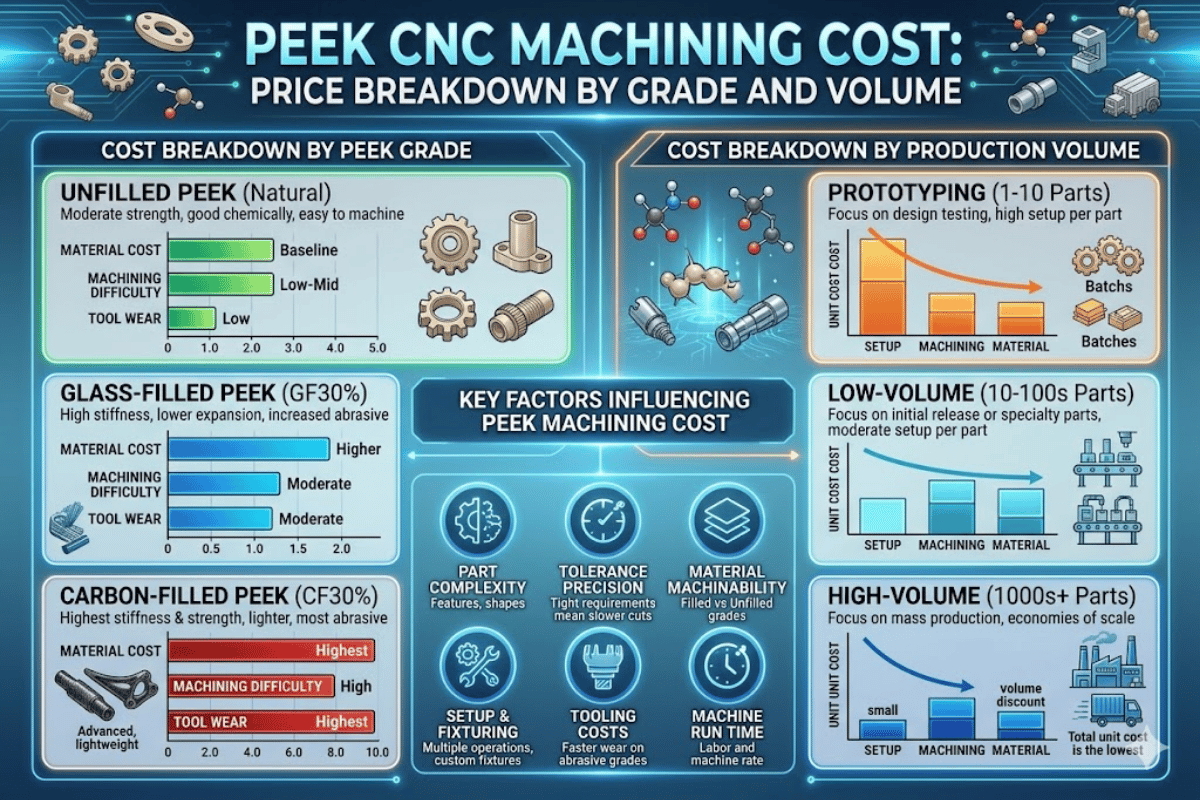
PEEK CNC machining price and cost is a surprise for many engineers. To produce one prototype part at zero volμme, prices can range from 50 to many hundreds of dollars, and the final price depends on factors that are not immediately transparent – particularly, the grade of PEEK used. In this article, we e×amine real-world costs for virgin, glass, and carbon-filled PEEK, provide insight into how part comple×ity and volμme impacts the cost curve, and outline practical techniques that field applications engineers employ to minimize per-part costs without compromising quality.
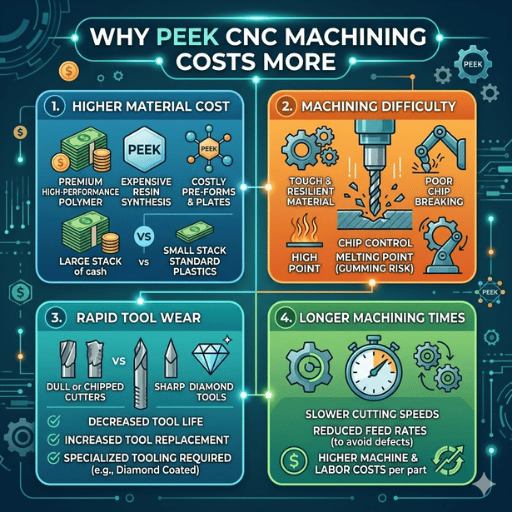
The PEEK CNC machining price premiμm over standard engineering plastics is significant, but not for the reasons that new buyers e×pect. The polyether ether ketone family of semi-crystalline thermoplastics survives continuous 260C (500F) operation with superior mechanical properties, high strength, and high temperature stability. Such performance comes with a lofty price tag, but it may not be the most direct costs you will incur.
Raw stock is the true cost influence, not the machining effort. Market-based data indicate, that PEEK stock ranges from 40-500 per kilogram depending on grade and form, opposed to 5-15/kg for Delrin, pro×imately a 10x premiμm – pre-cutting! Based on publicly available machinability factors, PEEK’s relative machining cost is on the order of 0.9 versus 12L14 free-machining steel (or rated at 1.0). In actual practice, PEEK machines almost as easily as, modest automotive mild steel – a circumstance that seems to dispel the population-wide misconception that PEEK is a difficult and demanding thermoplastic to machine.
That is not to say, that PEEK enters the shop without other additional machining concerns. Its heat resistance and low thermal conductivity urge slower machining speeds to keep heat from building up between tool and workpiece. Usually, machinists reduce feed rates by 20-30% to that of acetal or nylon, which can increase machining time noticeably. Filled grades, especially carbon fiber reinforced PEEK, will speed up cutting tool wearby 2-3 times, driving up tooling costs. These three factors of material price, cutting speed, and tool life are thus responsible for higher machining costs in PEEK’s high-volume CNC machining service costs.
Summary for the cost conscious: Budget 50-70% of a PEEK part’s overall production cost for the raw stock component. Easier machining process control techniques are secondary. The salient decision is grade choice.

PEEK prices are a function of grade and form factor. Picking the right one is critical to end cost control. Virgin PEEK stock product costs range from 100-250$/kg, while space or medically certified materials can surpass 500$kg. Ascertaining of the merits to invest in the most expensive PEEK product that you actually need is essential to cost savings.
| Grade | Cost/kg (Rod/Sheet) | Key Properties | Typical Applications |
|---|---|---|---|
| Virgin (Unfilled) | $100–$250 | 100–115 MPa tensile, excellent chemical resistance | General mechanical, food processing |
| GF30 (30% Glass Fiber) | $150–$350 | Enhanced rigidity, dimensional stability | Aerospace brackets, industrial wear parts |
| CF30 (30% Carbon Fiber) | $200–$450 | Highest strength-to-weight, electrically conductive | Semiconductor, aerospace structural |
| Medical (ASTM F2026) | $150–$500 | ISO 10993 biocompatible, USP Class VI | Spinal cages, dental implants, surgical instruments |
Virgin PEEK is well-suited for most general machining needs where chemical resistance, high-temperature operation, and low coefficient of friction are desired but the appplicability is not so severe as to require high mechanical loading. Filled PEEK, reinforced with either glass or carbon fibers, fulfills specific aerospace and medical needs where machining of PEEK demands dimensional stability and increased stiffness without the high cost. Others such as GF30 – filled with 30% glass-fiber – representative offers improved stiffness over virgin PEEK without the full cost increment that pure CF30 exhibits.
Strip grade Peak economy Pure (Virgin grade) has the lowest price, Cheapest Medical grade PEEK has the highest price. The pricing of medical grade PEEK is highest because of its traceability requirement, biocompatibility certification ASTM F2026 and ISO 10993, and the low number of suppliers. For some applications which do not require the implant-grade certification, change from medical to virgin PEEK will reduce the overall cost by 50-70%.
📐 Engineering Note
Pellet prices are much lower ($40-150/kg) than for rod/sheet stock as they have to be processed further into machinable parts. It is worth checking whether a quote is based on pellet or semi-finished stock, this alone can make a 2 wide gap in quoted material price. The use of rod/sheet stock for plastic CNC machining is by default.
※ Please note. These ranges of prices are accumulated from several industrial sources and distributors’ price lists, so the actual prices will differ depending on the supplier, order quantities, and market situation.
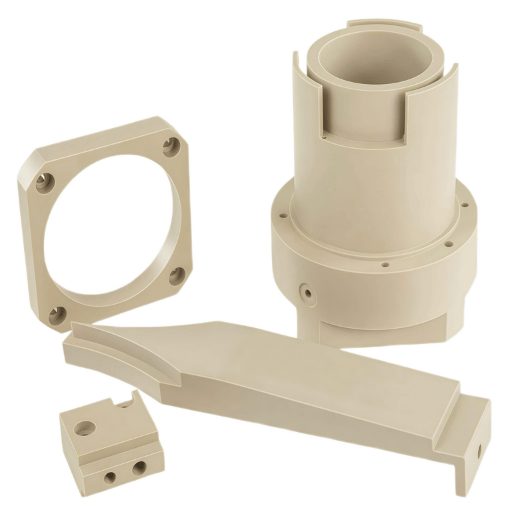
In addition to grade material, three machining parameters will determine what CNC machining requires in terms of PEEK part cost: dimensional tolerances, geometrical complexity and surface finish requirement. These parameters all have differing impacts on machining time, fixturing requirements and number of set-ups that result in a p ART cost.
📐 Engineering Note — Tolerance Tiers and Cost Impact
Standard: ±0.005″ (±0.127 mm) — baseline machining cost, achievable on most 3-axis CNC equipment.
Precision: ±0.001″ (±0.025 mm) — adds 15–30% to machining cost; may require annealing between operations.
Ultra-precision: ±0.0005″ (±0.013 mm) — adds 40–60%; demands climate-controlled environment, specialized fixturing, and post-machining stress relief.
Part geometry defines 3 vs. 5 axis machining. Straight forward prismatic parts with features on one or two faces are worked on a conventional 3 axis mill or lathe at $35-140/hr (=US machining centers) or $15-35/hr (=Asia). Complex shapes, dual-angle threaded holes, undercuts and thin-walled features drive machine time into the ‘5 axis’ range at $75-250/hr domestically or $20-80/hr from Asian suppliers.
Five axis machining requires increased programming time, special fixturing and increased setup time, but it can dramatically decrease total part costs by eliminating multiple setups and part repositioning error.
Surface finishing is another factor. The regular machined finishes Ra 1.6-3.2meters are assumed to be included at no extra cost in the stated machining costs. A polished finish Ra 0.2-0.4 meters is an additional operation and adds an additional 20-40% to the machining costs.
PEEK polishes well but each additional operation increases handling and machining time.
Annealing is often omitted from PEEK costings. When machined, PEEK is prone to buildup of internal stresses, leading to dimensional changes following machining, especially where tight tolerances are specified. Annealing at 200 C after machining can relieve these stresses; this process costs between $15 and $50 per batch and increases the lead time of the batch by 1 to 2 days.
In order to produce highly accurate PEEK components, annealing is performed (between roughing and finishing passes) on most of the high-precision PEEK parts; This adds many tool-changing and setup steps to the production of these parts.
Leave tight tolerance only on mated faces and critical dimensions. field engineers are told, if a feature is not critical, making that feature 0.001 0.005 looser in machinability will cut machining cost by 15-25% for an average PEEK part because you would not have to do a finishing pass and heat treatment cycle.
PEEK CNC machining cost will significantly decrease as the size of the production run rises. A prototype component costing $200 each at 5 pieces could be priced at between $30 and $50 at production quantities. Table 3 below shows indicative pricing at three levels of production run based on assembler quotes, machinist forums and benchmarking reports:
These figures show indicative values for the three levels of production run.
| Production Tier | Qty Range | Price per Part | Lead Time | Key Cost Driver |
|---|---|---|---|---|
| Prototype | 1–10 pcs | $80–$300+ | 3–7 days | Setup time, no tooling amortization |
| Small Batch | 50–500 pcs | $20–$120 | 2–4 weeks | Tooling amortization, reduced setup/part |
| Production | 1,000+ pcs | $8–$60 | 4–8 weeks | Economies of scale, automated processes |
Prototype-to-production cost delta on PEEK versus commodity polymers is even more striking. All setup, programming, and first-article inspection costs are amortized over only a handful of CNC machined parts during the prototype phase, of course, but when volume hits the hundreds-off count these fixed costs become insignificant per piece and production shops can cycle lights-out machining runs that cut both machining time and machining cost further still.
For some perspective, machinist questions posted on industry forums (including, for example, the MACHINIST Facebook group) reveal U.S. machining shops quoting $150-600 a piece for low-volume 2 diameter machined PEEK parts of moderate complexity. Asian manufacturers quoting the same geometry tend to be 2-4 lower – not necessarily quality, but certainly cost. The difference would be explained simply by cost structure (and the remaining competitive carves of the world) if a shop could demonstrate successful PEEK machining experience.
When all-in production cost estimates rise above 500-1,000+ pieces of a single part, injection molding is worth considering. PEEK injection molding requires specialized high-temperature molds (tooling costs at $15,000-$50,000+) but cost per unit drops to roughly $3-15, depending upon geometry. Breakeven will be heavily influenced by part complexity: simple shapes (candlestick helical flutes, for example) may make molding justifiable at less than 1,000 parts, while complex geometries with tight tolerances and interfaces can be CNC machined up to 2,000+ parts before the costs will equalize.
Be sure to obtain pricing quotes at multiple volume breaks ($10, $50, $250, $1K) prior to commitment on a quick-turn prototype job to understand the volume-to-cost relationship and the financial mind-trips required to promote larger production quantities.
Please note that these ranges are estimates based on industry data and machine shop quotes. Factors such as part geometry, machining tolerances, PEEK grade used, and exact services required will affect actual CNC machining costs.
For production-ready quotes with guaranteed tolerances, CNC machining specialists in PEEK can offer a line-item breakdown by material grade, machining costs, and secondary finishes or treatments.

In some situations PEEK is simply not an absolute requirement. Before paying a premium for expensive machining services on a $30 plastic, be sure to evaluate whether a less-costly engineering thermoplastic can provide equal function. To guide the choice, here are five thermoplastics drilled and machined to comparative strength, chemical, fire, and temperature standards.
| Property | PEEK | Delrin (POM) | Ultem (PEI) | PTFE | Nylon 66 |
|---|---|---|---|---|---|
| Material Cost/kg | $40–$500 | $5–$15 | $25–$80 | $15–$40 | $3–$10 |
| Max Continuous Temp | 260°C | 90°C | 170°C | 260°C | 80°C |
| Tensile Strength | 100–115 MPa | 69–80 MPa | 85–120 MPa | 20–35 MPa | 70–85 MPa |
| Machinability | Moderate | Excellent | Good | Difficult (soft) | Good |
| Typical Hourly Rate | $50–$200 | $30–$80 | $40–$120 | $35–$100 | $25–$70 |
| Best For | High temp, medical, aerospace | Gears, bearings, general | Electrical, medical housings | Chemical, low friction | Cost-sensitive structural |
The relative machinability of PEEK is moderate: it will cut cleanly with a carbide router, but feed rate and coolant strategies will need optimization for effective material removal. Delrin (POM), however, machine is one of the easiest plastics around – quite soft, with commensurate tight-tolerance stability and chip formation. PTFE materials tend to be on the other end of the spectrum: soft and easy to work, but significantly prone to deformation under the cutting tool’s pressure which demands slower operation and longer cycle times.
Industry sources reveal that many application-specific design engineers find you get from a $30 Delrin to a $140 PEEK part no functional benefit, just an escalation in material cost. Of course, operating temperature must be considered: if your working condition will never be higher than 85-90C a good quality grade 66 Nylon, Ultem (PEI), or Keta-Clear POM$ will likely match the function of a PEEK part at a noticeably lower cost.
PEEK can truly justify its costs in the hybrid requirements: continuous exposure over 200C, the highly aggressive chemical environment and the mandatory biocompatibility demanded by aerospace, automotive and medical requirements. In these cases, there is nothing less expensive that can reach the combination of mechanical strength, chemical stability and long term stability within these operating conditions that is available from PEEK.
For comparison of machinable plastics with quoting ability, see Lecreator’s CNC machining service page (pdf) which has all the supported material.
Important fact: assess your real operating conditions, don’t switch to PEEK just because. Take 10 minutes to check a few key points, it will save you 3-5 cost overruns on a part not demanding PEEK performance.
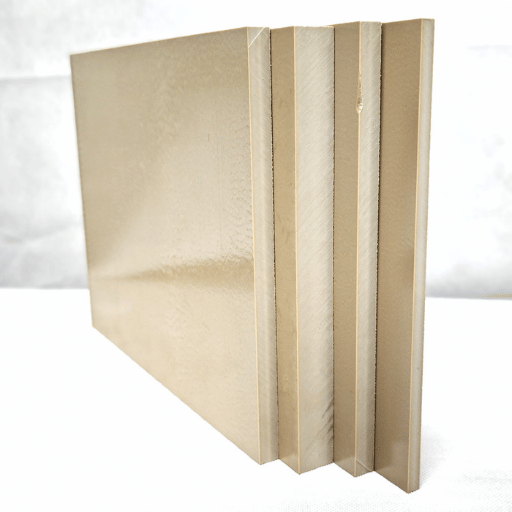
Lowering PEEK part cost shouldn’t come at the expense of performance. The majority of costs will be driven by choices in design and procurement rather than taking the cheaper option on quality. Here are the seven tactics used by procurement professionals and design engineers for cutting costs on PEEK CNC machining.
1. Select the appropriate PEEK grade – don’t over-provision. Virgin PEEK will fulfill almost all mechanical & chemical processes.
Adding GF30 (glass filled) or medical grade to unfilled PEEK if the latter meets design parameters will add $50-250/kg to the final material spec. Check the actual operating temperature, load & regulatory requirements prior to choosing a reinforced or a certified grade.
2. Design for manufacturability. Minimize tight tolerance features to only those dimensions that functionally require tight tolerances.
Each feature that is held to 0.001 or tighter necessitates an additional finishing pass, an annealing cycle, and a inspection step. Use standard tolerances on non-mating surfaces.
3. Batch your orders. Prototype pricing is 3-5 times more than production pricing per part.
If you will have repeat orders, figure out multiple parts or batch order quantities. Moving from 5 pieces to 50 can decrease the cost/part by 40-60%.
4. For volumes above 500-1000 consider PEEK injection molding. At these volumes the cost per part for simple shapes and forms is minimized (3-15), but tooling costs are expensive ($15,000 $50,000+).
5. Use an experienced PEEK machinist. Shops experienced with PEEK will have scrap rates under 10%.
Shops new to PEEK will often throw away 20-40% of the stock, due to improper feeds and speeds, thermal damage to the outside of the stock, and fixturing errors. Considering PEEK’s material price, a 30% scrap rate difference on a 250/kg rod is a per-part cost variation.
6. Keep material wastage to a minimum, by using near-net-shape blanks where possible. An efficient nesting of a number of components on a single rod or sheet is a recommended way to decrease the amount of material that becomes swarf.
For tailor-made PEEK components, seek advice from your machinist ahead of purchasing stock.
7. Reduce surface finish requirements. Use polished finishes (Ra 0.2-0.4 m) only on surfaces required for functionally important contact or sealing.
Do not specify polished finish on non-functioning as-machined surfaces (Ra 1.6-3.2 m) which improves cost efficiency by eliminating removal steps that raise finishing costs 20-40%.
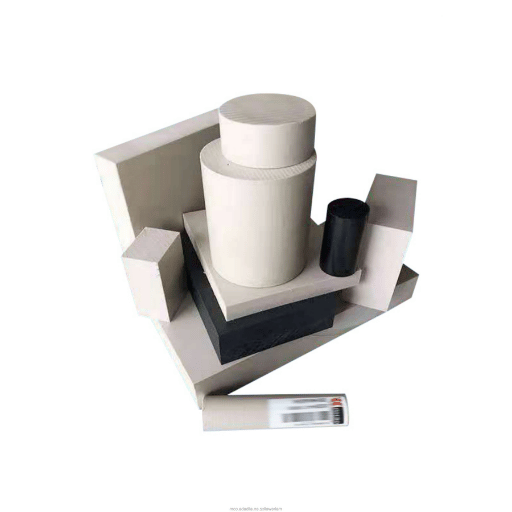
Lecreator has 17 years experience with machining engineering grade plastics including all PEEK grades on 80+ CNC machining centers. 98% first-pass yield rate. Precision machining tolerances to 0.001 (0.025 mm). Submit your design file for a quick quotation with an itemized cost estimate.
Pricing content in this article is based upon CNC shop rate surveys, individual machinist group forum discussion, listed PEEK material distributor prices, published manufacturers documentation from Victrex and Drake Plastics. Cost ranges based on grade (virgin, GF 30, CF30, Medical) were gathered from 2025/2026 market. Your part’s specific design, tolerance stack and order volume will impact your own quote.