

Supportive, Professional, Client-Focused Service
From prototypes to full-scale production, we’ve got you covered.


![Types of PEEK Grades for Different Applications [Guide]](https://le-creator.com/wp-content/uploads/2026/04/Types-of-PEEK-Grades-for-Different-Applications-Guide.png)
PEEK Grade Types: Properties, Applications, and Selection Guide
📐 PEEK Quick Specs
| Parameter | Value |
|---|---|
| Full Name | Polyether Ether Ketone (PEEK) |
| Polymer Family | Polyaryletherketone (PAEK) |
| Continuous Use Temp | 250°C (482°F) |
| Melting Point | 343°C (649°F) |
| Glass Transition | 143°C (289°F) |
| Density (Unfilled) | 1.32 g/cm³ |
| Key Standard | ASTM D6262-23 |
| Major Producers | Victrex, Solvay (KetaSpire), Evonik (Vestakeep) |
Selecting the appropriate grades of peek grades for specific applications is among the most important material choices an engineer will make. peek – polyether ether ketone – is a semi-crystalline thermoplastic used in aerospace, medical, semiconductor, and Oil & Gas application. However, ‘PEEK’ is not a single material.
It is available in four major grade families, each with its own set of properties, thermal characteristics, and machinability tendencies. This article describes the unfilled, glass-filled, carbon-filled, and bearing grade families of grades of peek with relevant property data, application advice, and machining tips based on manufacturing experience.
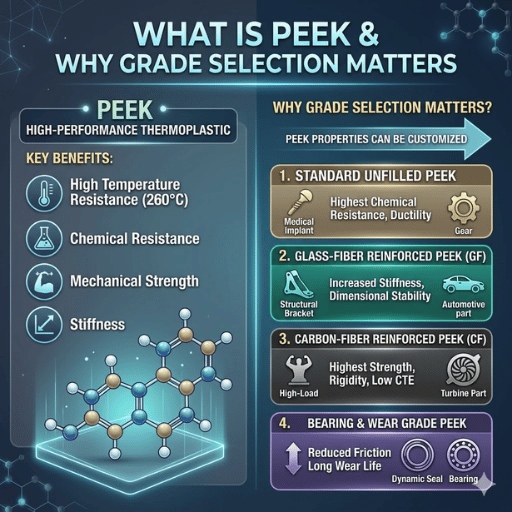
PEEK is a semi-crystalline thermoplastic belonging to the polyaryletherketone (PAEK) family. It holds continuous service temperatures up to 250°C (482°F), with a glass transition temperature (Tg) of 143°C (289°F) and a melting point (Tm) of 343°C (649°F). As a resin-based thermoplastic, PEEK delivers mechanical strength that rivals some metals while maintaining the processability advantages of a polymer. These thermal properties place PEEK well above standard engineering plastics like nylon (PA66, continuous 80-120°C) and even above PPS (200°C continuous).
PEEK — also written as polyetheretherketone — serves demanding applications in aerospace, medical devices, semiconductor manufacturing, and oil & gas where few other plastics survive.
Another characterization of PEEK is that chemical resistance. PEEK resists most organic solvents, acids, and bases. However, concentrated sulfuric acid will attack the polymer chain.
This resistance renders PEEK commonly used in chemical processing, oil & gas downhole applications and semiconductor wet-bench equipment.
Why Grade Selection is important: unfilled peek cost between $40-80/kg in industrial rod stock. Carbon-filled grades are $120-200/kg. Medical Grade unfilled peek (per astm.org/f2026-17.html”>ASTM F2026-17) can be over $500/kg.
The wrong grade selection can have up to a 10 cost increase in materials alone, or lead to early end-of-life failures.
ASTM D8033-22 sorts literature by property specification for the peek molding and extrusion grades. ASTM D6262-23, on the other hand, is for the PAEK stock shapes – rod, plate, and tube – precursors that CNC shops machine to finished parts.
Our machinists will machine all four types of the peek grade families (unfilled, glass-filled, carbon-filled and bearing grade) which all have different tooling and cutting data. The following are the properties, best-fit applications and machining characteristics of each of these grades as filed from the published data and production floor trial and error data.
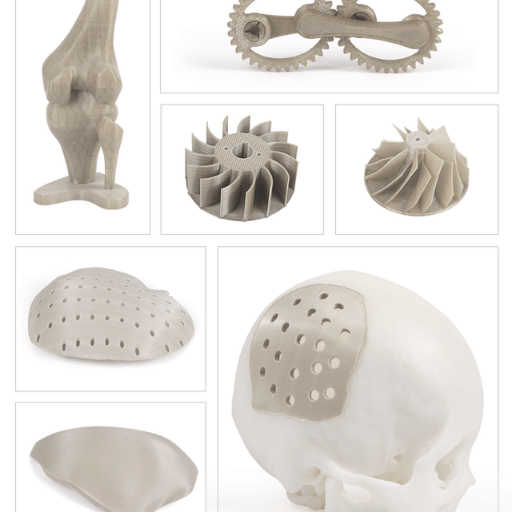
unfilled peek, using Victrex 450G as the reference grade, provides tensile yield of 100 MPa, at break elongation of 50%, and flexural modulus of 4.1 GPa. The heat deflection temperature (HDT), i.e. the temperature where the material deforms at 264 psi (1.8 MPa) pressure, is 160C. All grades share a continuous service temperature of 250°C — one constant across the entire PEEK family.
Unfilled PEEK finds its highest-value use in the medical sector. Biocompatible per ASTM F2026-17, it goes into spinal fusion cages (intervertebral spacers), dental abutments, and cranial reconstruction plates. A 2019 study in the Journal of Clinical Medicine (PMC) confirmed PEEK as mechanically suitable for denture bases, with flexural properties meeting ISO 20795-1 requirements.
In addition to its medical grades, unfilled peek can be used to deliver all FDA-compliant machinery for food processing; semiconductor wafer carriers (chemical purity is critical), and chemical-resistant valve fittings. Its 50% elongation is the highest of any peek grade, and presents excellent mechanical toughness and fatigue resistance – real benefits for impact or vibration loading situations.
In machining terms, unfilled peek is the easiest to machine of the lot – others tell us that a knowledgable machinist can handle it “like nylon”; standard carbide tooling extends well, surface finish is predictable, and chip formation is clean. For machining unfilled PEEK for tight PEEK CNC machining we generally attain 0.025 mm on critical dimensions.
📐 Engineering Note
ASTM F2026-17 defines implant-scale peek specifications. The price of medical-grade rodstock can be between 5 and 10 times more expensive than industrial grade ( $500/kg versus $40-80/kg ) with no observable material difference. Make sure of the procurement paperwork and lot history.
Engineers sometimes forget of the creep qualities of unfilled peek at above 150C, in the presence of sustained loads. In this upper range, it generally outdo most engineering plastics at this level of test, but it will still creep under very high sustained stress at high temperature. For static high temperature application, glass-filled and carbon-filled grades will provide greater creep performance.
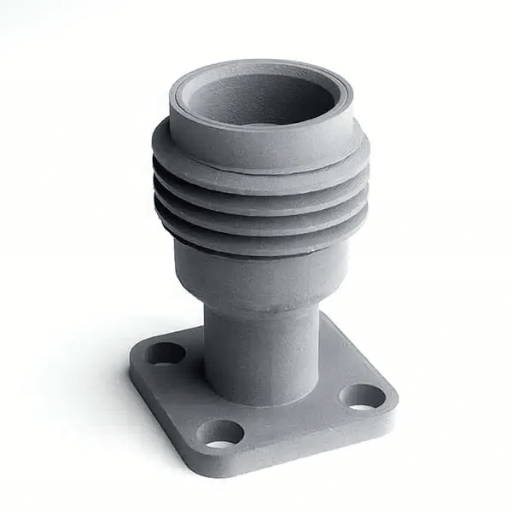
glass-filled peek has a typical 30 wt% glass fiber reinforcement present. Popular grades such as Victrex 450GL30, and Solvay KetaSpire KT-820 GF30. The addition of glass fiber raises tensile strength to 130-140 MPa (up from 100 MPa unfilled), increases flexural modulus to 6-7 GPa (4.1 GPa for unfilled is impressive), and raises HDT above 315C at 1.8 MPa.
Ductility is the trade-off. Elongation at break falls from 50% to a mere 2-3%. Mishandled glass-filled peek parts are not impact-friendly, or snap-assemblyable parts requiring some flex in the design. Parts become stiffer and dimensionally stable through thermal cycles — a perfect fit for semiconductor fixturing and aerospace structural brackets.
Major applications for glass-filled peek include high-temperature pump components, valve seats, mechanical seals in rotating equipment, and structural brackets in aerospace.38.
⚠️ Machining Warning
Glass fiber renders tool life 50-70% worse than unfilled peek. Use PCD or diamond coated carbide tooling for high volume. Reduce cutting speed 30-50% below unfilled peek. glass-filled peek will also be abrasive against mating surfaces – consider this if sliding motion will occur.
✔ When to Specify Glass-Filled Over Unfilled

Carbon-filled peek: T 30 wt% carbon fiber (Victrex 450CA30, Solvay KT-820 CF30) is the strongest grade within the PEEK family. Stock form tensile strength exhibits 150-170 MPa, and its 11-12 GPa flexural modulus is almost three times the unfilled grade. Machined molasses 450CA30 specification can reach 226 MPa, and fit for injection molding.
thermal conductivity demonstrates a value some 3.5 higher than hocifer of unfilled peek, contributing to added heat-spreading ability in dynamic and friction-generating scenarios. HDT supports at 315C, and the coefficient of friction measures 0.16. (versus 0.38 for unfilled peek), but not so low as in the case of bearing-grade industrial formulation 0.11.
Engineers specify carbon fiber peek machined parts for aerospace structural components, high load bushings where static strength is critical, oil and gas downhole tools subjected to extreme HPHT conditions, or automotive driveline components where mass reduction over aluminum is desired. Research published by PMC/NIH on tribological characteristics of carbon fiber-reinforced peek confirm the wear resistance benefits of CF-peek composites under a wide variety of contact conditions.
One significant property: carbon fiber supplies conductivity to peek. This makes carbon-filled PEEK the de-facto selection for ESD-sensitive semiconductors where static discharge must be managed. Unfilled PEEK and Nulafo Samekol are electrical insulators and cannot function in this role.
📐 Engineering Note
Carbon-filled peek is the more challenging to machine grade. The 30% carbon fiber amount is highly erosive – expect 2-3 times faster tool wear compared to unfilled peek. PCD (polycrystalline diamond) tooling is a requirement for production quantities. Feed and speed rates should be adapted far lower, and coolant strategy will matter more than other grades.
A frequent specification error: choosing carbon-filled when bearing-grade would be the best choice for sliding contact. Carbon-filled is excellent at static Vesv. and structural stiffness, not a self-lubricating sliding interface. For rotating shafts, reciprocating seals, or otherwise sliding parts, bearing-grade peek is the correct material. While the CoF of 0.16 may look good theoretically, carbon-filled lacks the self-lubricating properties of bearing-formulations.

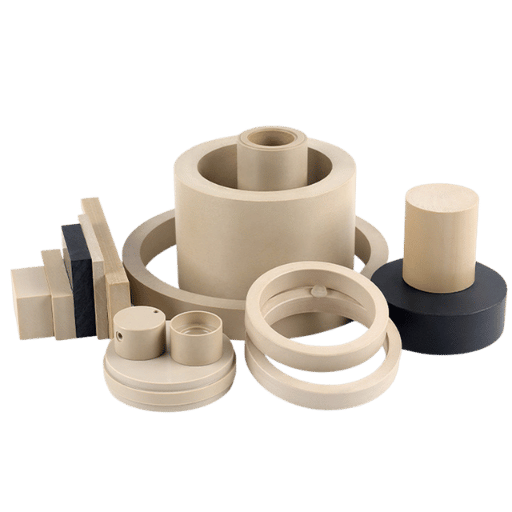
Bearing grade PEEK uses a tribological formulation called the “10-10-10” mixture: 10% carbon fiber for structual reinforcement, 10% graphite for heat-handling and dry lubrication, and 10% ptfe for friction reduction. Victrex 450FC30 is the most frequently specified example, with tensile strength of 131 MPa, flexural modulus of 8.1 Gpa, coefficient of friction of 0.11, and HDT of 277C.
A proportionate formulation is the Ensinger TECApeek PVX, which uses an alternate ratio and achieves a CoF of 0.18-0.20, PV (pressure-velocity) limit of 500,000 psift/min, and tensile strength of 76 MPa. The property differences are great if you compare Victrex and Ensinger datasheets, always check empirical data from the specific manufacturer opposed to assumption 1:1 comparisons.
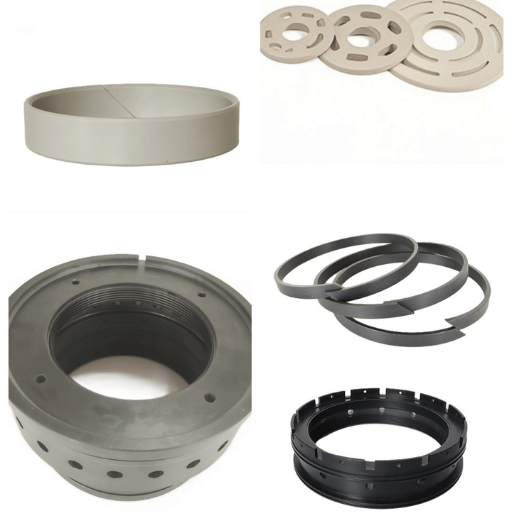
With superior tribological properties, bearing-grade PEEK achieves the lowest friction of all PEEK grades: 0.11-0.20 depending on formulation, as opposed to ~0.38 for unfilled. Hence, its low friction makes it the evident choice for thrust washers, journal bushings, compressor piston rings, rotary shaft seals, or pump wear rings. In our shop, bearing-grade PEEK is the most frequently specified grade for custom PEEK bushings and wear components – about 40% of all PEEK orders.
In filled grades, bearing-grade offers best machinability. PTFE acts as an internal lubricant during cutting, reducing friction between the tool and workpiece. Tool wear is greater than unfilled peek, but dramatically less that glass-filled or CF grades.
💡 Pro Tip: PV Limit Is Your Go/No-Go Criterion
Most bearing-grade peek formulations are rated to 500,000 psift/min dry no-lubrication. Above this PV rating, consider carbon-filled PEEK with external lubrication, or check metal bearing grades (bronze, Babbitt alloys, etc.). When you have external lubrication available, you’ll be able to up the bearing-grade PEEK PV rating by 2-3 – but double-check the manufacturer’s test data to ensure suitability for your operational conditions.
Below is property data compiled from Victrex datasheets, Ensinger TECAPEEK PVX specifications, and polyfluoroltd technical compilations. All values are for stock shape (extruded rod/plate) grades unless otherwise specified.
| Property | Unfilled | Glass-Filled (30% GF) | Carbon-Filled (30% CF) | Bearing-Grade (10-10-10) |
|---|---|---|---|---|
| Tensile Strength (MPa) | 100 | 130–140 | 150–170 | 76–131 |
| Flexural Modulus (GPa) | 4.1 | 6–7 | 11–12 | 4.8–8.1 |
| Elongation at Break (%) | 50 | 2–3 | 1.3–2 | 2.5–3 |
| HDT at 1.8 MPa (°C) | 160 | >315 | 315 | 277 |
| Coefficient of Friction | ~0.38 | 0.25–0.30 | 0.16 | 0.11–0.20 |
| Density (g/cm³) | 1.32 | 1.51 | 1.44 | 1.44–1.48 |
| Continuous Service (°C) | 250 | 250 | 250 | 250 |
Sources: Victrex 450G / 450GL30 / 450CA30 / 450FC30 datasheets; Ensinger TECApeek PVX datasheet; polyfluoroltd grade compilation.
From tool wear data we recorded in our peek CNC machining service operation, validated by data found in industry forum discussions:
Machinability hierarchy from our CNC operation: unfilled > bearing-grade > glass-filled > carbon-filled. Tool wear increases proportionally to the degree of filler hardness, with glass fiber being just as abrasive as carbon fiber metals. This finding often surprises engineers who have been led to believe the harder materials must be more abrasive to tooling.
✔ Filled PEEK Advantages
⚠️ Filled PEEK Limitations
Four questions form a logical flowchart selecting a grade. Should you answer “yes” in each stage, you’ll emerge at the right grade family for your needs.
📐 PEEK Grade Decision Framework
| Question | If Yes → |
|---|---|
| Is it a sliding or bearing surface? | Bearing-grade (10-10-10) |
| Is dimensional stability under heat critical? | Glass-filled (30% GF) |
| Is maximum structural strength needed? | Carbon-filled (30% CF) |
| Is biocompatibility or food-contact required? | Unfilled (per ASTM F2026 / FDA) |
| None of the above? | Start with unfilled (lowest cost, best machinability) |
Overspecification is the costliest error in PEEK grade selection. Engineers often default to carbon-filled as the ‘safe’ choice — only to pay a 3-5× material cost premium and end up with shorter tool life, without a measurable performance gain over unfilled PEEK. A $200 test machining run with your chosen grade can prevent a $20,000 production mistake.
Pro Tip: Always request a test machining run before choosing a bearing grade for your production quantities. Material behavior during machining differs considerably between various peek grades. Surface quality, tolerances, and internal stress levels all are impacted by filler type and quantity.
Uncertain what to choose? Our engineers are happy to recommend the fitting grade based on your application criteria, operating conditions and budget- utilizing 17 years experience machining to tight tolerances in medical, aerospace and semiconductor markets.
Carbon-filled (30% CF) tops the chart at 150-170 MPa tensile for stock shapes, reaching 226 MPa injection-molded.
Yes, in specific cases. Aerospace brackets, automotive drivetrain parts, and medical implants are common metal-to-PEEK conversions. Carbon-filled PEEK delivers 60-70% weight savings over steel while matching aluminum-level tensile strength. Whether the switch makes sense depends on operating temperature, loading pattern, chemical exposure, and your production volume — PEEK material cost runs higher than most metals, so the business case usually hinges on weight savings or corrosion resistance.
Unfilled PEEK grades comply with FDA food-contact regulations. Medical implant applications follow ASTM F2026-17. Always verify your supplier carries current certifications.
A tribological formulation with 10% carbon fiber, 10% graphite, and 10% PTFE by weight. Carbon fiber provides reinforcement, graphite aids thermal dissipation and dry lubrication, and PTFE lowers sliding friction. Victrex 450FC30 is the most widely specified version of this formulation.
PEEK handles 250°C continuous service vs 200°C for PPS and 170°C for PEI (Ultem). PEEK also wins on chemical resistance and mechanical strength across the board, but it costs 3-5× more than PPS per kilogram. If your service temperature stays below 200°C and chemical exposure is mild, PPS often makes more economic sense.
All the peek grades have a 250C (482F) continuous service temperature whatever the filler and short term 300C exposure can also be achieved without suffering any major deterioration. Glass transition takes place 143C (289F) and the melting point is 343 C (649 F).
About This Analysis
This guide has been written by the engineering team at Shenzhen Le-creator Technology Co., Ltd., a precision machining company with more than 17+ years experience, 100+ employees, and 80+ CNC machines. We machine both of peek’ grades families ( 40 kinds!), on a daily basis. Our applications encompass all four industry families: medical device, aerospace, semiconductor, and industrial.
Property data in this article originates from manufacturer datasheets (Victrex, Ensinger, Solvay), ASTM standards, and peer reviewed publication. Machining data is based upon our manufacturing floor experience of thousands of individual PEEK components, with a 98% first-pass yield and 100% outgoing quality inspection on every order.
References & Sources
Related Articles