

Supportive, Professional, Client-Focused Service
From prototypes to full-scale production, we’ve got you covered.



The distinctively capable materials represented as acrylic and polycarbonate are preferred when a user seeks linear strength, surface resistance capability, and absolute clearness. These materials have utility in a wide variety of applications that calls applications as construction, automotive, DIY projects, jewelry and other artifacts, and even purely everyday act. So, how do you decide which one will be the best choice for your requirement? This article aims to indulge in a detailed discussion over the differences, strengths, and weaknesses of acrylic and polycarbonate to help you arrive at an informed decision. Whether you need impact resistance, optical transparency, or reasonable price, we will break down just about everything to help you make wise decisions on the materials to meet the aforesaid requirements. Read on to track the ultimate showdown between acrylate and polycarbonate!
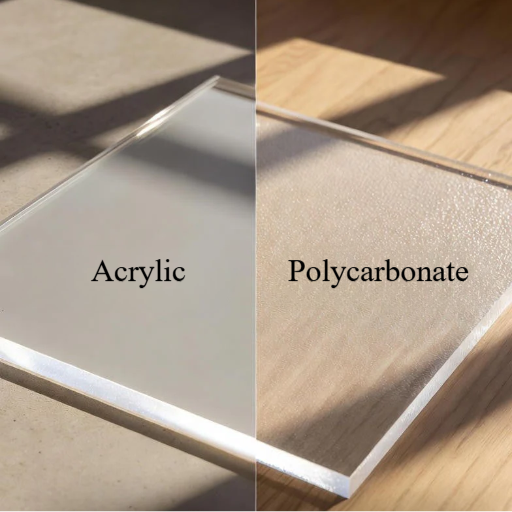
Acrylic and polycarbonate are two of the favorite thermoplastics, rendering two different materials for two separate applications because of their intrinsic qualities. Acrylic for its outstanding optical clarity, fine polish, and UV resistance, is used mainly for display, signage, and other decorative applications. On the other hand, polycarbonate, being extremely strong and tough, with great impact resistance, is used for impact-prone areas safety devices and machine guards. The major differences are that acrylic costs less and is scratch-resistant, while polycarbonate combines strength with flexibility. For a choice, the end usage should be considered in areas of impact resistance, looks, and material cost.
Material Overview
Material Overview
Acrylic is commonly known as polymethyl methacrylate (PMMA). The acrylic plastics are lightweight and transparent materials with high durability and light transmittance for reflecting colors. Acrylic glass, a product of engineered resin, offers the same optical clarity, but stronger and has a slightly higher light-transmission rate compared to other materials like glass. Although these productions have some benefits, other more affordable materials specifically employed for transparent light dissemination can safely replace them. About 92 percent of light across various spectrums is passed by the material which gives it high reflectivity as well.
Latest data has shown that acrylic plastic has lately been an important subject of frequent internet searches where consumer demands have been referred to as primarily relating to the subject’s sustainability and environmental impact. It was found that the material is not biodegradable but can be recycled and repurposed, causing waste prevention. Manufacturers are now looking to use more eco-friendly processes in the manufacture of acrylic in view of the increasing interest in environmentally friendly materials. Its affordability and toughness and transparency of acrylic ensure that it is a material of choice in heavy industrial and commercial usages across various applications.
Polycarbonate plastic is a versatile, light, and durable material that is used in a variety of sectors. High on impact resistance, polycarbonate is transparent and usually finds applications including eyeglass lenses, medical devices, vehicles, and electronics. Polycarbonate is also thermally very resistant, thus it is often used in the presence of heat. One main drawback of polycarbonate is the frequent concern that bisphenol-A (BPA)-which is sometimes used in its production-might leach over time. Nonetheless, the production of BPA-free polycarbonate has seen substantial growth in sync with the ever-growing trend among consumers for environmentally conscious and safer materials. Polycarbonate is the essential material to use in our modern manufacturing set-up because it combines strength and adaptability.
Careful consideration of material choice stands activity; materials choice will directly affect the performance, life, and enduring quality of the concerned product. Properties of materials chosen for any given application do relate to the working conditions and the environment; some of the decision aspects may be cost, while others may have to do with extensive safety standards and application-specific considerations. To illustrate, polycarbonate might have generated traction in such automotive manufacturing industries, electronics, and construction given its strength, light weight, and resistance to impact. However, the consideration here will be on ecological avenues, like possible chemical leaching. Turning these into BPA-free alternatives will speak for consumer health and confidence. Given the growing role of sustainability, the focus must be on recycling and reducing environmental impact. By expertly analyzing the material properties against cost and their impact on the environment, manufacturers can create value-added systems that will meet performance standards responsibly and sustainably.
Key Decision Factors

Polycarbonate has far greater impact resistance than acrylic. Glass, for instance, can bear 250 times more impact than polycarbonate and around 30 times more than acrylic. This makes the benefit-critical use of polycarbonate for its resiliency and safety. Acrylic, though having pretty nice impact resistance and being clear in the attitude, breaks and shatters much more than polycarbonate in situations where the impact is severe. Polycarbonate, being almost unbreakable, is best for projects with severe stresses such as safety shields, machine guards, and bullet-resistant glass; and acrylic tends to be chosen for its transparency and scratch resistance-all depending on what the requirements of the individual projects would dictate.
Relative Impact Resistance
Polycarbonate
250×
Acrylic
30×
*Values relative to standard glass impact resistance
Polycarbonate and acrylic are winners in optical clarity and transmission efficiency. Acrylic has an almost perfect classification with 92% luminous transmission for impeccable views in applications. Additionally, so the innate resistance to yellowing and degradation by UV is conducive to maintaining clarity all the time. Polycarbonate glass, which reaches about 88% transmission (that is, less clear), is still Milky-like transparency, and it is prone to toughness and impact work. This makes it a possibly better choice for situations where home safety and durability are critical, there might be a small reduction in question for how clear these objects should be. Both materials may or may not be polycarbonate-treated to enhance optical performance, whereas the tendency with acrylic is toward scratch-resistant finishes and with polycarbonate most would pair UV stabilizers to secure the longer lifespan outdoors. The choice between the two depends on what is important, optical clarity or strength in the project.
UV stability that acrylic offers enables the materials to maintain their clear appearance and resists yellow when constantly exposed to the sun. This long-time color conserved under the UV half-lives makes it very suitable for applications that demand lasting visual appeal, such as signs, display cases, and outdoor installations. Acrylics are also well-known to withstand the consequences of improved weather, while keeping their optical property.
Polycarbonate, on the other hand, is prone to discoloration, flaking, and degradation when not UV-stabilized. Also, as it can actually be so smooth and really impact-resistant, polycarbonate is required to have further layers or treatment when it is to be used in constant outdoor applications because of the broken-down natural UV protection. Profiting from stabilization, this material would have kept intact over time despite the weathering processes that make it a really good choice in the toughest of situations.
In the end, acrylic will retain clarity and aesthetics in the sun over the longest period. Polycarbonate could be confined to good outdoor performance even if it has a lack of UV-stability, provided that substantial UV protection is incorporated, mainly in the case where physical impact resistance is essential. The best choice will therefore be determined by the specific needs of the application and the environment.
Side-by-Side Comparison
| Property | Acrylic (PMMA) | Polycarbonate (PC) |
|---|---|---|
| Light Transmission | ~92% | ~88% |
| Impact Resistance | 30× vs. glass | 250× vs. glass |
| UV Resistance | Excellent (inherent) | Requires coating |
| Scratch Resistance | High | Moderate |
| Flexibility | Rigid / Brittle | Flexible / Ductile |
| Thermal Resistance | Moderate | High |
| Base Cost (per sq ft) | $3–$50 | $1.50–$15+ |
| BPA Concern | None | BPA-free options available |
| Polishing | Easy (flame, buff, sand) | Requires coatings |

Characterized by its strength, versatility, and optical clarity, acrylic is used in numerous areas and earns respect from industries the world over. The foremost application is in construction and architecture, where acrylic sheets are known for their unbeatable high light transmission and weather resistance and have windows, skylights, and partitions among their many possible applications. Acrylic subsequently occupies a special place in the retail sector, being used for display stands, signage, and protective barriers because of its neatness and durability. In the automotive and transportation sector, acrylic is widely deployed and contributes in other applications, such as light covers, instrument panels, and windshields for motorcycles and boats.
From this point, acrylic plays an important role in the medical sector, where it is used for stuff like incubators, shields, and dental prostheses because of its asepsis and ease of adjustment. Additionally, acrylic paints are always quite popular with the artistic and designing circles due to the rich color pallet and their flexibility. Acrylic is often in demand in the electronics industry because it is employed for screen displays and LED light covers. With the increasing availability and the development of eco-friendly manufacture methods, acrylic is becoming more important than ever in a host of applications.
Acrylic — Key Industry Applications
Polycarbonate panels, a supreme example of versatility, exhibit both structural strength and lightness-in-weight, providing transparency too. Notable performances are observed in roofing, skylights, and greenhouse structures, as well as coatings with a huge potential for thermal insulation and UV protection. The automotive industry is not far behind, where the impact-resistant polycarbonate plastic is oftentimes used to make windshields, headlight covers, and interior paneling. In addition, because of the stiffness imparted to the panels, these products find applications in industrial and security applications like but not limited to shields, shields for machinery, and bullet-resistant glazings. The provision of ease of installation to them may be cited as one more virtue. Their adaptability ranks high as well. Hence, irrespective of the industry, this structural accessory may be set simply into place and styled to best suit the work at hand.
Polycarbonate — Key Industry Applications
Acrylic is desired for its superior optical clarity and resistance to UV light. It is commonly used in display cases, signs and, sometimes, aquariums, and whenever aesthetic value and visibility are needed. According to recent news, the material’s light weight and resistant surface make it suited for outdoor displays and architectural elements although might break more easily than polycarbonate under pressure.
The polycarbonate is the material that comes with high durability. At the same time, polycarbonate is available with toughness and impact resistance. This is the reason why it is chosen for bullet-resistant windows, machine guards, and protective equipment that needs to be some tough game. Triggered by search data, there is a growing interest in utilizing polycarbonate in the construction of greenhouses as these materials can withstand extreme weather conditions. Unlike acrylic, polycarbonate is significantly better in thermal insulation, thereby saving energy for certain applications.
Both materials are highly flexible, and the preference is often determined by the project’s priority. Acrylic looks good for providing good looks and UV stability, while polycarbonate is unbeaten when it comes to strength and durability to secure safety for very demanding applications.

Acrylic panels are very much available and usually priced according to thickness, size, and whether they come in sheets or glass panels. As much as they are, the standard pricing on a given acrylic panel of economic thickness which is not really great will account from $3 to $10 per square foot; however, the price of a premium-grade or even thicker panel could again range from around $15 to a whopping $50 per square foot. The clarity, UV resistance, and type of surface finish (e.g., matte or glossy) greatly influence pricing. These premium grades of customized acrylic panels or special types, such as colored or frosted sheets, incidentally cost more. Acrylic should be manageable in the budget for certain large-scale projects, as bulk orders or wholesale options provide a great deal of discount on the already-competitive prices for acrylic.
Polycarbonate is a type of plastic capable of possessing a robustness, resilience, and versatility that make it an apt choice for varied needs. Costs for polycarbonate typically range between $1.5 and $5 per square foot for a particular composition of domestic rated polycarbonate sheet, dependent upon the variations in thickness, metering, and specialty grades; high performance polycarbonates that are UV or fire-resistant cost anywhere between $7 and $15, maybe more, per foot for domestic sheet. Like any form of customization onto acrylic, polycarbonate sheets with materials like frosted or antireflective finish or treated optics can add significantly to the total. With large projects in construction or industry, tube purchases or wholesale transactions can result in massive price cuts. The same goes for polycarbonate recycling, making its material cost-favorable through variation and retail quantity reduction.
| Grade | Acrylic (per sq ft) | Polycarbonate (per sq ft) |
|---|---|---|
| Standard / Economy | $3 – $10 | $1.50 – $5 |
| Premium / Specialty | $15 – $50 | $7 – $15+ |
| Bulk / Wholesale | Discounts available | Discounts available |
As regards long-term value, there are unique benefits of using either acrylic or polycarbonate at each, hence making a choice dependent on the specific application. Acrylic is very popular for its brightness, attractiveness, affordability, and resistance to sunlight, making it an excellent choice for projects wherein lasting visual attraction and money-saving go hand in hand. However, it is more brittle than polycarbonate and is therefore not compatible with applications that require the utmost impact resistance or flexibility.
Comparatively stronger and impact-resistant than an acrylic sheet counterpart, however, polycarbonate sheets have slightly higher cost. Polycarbonate, real tougher than acrylic, is more durable, highly adapting, and mostly used as a crashing shield-like in shatterproof safety glasses. Either applying it in the most demanding of applications, no other plastic can equal it so far as one is not looking for thermoplastic vaccine bags or certain transparent visors requiring resistance to gamma or beta rays. It is temperature-tolerant but has slightly lower UV resistance. An upfront expensive but cost-effective long term outfit, Polycarbonate is offered above and beyond the expanse of broke-back maintenance and replacement in extreme environments.
Choice between the two will always come down to the issue of weighing costs, aesthetics, durability, and application needs. Acrylic is more suitable for the project focusing more on aesthetics and moderate life. With regard to the quality of life, Polycarbonate is comparatively a better option depending on what applications or stylistic accent they have where strength in safety critically dominates over durability. By really telling the special needs of your project, you can make an informed decision that gives you the best value for your use in the long run.

When a laser cutter or circular saw is used to cut down acrylic, adequate caution must be maintained to cushion against any kind of inaccuracy. The laser cleaner is the best idea for a factory-like setting, probably most of the time. Not much finishing is required as it produces clean and smooth cuts that do not engineered pink on their edges. Although clean finishing is why it is recommended selectively, the blast serves at an advantage in an entirely different aspect due to the deep craftsmanship. With dull or poor-quality tools, or applying too much force, never will the material fracture and chip away.
Polycarbonate is a different kettle of fish. It is one of the toughest plastics around and has to be cut in a separate way. Given its exceptional impact resistance, polycarbonate will cut in a single go with no chipping. Polycarbonate can really be cut using anything, whether it is fine-tooth circular saws, jigsaws, or band saws. In case of warping, though, breaks could run right along the cut line. This further solidifies its case of lesser possibility of shattering than the acrylic. However, it generates a concerning amount of heat while being cut, and becoming a risk other than an irritation, while polycarbonate resists flame outstandingly. External cooling onto the cut edges may prevent total softer melting.
Appropriate clamping and stable support guarantee nice and precise cuts of both materials. CNC cutting is also popular to give the meticulous contour during high-precision applications and, at the same time, maximize material utilization. The application of whatever cutting method is a matter of judgment depending on size and type of work.
Acrylic and polycarbonate differ significantly in their bending and forming characteristics. Acrylic is more rigid and undesirable when it comes to breaking during bending especially if incorrect techniques and inadequate heat are used. The material should be heated lightly and the whole substance should be softened uniformly to allow for bending or shaping at particular angles. However, acrylic retains its proper shape very well once it cools.
On the other hand, polycarbonate is deemed very bendable, perfect for bending and forming characterized by good pliability. Polycarbonate may be cold bent at room temperature, making it a suitable material for fitting adjustments and applications including more flexibility. As for forming under high temperature, polycarbonate maintains its powerful strength and durability of some difficult forms or projects demanding some very hearty characteristics.
When durability, flexibility, and ease-of-forming are critical factors, a polycarbonate product is obviously superior; however, for products with more simple shapes, acrylic is preferable owing to durability, stiffness, and optical clarity. The key factors for choosing one over the other will depend upon the specific application and the desired properties of the finished product.
| Technique | Acrylic | Polycarbonate |
|---|---|---|
| Cutting | Laser / circular saw; chips with poor tools | Any saw; generates heat during cutting |
| Bending | Requires uniform heat; holds shape well | Cold bendable at room temperature |
| Polishing | Flame, buff, sand — high gloss | Sanding only; coatings required |
One of the differences between working with acrylic and polycarbonate, owing to the characteristic chemical composition of both materials, is how they polish and finish. Acrylic is very easy to polish to a high gloss finish by flame polishing, buffing, or sometimes through just sanding. These processes are excellent for scratch removal and restoration of optical clarity hence acrylic can be used in decorative applications.
In the case of polycarbonate, it will not be suitable for flaring due to the deformable surface hardening with hot flame which can cause severe wavy bubblings and discoloration. Sanding and cleaning are alternatives to more time-consuming suffixed measures to achieve smooth surfaces; however, in contrast, optical clarity for polycarbonate is more difficult to achieve compared to acrylic. Therefore, they are mostly bound to being coated with additional coatings, like anti-scratch or solid UV.
For this reason, in applications that have a heavy emphasis on looks, the material to use would be acrylic, whereas in scenarios where robustness and resistance are given greater weightage over the need for smooth and impeccable surface finish: polycarbonate would be the one to use.
Blends of Polycarbonate and Acrylic Polymers: Crystallization of Polycarbonate – Investigates the properties and behavior of polycarbonate/acrylic blends, providing insights into their material characteristics.
Polycarbonate-Modified Acrylic Polymers for Coating Materials – Describes the synthesis and applications of carbonate-modified acrylic polymers, relevant for comparing material properties.
A Comparative Study of Sound Transmission Loss Provided by Glass, Acrylic, and Polycarbonate – Examines sound transmission properties of acrylic and polycarbonate, offering a practical comparison.
Effects of Adhesive Structure on Impact Resistance and Optical Properties of Acrylic/Polycarbonate Laminates – Explores the impact resistance and optical properties of acrylic and polycarbonate laminates.