

Supportive, Professional, Client-Focused Service
From prototypes to full-scale production, we’ve got you covered.


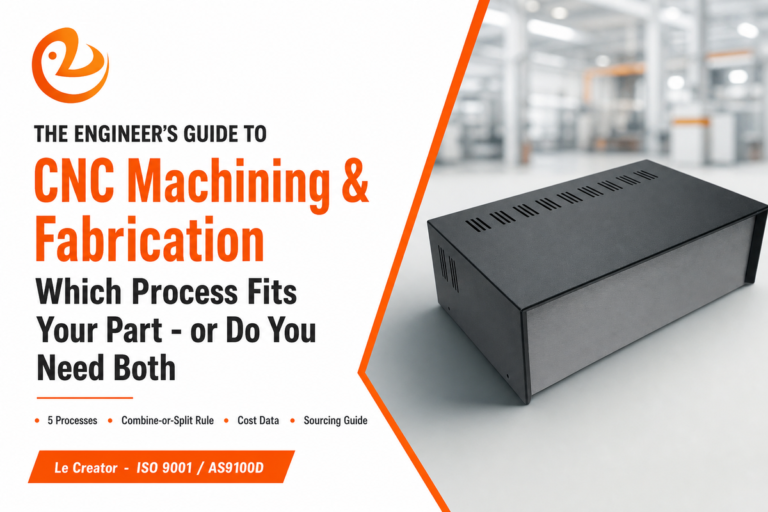
Custom machining guide for engineers: compare CNC processes, materials, tolerances, RFQ data, cost drivers, and supplier checks before production.
Custom machining is the controlled manufacturing process used when a standard catalog item cannot satisfy the drawing, material, tolerance, surface finish, or end-use requirement. For engineering teams, it usually means a computer-aided design (CAD) file, a 2D drawing, a material decision, and an inspection plan are turned into metal and plastic machine parts by a CNC machine or another subtractive manufacturing route.
Successful custom machining projects do not begin with the question “who has the fastest instant quote?” They begin with a product definition that even the best online machine shop can manufacture, inspect, and repeat. This guide to cnc machining is written for engineering teams that need the file, process, inspection, and supplier conversation to line up before release. That definition must tell the supplier what matters, what can remain standard, which revision is authoritative, and where risk sits in the assembly.
Engineering takeaway
Treat custom machining as a handoff system, not only as a machining process. Quote-ready packages combine geometry, material, tolerance, manufacturing process, inspection evidence, data-control limits, and a supplier conversation before production parts are released.
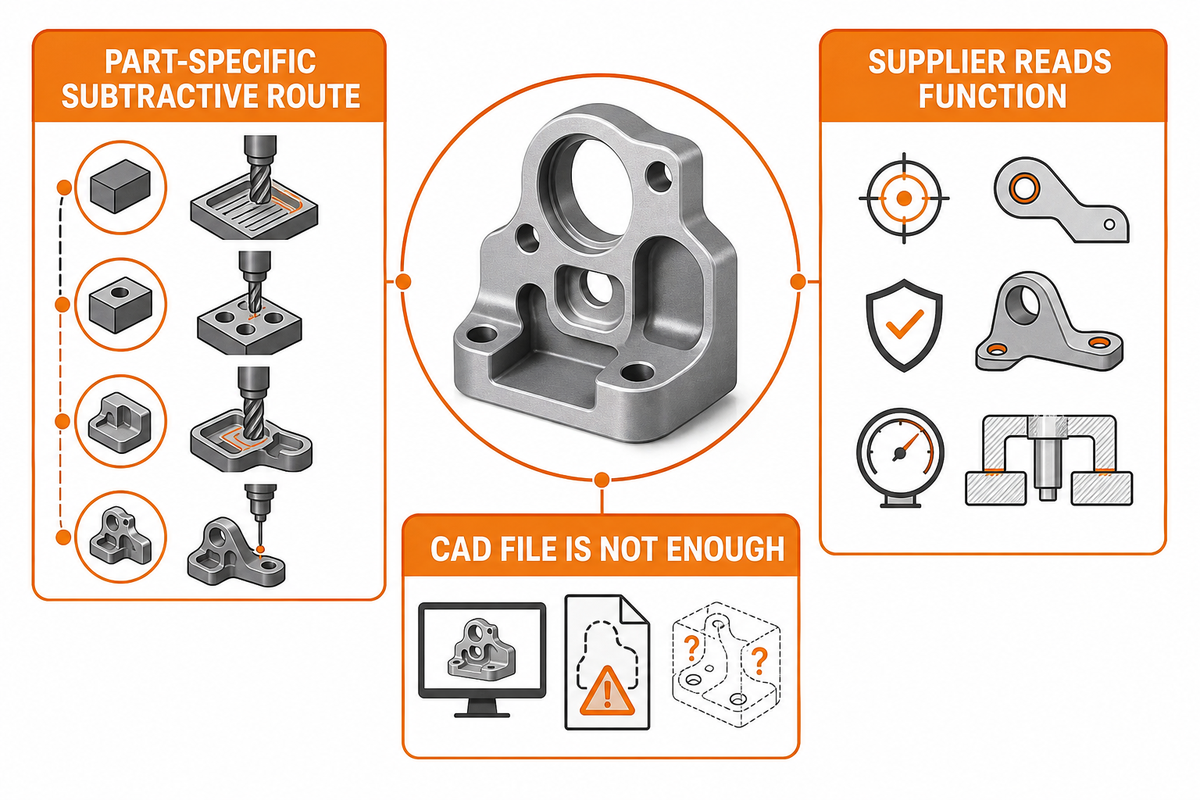
Custom machining is part-specific subtractive manufacturing. From digital product data, a CNC machining service chooses a route such as CNC milling, CNC turning, wire EDM, or finishing, removes material from plastic or metal stock, and verifies the result against agreed requirements. Goodwin University describes CNC as computer-controlled machine tool operation driven by CAD drawings or blueprints, while NIST frames machining around accuracy, precision, process planning, tooling, fixtures, and tolerance requirements.
That is why custom cnc machining differs from buying a standard component. Suppliers must understand the intended function, not only the model shape. One bracket may need corrosion resistance; a manifold may need chemical resistance; a robotic end effector may need low weight and impact strength; a bearing surface may need controlled roughness and precise machining after anodizing or a thermal cycle.
In custom CNC machining online, it is easy to upload a CAD file and expect the file to explain everything. It rarely does. If the CAD model conflicts with a drawing, if the alloy is vague, if the datum structure is missing, or if inspection requirements are not defined, the online quote becomes an assumption engine. Good suppliers ask questions before they cut custom parts.
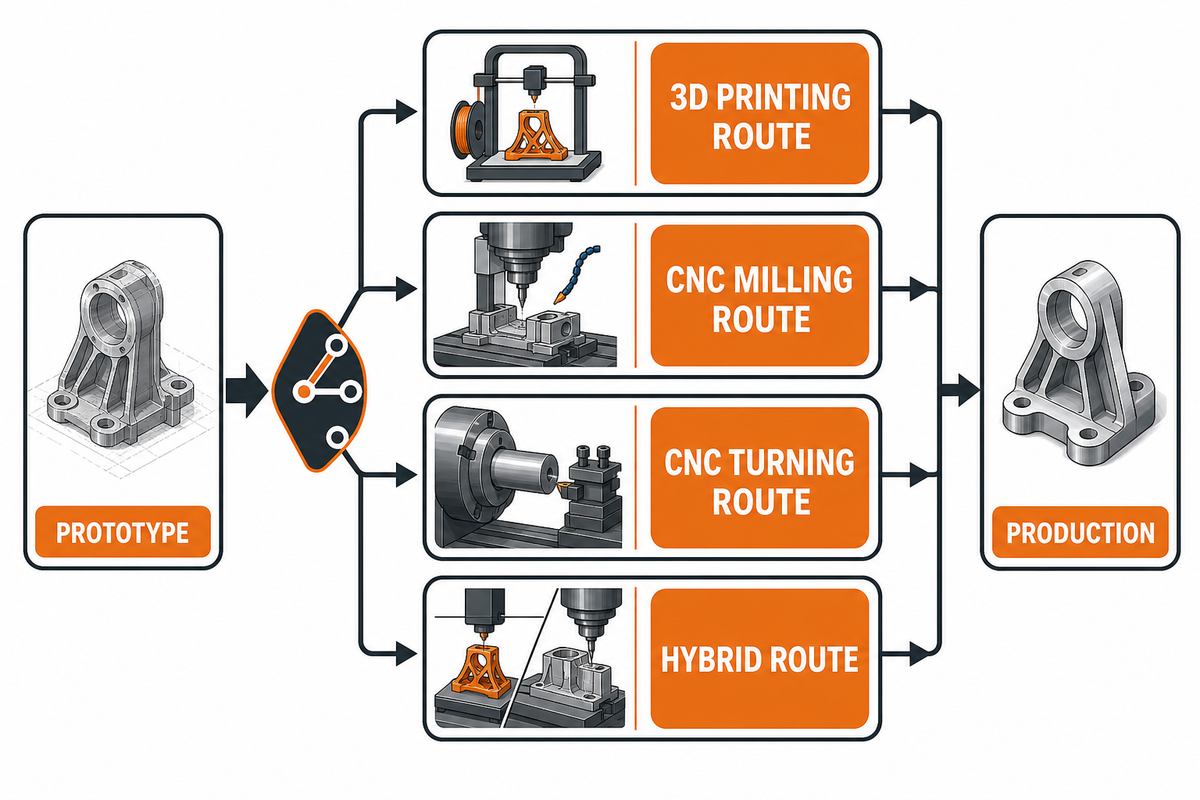
The Prototype-to-Production Switchboard helps engineering teams choose between additive manufacturing, CNC machining, and a hybrid route. Use 3D printing service for rapid prototypes and geometry-first parts when the immediate goal is fast shape learning, internal passages, visual models, or early fit checks. Move toward CNC when the prototype must behave like end-use parts in production material.
Hubs compares 3D printing and CNC machining by production volume and use case, but it is a supplier-published guide, so use it as an example rather than independent proof. Practically, the point still holds: 3d printing is often better for complex form, rapid prototyping, and low-volume design learning, while CNC machining is usually stronger when the part needs production material, threaded features, bearing seats, machined surface finish, or tight tolerance.
Lecreator’s 3D printing page lists FDM, SLA, SLS, MJF, and metal printing, along with 50+ materials and quick delivery claims. Those are first-party capability claims, not third-party certification. They are useful for deciding whether prototypes and production parts should move through one manufacturing partner or through separate additive and subtractive suppliers.
| Route | Best Fit | Watch Point |
|---|---|---|
| 3D printing | Geometry learning, ergonomic models, internal channels, early prototypes | Material behavior and tolerance may not match the final machined part |
| CNC milling | Milled parts, pockets, slots, flat faces, complex prismatic geometry | Tool reach, internal radii, setup access, and cnc machining surface targets |
| CNC turning | Round parts, shafts, bushings, threaded features, turned fittings | Off-axis features may need cnc turning with live tooling or a second operation |
| Hybrid route | Fast printed form study followed by precision cnc prototypes or bridge production | Design changes must be frozen before quick-turn parts move into production checks |
| 4-axis CNC machining | Multi-face brackets, housings, and features that need fewer setups | Confirm fixture access, 25 mm tool reach, and datum transfer before release |
| CNC turning with live tooling | Round parts that also need flats, cross holes, or milled slots | Off-axis features can add setup time when runout needs 0.05 mm control |
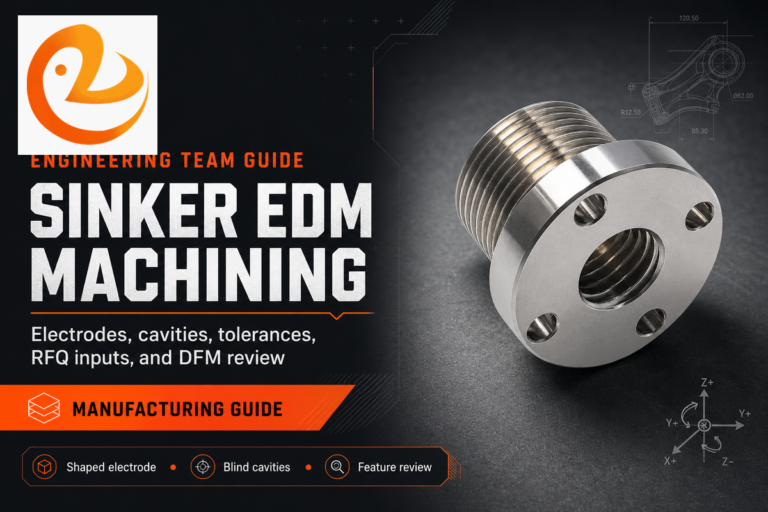
| EDM support | Fine profiles, small internal corners, hard conductive materials, tool inserts | Start holes, recast layer limits, and edge condition must be specified |
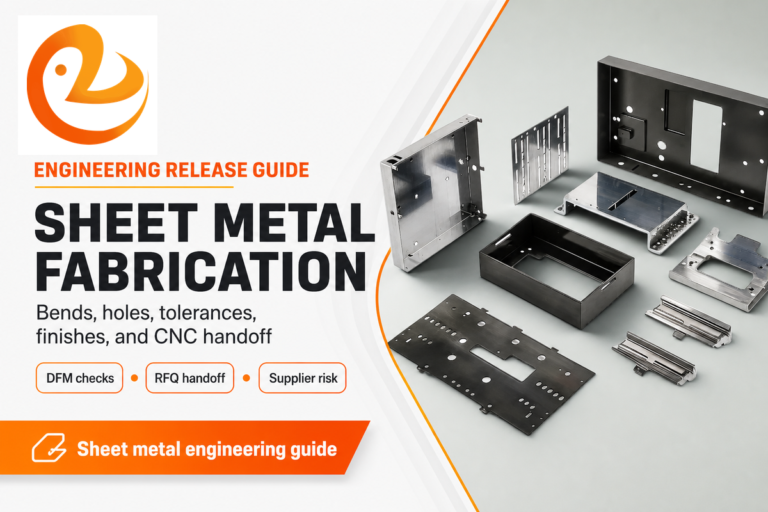
| Sheet metal plus machining | Enclosures, bent covers, machined spacers, and assembled hardware | Keep bend radius, hole-to-bend distance, and machined interface notes together |
| Bridge production | Pilot builds, 10-100 sets, or pre-tooling production checks | Do not release 1000+ parts until revision, inspection, and yield evidence are stable |
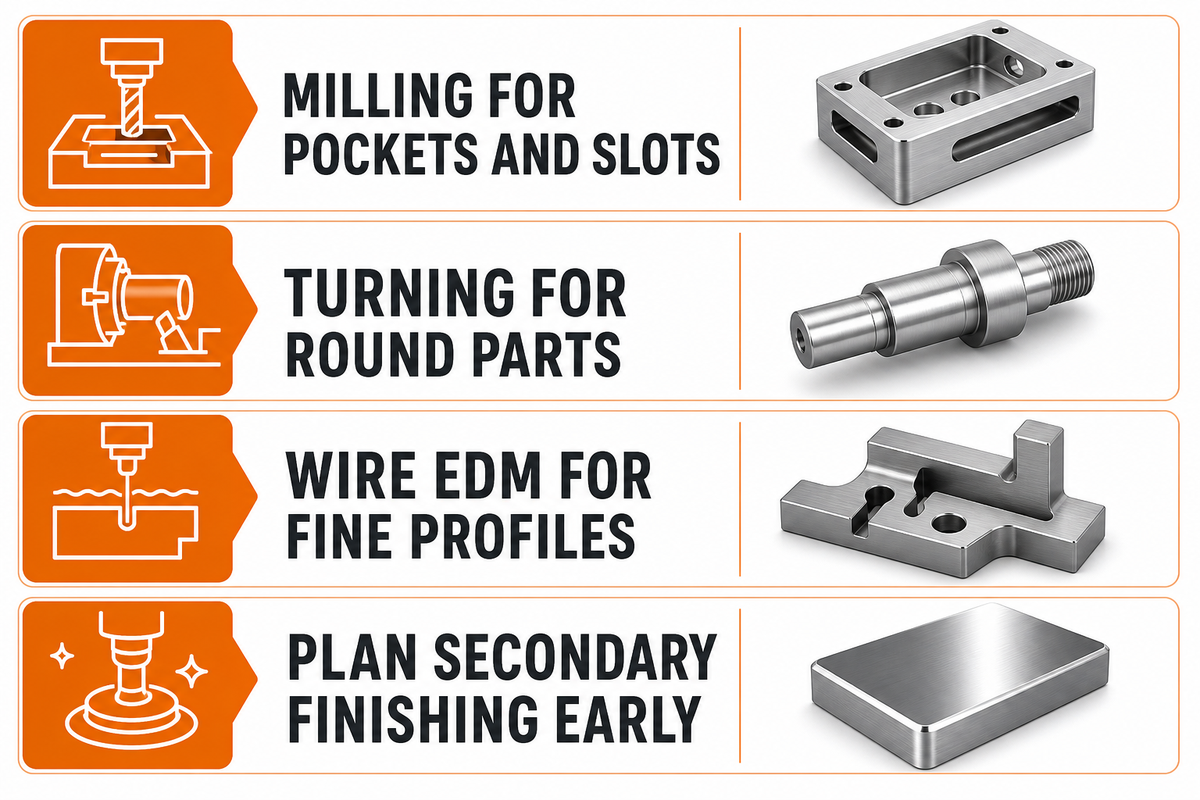
The Process Capability Matrix keeps the machining process tied to geometry. CNC milling is not simply “better” than cnc turning, and advanced cnc machining capabilities do not remove the need to define access, datum strategy, and inspection. For open geometry, 3-axis machining may be enough; 4-axis cnc machining can reduce setups on multi-face parts; cnc milling and turning can be combined when a part has both rotational and prismatic features.
Electrical discharge machining, grinding, bead blasting, anodizing, passivation, thermal processing, plating, and other secondary finishing steps should be planned early. If the final size is affected by coating or a thermal cycle, the custom machining supplier needs that requirement before programming begins. Even a supplier that offers cnc milling and cnc turning under one roof can fail if the process route does not match the drawing.
| Process Type | Best-Fit Geometry | Design Watchout | Inspection Note |
|---|---|---|---|
| CNC milling | Flat faces, pockets, holes, slots, brackets, housings | Deep pockets and square internal corners may need EDM or a 1.0 mm relief radius | Define datums and critical faces for CMM or fixture checks at 0.05 mm targets |
| CNC turning | Shafts, pins, bushings, rings, fittings, round metal parts | Cross holes or flats may require live tooling or a mill setup | Roundness, runout, threads, and 0.02 mm concentricity need explicit checks |
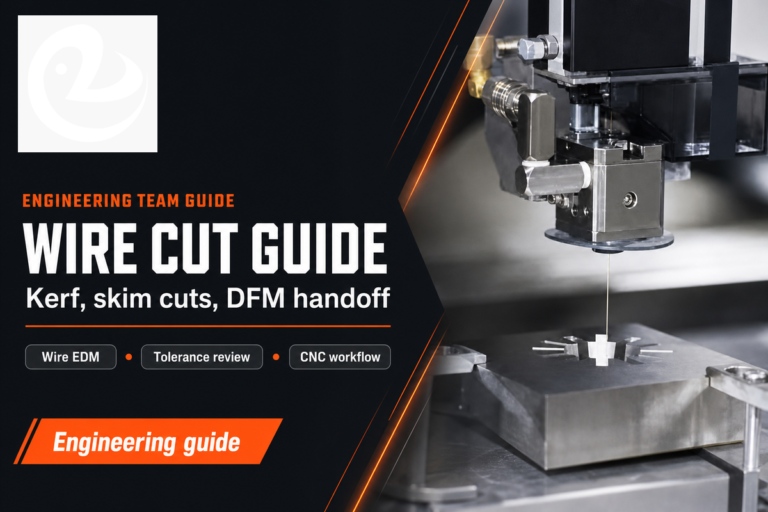
| Wire EDM | Through profiles, slots, fine conductive metal features | Needs a through path or start hole | Confirm cut taper, 0.10 mm wire path, recast layer, and edge condition where critical |
| 3-axis machining | Open faces, simple pockets, plates, jigs, and brackets | Multiple sides may add a second setup if datums are not stable | Use 0.10 mm general checks and isolate 0.03 mm critical features |
| 4-axis cnc machining | Multi-face parts, radial holes, indexed features, wrapped geometry | Tool reach, fixture clearance, and datum transfer drive the setup plan | Confirm 25 mm reach limits and CMM strategy before quoting |
| CNC turning with live tooling | Shafts, pins, nozzles, collars, round bodies with side features | Milled slots on turned parts can change chucking and sequence | Call out 0.05 mm runout and thread gauge evidence where needed |
| CNC milling and turning | Parts with rotational and prismatic geometry in one component | Sequence matters when milled datums depend on turned surfaces | Separate 0.02 mm bearing features from 0.10 mm noncritical faces |
| Surface grinding | Flat plates, spacer faces, gauge surfaces, wear surfaces | Grinding should be planned before coating or final assembly | Use 0.01 mm flatness or Ra 0.8 um only where function justifies it |
| Secondary finishing | Anodizing, polishing, passivation, plating, blasting, marking | Finish can alter size, appearance, corrosion resistance, and lead time | Separate cosmetic surfaces from functional surfaces; coating buildup may be 5-25 um |
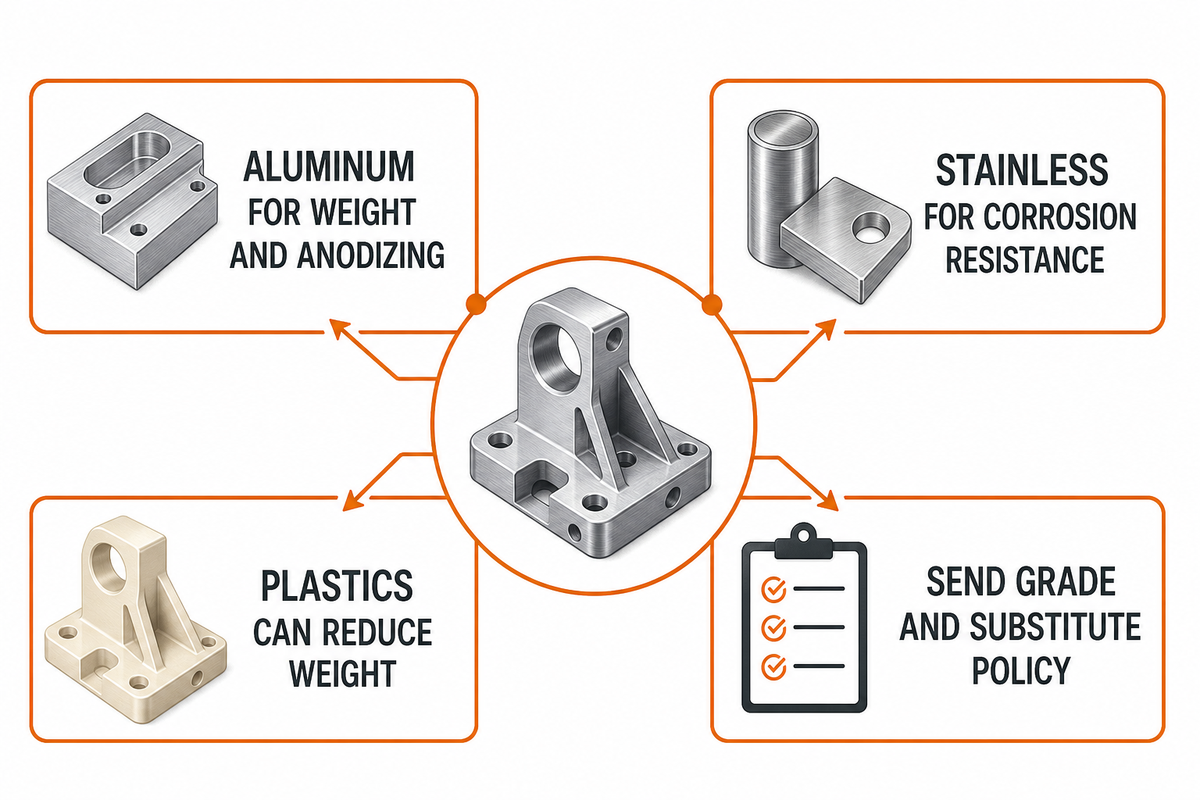
CNC machining materials should be selected by function first. Aluminum, also written as aluminium in some drawings, is often chosen for weight, machinability, and anodizing. Stainless steel is common when corrosion resistance matters. Brass and copper help with conductivity or fitting applications. Titanium can deliver high strength at low weight, but machining time and tool wear can rise. Alloy steel and carbon steel can fit load-bearing production parts when thermal processing and coating are specified.
Plastic and metal decisions also belong in the same discussion. POM (polyoxymethylene), PEEK (polyether ether ketone), PTFE (polytetrafluoroethylene), ABS (acrylonitrile butadiene styrene), nylon, and other plastics can reduce weight, add chemical resistance, manage friction, or protect electrical behavior. They also change thermal expansion, impact strength, tensile strength, and inspection strategy. Metal and plastic parts in the same assembly may need different tolerance logic because one material moves more with heat, absorbs moisture, or needs different fixturing.
Do not send “aluminum” or “plastic” as the whole requirement. Send the grade, temper, color or finish, certificate requirement, substitute policy, and any mechanical properties that are function-critical. When the exact material is not known, ask the custom cnc supplier to quote alternatives and explain tradeoffs instead of quietly substituting.
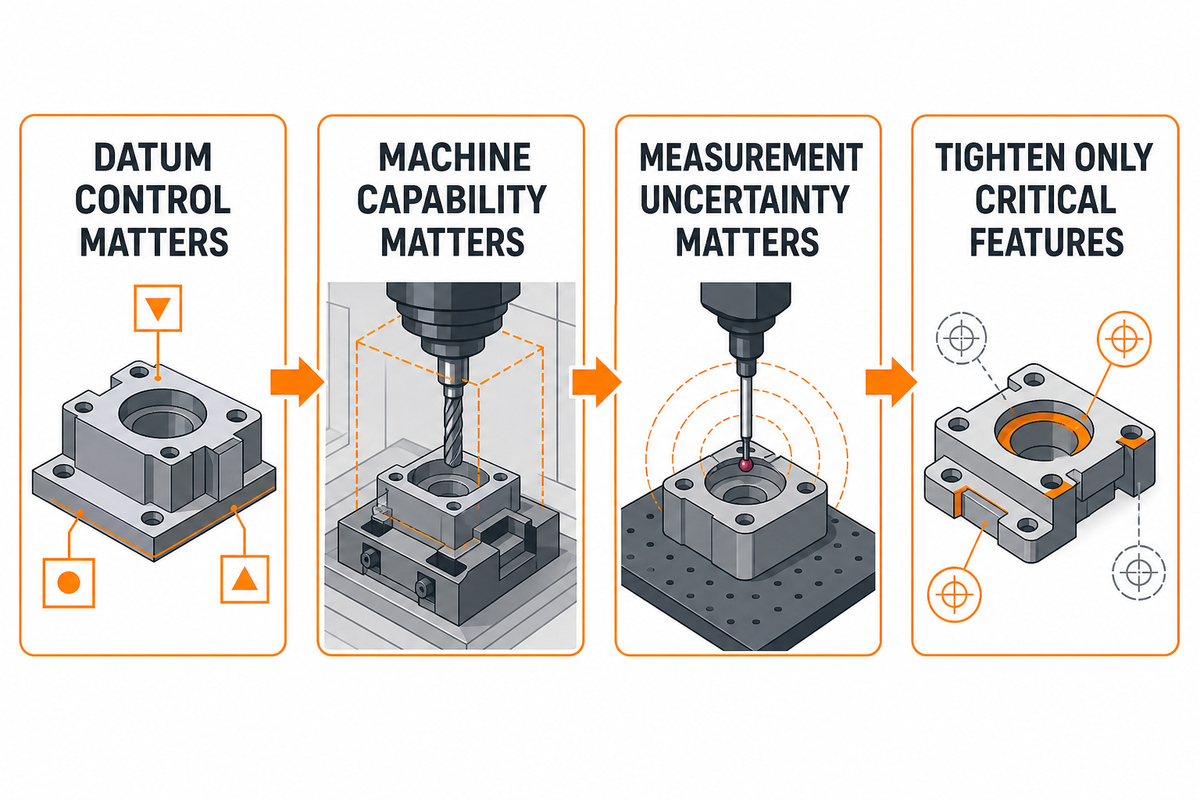
The Tolerance-to-Inspection Chain is the most common source of hidden cost in custom machining. Tolerance is not only a number on a drawing. It depends on datum control, feature access, machine capability, fixture stability, tool wear, material behavior, surface finish, inspection method, and acceptance criteria.
ASME Y14.5 is the dimensioning and tolerancing standard family buyers often reference for GD&T, and ANSI’s standards explainer identifies ASME Y14.5-2018 (R2024) as part of current drawing and model requirements context. ASME Y14.41-2026 adds digital product definition data practices for preparing and revising digital data sets.
P0-1 found a missing boundary that matters: inspection evidence must also account for measurement uncertainty and traceability. NIST explains that measurements have uncertainty, specifications have tolerances, and manufacturing decisions carry finite false-accept and false-reject risk. NIST’s metrological traceability policy also says traceability needs a documented unbroken calibration chain and that traceability alone does not guarantee fitness for purpose.
Buying teams should keep the rule simple: tighter tolerance is not always better. Tighten only the features that control assembly, sealing, wear, motion, or measurement. Leave noncritical dimensions at standard machining tolerance when function allows. That reduces cnc machining costs while making inspection easier to defend.
In practice, a cnc machining process can separate examples like 0.20 mm general pockets, 0.10 mm clearance holes, 0.05 mm locating shoulders, 0.02 mm bearing seats, Ra 3.2 um cosmetic faces, Ra 1.6 um sealing faces, and 24 hr inspection review. These numbers are not Lecreator promises. They show why a coordinate-measuring machine report, surface finish note, and drawing revision need to match before cnc machined parts are accepted.
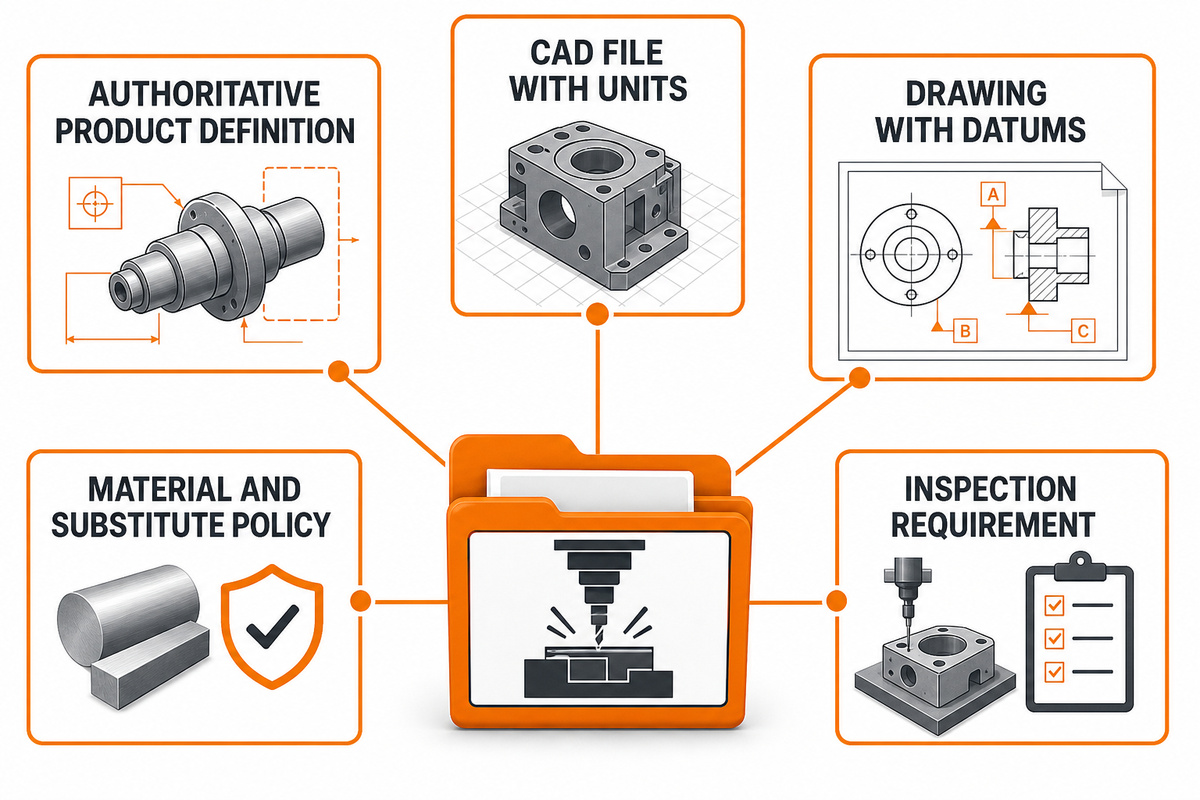
The 9-Point RFQ Data Pack turns an idea into a quote-ready manufacturing package. NIST research on model-based definition warns that CAD-to-manufacturing exchange needs product and manufacturing information in addition to shape geometry so suppliers can manufacture and inspect physical parts. That means a CAD file alone is not enough for controlled custom manufacturing.
If you need an online cnc machining service, this data pack also helps the supplier decide whether an instant quote is safe or whether engineering review is required. It reduces back-and-forth, protects custom cnc machining parts from preventable mistakes, and gives both sides a better basis to get a quote.
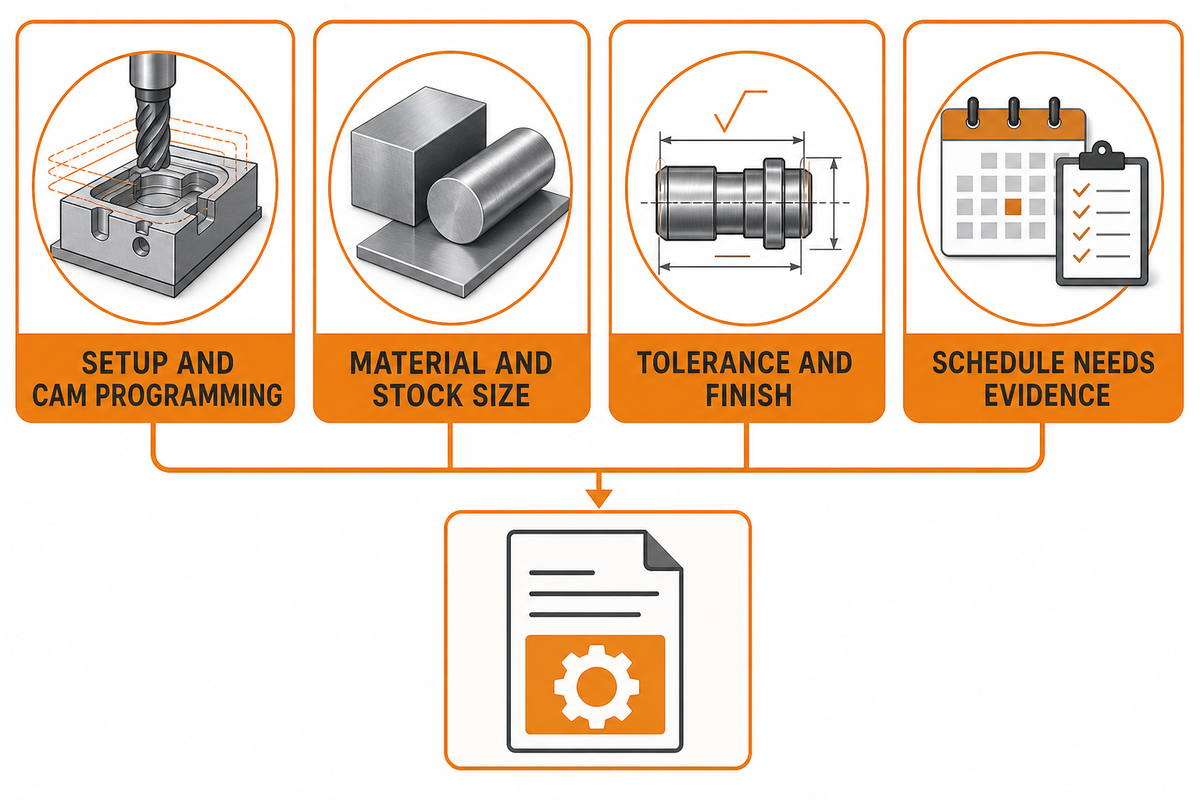
Custom machining cost is driven by setup, CAM programming, material, stock size, cycle time, tool wear, fixture strategy, tolerance, finish, inspection, yield risk, delivery target, and communication quality. Supplier-published guides such as Davantech’s 2026 CNC cost page give useful examples of cost factors and regional hourly-rate ranges, but they are L4 commercial examples, not universal market truth.
The fastest way to reduce cnc machining costs is not always to choose the cheapest material or remove inspection. Better levers include relaxing noncritical tolerance, using standard stock, reducing setup count, keeping internal radii tool-friendly, choosing machinable alloys, avoiding cosmetic finish on hidden faces, and sharing assembly context early. Designs that are easy to mill, turn, fixture, and inspect are usually less expensive than designs that hide functional priorities.
For quick-turn parts, do not confuse speed with production readiness. Rapid prototypes can validate shape, fit, and basic function. Production readiness still needs material confirmation, repeatable process route, inspection plan, and stable revision control. That is especially true when prototype machining moves into rapid prototyping and production.
Use schedule numbers as planning inputs instead of slogans. Timelines such as a 2-day visual prototype, a 5-day machined pilot, a 10-day production-ready sample, and a 48 hr drawing review can all be reasonable in different contexts, but each route depends on material availability, machine loading, inspection time, and whether the cnc manufacturing plan is stable.
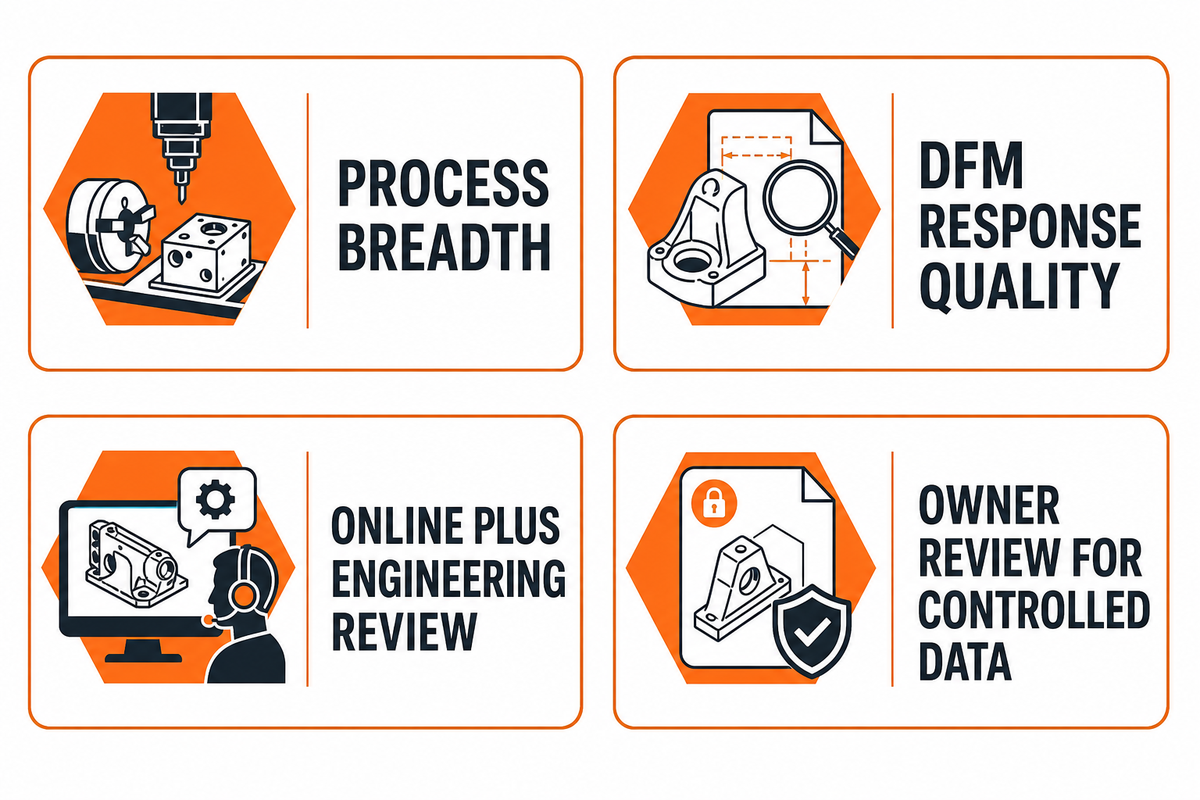
Suitable custom machining suppliers should do more than accept files. Look for process breadth, DFM response quality, material sourcing discipline, inspection capability, documentation, communication speed, and the ability to scale from cnc machined prototypes to production parts. Lecreator’s public About page identifies Shenzhen Le-creator Technology Co., Ltd. and states 17+ years of experience, 100+ professionals, 80+ machines, and 98%+ first-pass yield. Use those as first-party signals, then verify fit against the actual project.
Ask whether the supplier can provide cnc machining service online for simple geometry and engineering review for complex work. Strong partners can explain when cnc milling, cnc turning, cnc milling and cnc turning, wire EDM, sheet metal, finishing, or 3D printing fits. They can also explain where advanced cnc, advanced cnc machining capabilities, precision cnc machining services, precision cnc parts, manufacturing services, cnc technology, and a quality cnc workflow create value rather than marketing noise.
For controlled or tightly specified projects, add a conditional owner-review branch. DCSA advises industry to review contracts, FAR and DFARS clauses, and applicable CUI safeguarding requirements. BIS explains that releasing controlled technology to a foreign person can create a deemed export issue. These are not requirements for every custom machining job. Treat them as flags that defense, controlled-data, or other regulated projects need the buyer’s responsible owner involved before files are released.
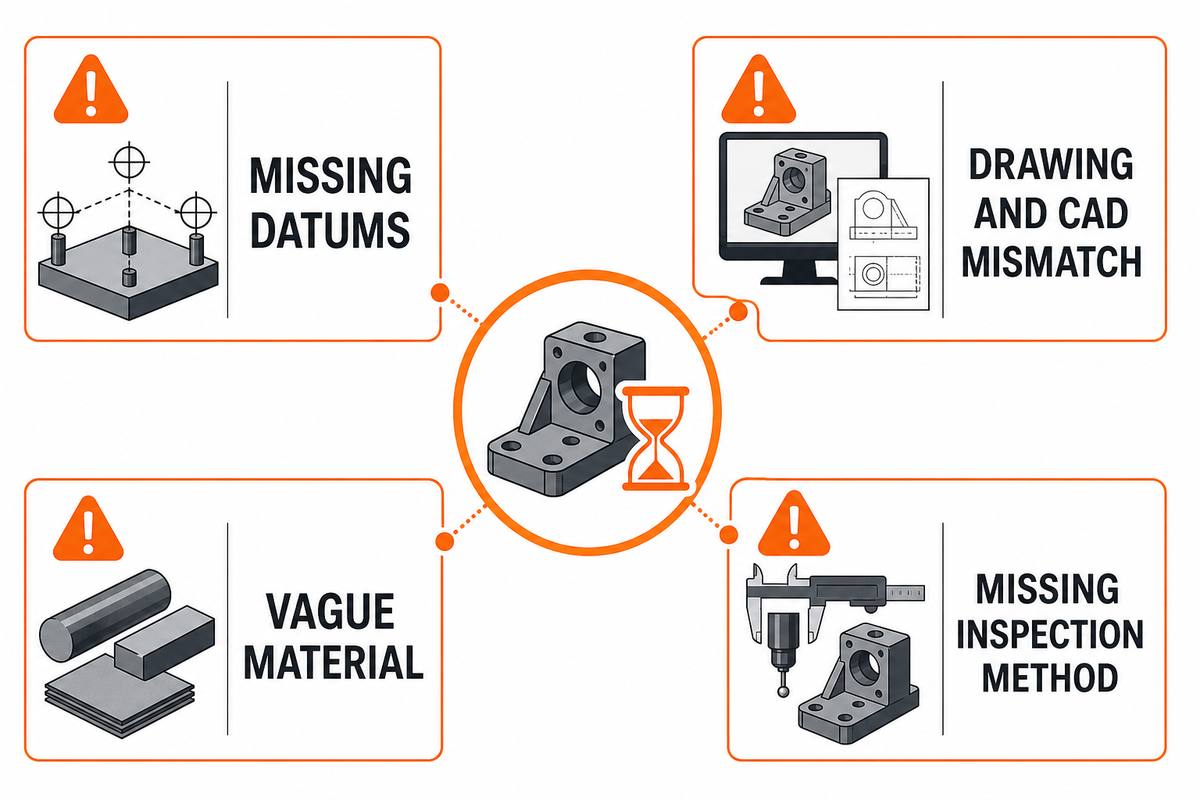
Most custom cnc failures are not mysterious. They come from unclear product definition, missing datums, drawing and CAD mismatch, vague material, unrealistic finish, over-tolerancing, missing inspection method, hidden mating parts, or quantity changes after quote. Modus Advanced and Practical Machinist both publish examples and practitioner comments around drawing errors and quote ambiguity, but those are supplier and forum sources, so use them as pain signals rather than independent authority.
The engineering fix is not to add more notes everywhere. It is to make the critical path visible. Which features drive assembly? Which surfaces are cosmetic? Which dimensions need precise machining? Which inspection record proves acceptance? Which custom cnc parts must match another supplier’s component? Which metal and plastic parts need separate thermal or chemical rules?
Use the failure list as a pre-RFQ review, not as blame after delivery. If a supplier has to guess material grade, drawing authority, acceptance method, or end-use limits, the quote may be fast, but the manufacturing risk has simply moved downstream.
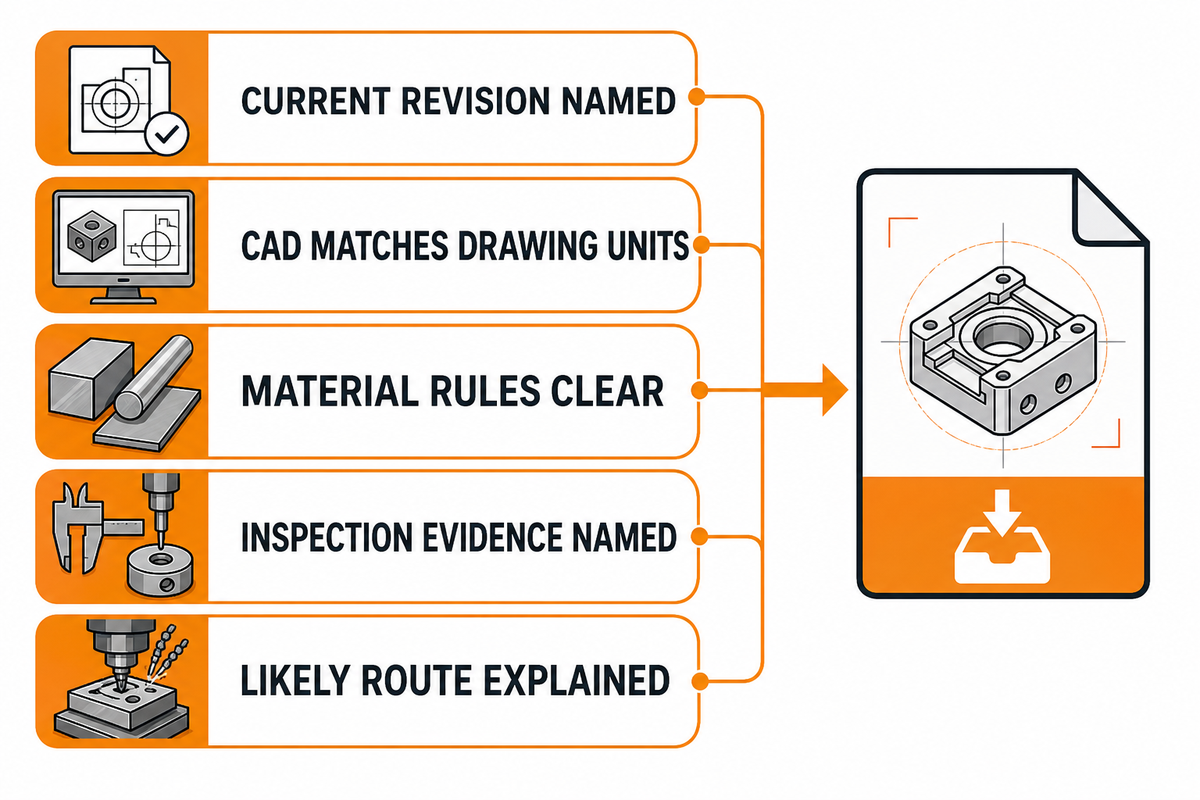
Before you request pricing, confirm that the package answers these questions.
If your team is comparing custom machining near me options or needs custom cnc machining services for prototype, quick-turn parts, precision parts, or production parts, prepare the data pack first. Then ask Lecreator to review manufacturability, cnc machining design, cnc machining design tips, cnc machining applications, cnc machining materials, and inspection evidence before release.
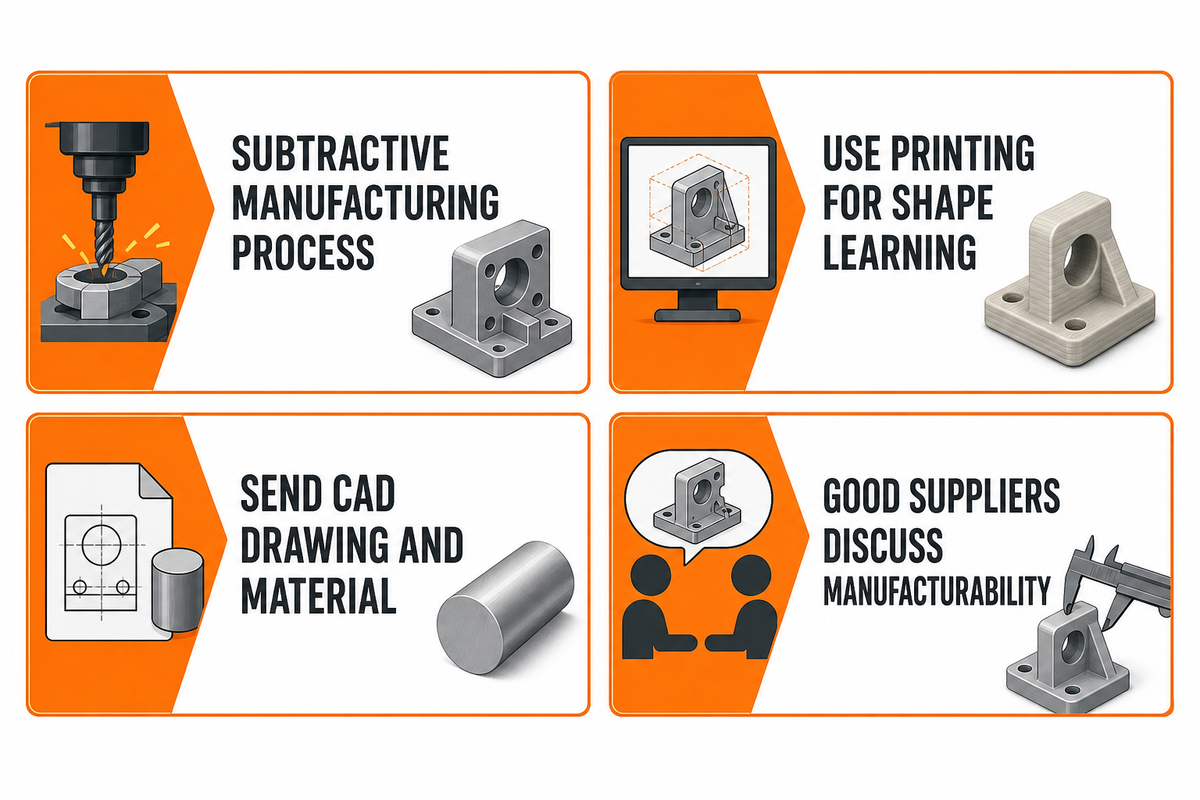
These cnc machining faqs summarize the decisions that usually matter before an engineering team asks for a quote.
Custom machining is a subtractive manufacturing process used when a standard component cannot meet the drawing, material, tolerance, surface finish, or end-use requirement. Computer numerical control, often shortened to CNC, uses a machine tool such as a mill, lathe, EDM system, or combined machining center to remove material from metal or plastic stock. In practical cnc manufacturing, the supplier verifies cnc machined parts and cnc-machined parts against the agreed CAD model, 2D drawing, inspection plan, revision identity, and acceptance evidence.
Use 3D printing when the main goal is shape learning, internal geometry, fit checks, or fast design iteration before final material behavior matters. Move to CNC machining when the prototype must use production material, hold tighter tolerance, include threaded or bearing features, show machined surface finish, or behave like end-use parts under load, heat, chemicals, wear, or assembly stress.
Send the authoritative CAD file, 2D drawing, revision, material grade, quantity, finish, critical dimensions, tolerance notes, inspection requirements, target lead time, and end-use context. If the part has mating components, regulated data, controlled technology, cosmetic surfaces, threads, or required reports, include those details before requesting an online quote because they affect machining process selection, cost, delivery, supplier eligibility, and whether the supplier can quote without guessing a hidden acceptance test or revision-controlled first article review before release.
Reduce cost by loosening noncritical tolerance, naming critical surfaces, using standard stock before formal quoting, and choosing machinable materials with clear substitute rules. Keep paid precision only where it protects fit, motion, sealing, wear, or inspection acceptance on the drawing.
Good suppliers can discuss manufacturability before quoting, explain process limits, document inspection, source appropriate materials, protect critical tolerances, and communicate risk early. For cross-process work, a partner with CNC machining, sheet metal, finishing, and 3D printing can reduce handoff friction, but the buyer still needs to verify quality, data-control, and compliance requirements for the specific project.