

Supportive, Professional, Client-Focused Service
From prototypes to full-scale production, we’ve got you covered.



The Engineer’s Guide to Rapid Prototyping Services: Process Selection, Material Matching, and Prototype-to-Production Strategy
📐 Quick Specs
| Technologies Covered | CNC, SLA, SLS, FDM, DMLS, Vacuum Casting, Rapid Injection Molding |
| Tolerance Range | ±0.025 mm (CNC) to ±0.3 mm (FDM) |
| Typical Lead Time | 1–10 business days |
| Material Families | Engineering plastics, photopolymers, metals (Al, Ti, SS), composites |
| Cost Range | $50–$5,000+ per part |
| Standards Referenced | ASTM F2792, ISO 9001, AS9100D, ISO 13485 |
Selecting the wrong prototyping process is a gamble that costs more than money – it costs weeks of development time, sets back your validation cycle and can leave your engineering team scratching their heads. This guide provides a clear breakdown of exactly how rapid prototyping services are manufactured on modern manufacturing technologies what process suits which application, the true costs involved and moving from a validated prototype to full-scale production without tooling wastage. Whether you need snap-fit enclosures, structural aerospace brackets, or medical device components, the process selection framework outlined here will help you match process, material and budget to your objectives. For a rapid prototyping service capable of supporting the entire product development process from initial engineering prototypes all the way through to digital manufacturing and final production, this is the evaluation playbook.
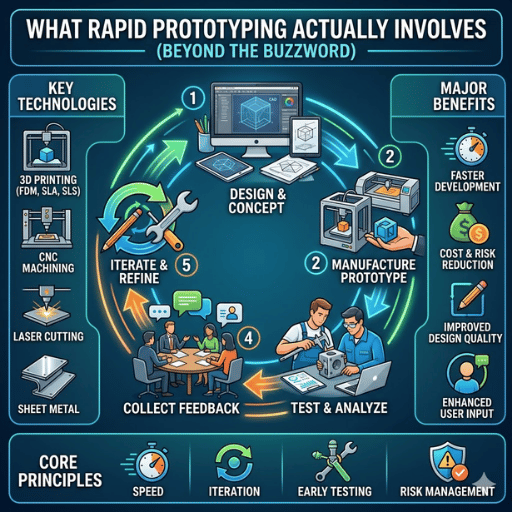
The phrase “rapid prototyping” gets thrown around quite a bit. For procurement it means speedy quotations. For marketing it’s synonymous with agility. But for the engineer it’s a precise manufacturing process, with defined inputs, process controls and measurable outputs that cut down the product development cycle times. Here’s what you can expect when sending a part out for rapid prototyping:
These six stage map onto the larger additive manufacturing taxonomy set out in ASTM F2792-12a, which defines 7 families of AM process: vat photopolymerisation, material extrusion, powder bed fusion, binder jetting, material jetting, directed energy deposition and sheet lamination. The majority of rapid prototyping services are representative across 3-4 of these families, alongside subtractive (CNC) and formative (moulding) prototyping methods — whether you need a single prototype or multiple prototypes for concurrent testing.
Here is the key point: rapid prototyping is not one technology — it is the choice of technology. Each branch of the decision tree is best suited to a form, fit, functional or combined test, and depends on how close the prototype material needs to be to production grade material. Prototyping services allow teams to use rapid prototyping with 3D printing, CNC machined parts, or molded parts — each prototyping approach offering different trade-offs between speed, precision, and per-unit cost for prototyping projects of any scale.

All prototyping technology involves balancing of precision, speed, choice of material and cost. Below are real data points for each process — use these comparisons to judge which approach meets your part-specific criteria.
| Technology | Tolerance | Surface Finish (Ra) | Min Wall | Cost/Part | Lead Time | Best For |
|---|---|---|---|---|---|---|
| CNC Machining | ±0.025 mm | 0.8–3.2 μm | 0.5 mm | $100–$2,000 | 3–10 days | Metals, tight tolerance |
| SLA | ±0.05 mm | 1.0–2.0 μm | 0.3 mm | $50–$500 | 1–3 days | Visual prototypes, fine detail |
| SLS | ±0.15 mm | 6–15 μm | 0.7 mm | $50–$800 | 2–5 days | Functional prototypes, nylon parts (laser sintering) |
| FDM | ±0.25 mm | 8–25 μm | 0.8 mm | $5–$300 | 1–3 days | Concept models, low cost |
| DMLS | ±0.1 mm | 5–15 μm | 0.4 mm | $200–$2,000+ | 5–10 days | Metal functional parts |
| Vacuum Casting | ±0.15 mm | Mold-dependent | 0.5 mm | $30–$150 | 5–15 days | Small batch (10–50), rubber-like |
| Rapid Injection Molding | ±0.05 mm | 0.8–3.2 μm | 1.0 mm | $5–$25 (+ $1,500–$15,000 tooling) | 10–20 days | Bridge production 100–5,000 |
What are the practical differences that go beyond what a tolerance column represents? Here is how they compare on the factors that often lead the check box for whether to keep additive or go subtractive. (Note: in this context additive means 3D printing technologies, subtractive means CNC machining services)
✔ Additive Manufacturing (3D Printing) — Advantages
⚠ Additive Manufacturing (3D Printing) — Limitations
✔ Subtractive Manufacturing (CNC) — Advantages
⚠ Subtractive Manufacturing (CNC) — Limitations
When your part requires tight tolerances on mating surfaces but complex internal geometry, a hybrid approach works well: 3D print the body, then CNC machine critical interfaces. Many providers offering CNC prototype machining also run additive lines under the same roof, which eliminates coordination delays. Similarly, 3D printing prototyping services with in-house CNC means your DFM review can recommend a multi-process prototyping approach without adding a second vendor. Services offer a range of rapid prototyping methods — from industrial 3D printing and sheet metal parts fabrication to rapid CNC machined parts and 3D printed tooling — prototyping services using these manufacturing methods help teams build prototypes and production parts from a single source.
Material selection for prototyping is not just about matching the final production material. It is about matching the functional requirement of the test. Durable prototypes for drop tests need impact resistance. 3D printed prototypes for thermal validation need the right heat deflection temperature. A prototype for stakeholder review needs surface finish and color accuracy. The table below maps common prototyping materials to their mechanical properties and production equivalents.
| Prototype Material | Tensile Strength | Heat Deflection | Prototype Use Case | Production Equivalent |
|---|---|---|---|---|
| SLA Tough Resin | 55 MPa | 58°C | Snap-fit housings, functional testing | ABS injection mold |
| SLS Nylon PA12 | 48 MPa | 175°C | Gear assemblies, living hinges | PA12 injection mold |
| CNC Aluminum 6061-T6 | 310 MPa | N/A (melts 580°C) | Structural brackets, heat sinks | Production Al 6061-T6 |
| CNC Stainless 316L | 515 MPa | N/A (melts 1,375°C) | Medical instruments, food contact | Production SS 316L |
| FDM ABS | 33 MPa | 98°C | Form/fit checks, jigs & fixtures | ABS injection mold |
| FDM PETG | 50 MPa | 70°C | Chemical-resistant housings | PET injection mold |
📐 Engineering Note — Tolerance Stack-Up During Process Transition
When transitioning from a CNC-machined prototype to injection-molded production, expect dimensional shifts of 0.05-0.15 mm due to mold shrinkage, warpage, and gate location effects. For glass-filled nylon (PA66-GF30), shrinkage runs 0.3-0.5% along flow and 0.7-1.2% across flow. Always build this variance into your tolerance stack-up analysis before approving the prototype dimensions as final. A prototype that passes at 0.05 mm may fail production QC if the mold shrinkage pushes critical dimensions outside the acceptance window.
Established prototyping providers typically stock 50+ material options across plastic and metal parts, which means you can match prototyping materials to your production spec without waiting for special-order stock. The key is communicating what you are testing – not just what material you want – so the engineering services team can recommend cost-effective rapid prototyping services that deliver equivalent functional data at lower cost or faster turnaround.

Rapid prototype pricing is not linear. A part that costs $80 via FDM might cost $400 via rapid CNC – but if the FDM version fails functional testing because of anisotropic weakness, you have spent $80 plus two weeks of wasted development time. Understanding the real cost structure helps you make cost-effective decisions and spend in the right places.
| Process | Setup Cost | Per-Unit Range | Sweet Spot Quantity | Lead Time |
|---|---|---|---|---|
| FDM | $0–$50 | $5–$300 | 1–10 parts | 1–3 days |
| SLA | $0–$50 | $50–$500 | 1–5 parts | 1–3 days |
| SLS | $0–$100 | $50–$800 | 5–50 parts | 2–5 days |
| CNC | $100–$300 | $100–$2,000 | 1–50 parts | 3–10 days |
| DMLS | $100–$500 | $200–$2,000+ | 1–10 parts | 5–10 days |
| Rapid IM | $1,500–$15,000 | $5–$25 | 100–5,000 parts | 10–20 days |
Hidden cost drivers most engineers miss:
⚠️ Important — The Lowest-Quote Trap
When comparing new prototyping vendors, choose by total project cost rather than per-unit price. A low quoted price without a DFM review could mean you are paying 30%+ more for your final product while waiting an additional 3-4 weeks to get there. Choosing a vendor that adds 15% to their quote to catch DFM issues before they cut metal costs you in the long run.
📐 Engineering Note — CNC Machine Rate Benchmarks
Typical pricing for U.S.-based CNC shops runs about $75-$150/hr for 3-axis systems and $100-$200/hr for 5-axis systems. Chinese shops operating in compliance with at least AS9100D or equivalent standard will generally charge about $25-$60/hr for the same machine configurations. That means whether you pay $400-$600 domestically or $100-$240 in China for a 4-hour CNC prototype, the main difference is 5-7 days of shipping.
Always request a quote using your provided cad files and tolerance callouts – verbal estimates are not reliable to within more than 30-60%.

Between the “working prototype” and “production ready part” is the reason most projects get hung up. Engineering teams validate a CNC machined prototype, get approval, and then face a 12–16 week wait for steel production tooling needed for final production. Bridge tooling fills that gap – and understanding the economics determines whether it makes financial sense for your project.
✔ Aluminum Soft Tooling — Advantages
⚠ Aluminum Soft Tooling — Limitations
Based on the Wohlers Report 2025, the worldwide additive manufacturing industry generated $21.9 billion dollars in revenue in 2025, a growth rate of 9.1%. Manufacturing services account for 47% of that revenue — helping engineering teams move prototypes quickly from prototype to production using advanced manufacturing methods without owning a fleet of machines.
Most hardware programs benefit from a three-stage bridge strategy:
This phased approach minimizes financial risk. If market feedback during Stage 2 requires a design change, you have spent $3,000–$15,000 on an aluminum tool — not $25,000+ on a steel tool that now needs modification. The prototype-to-production pathway is most effective when one entity oversees all three stages, allowing dimensional data from Stage 1 to directly inform Stage 2 tooling design.

Not every prototyping service provider offers the same value — or the same high-quality results. A shop with 3 FDM 3D printers and a quoting portal is not equivalent to an expert rapid prototyping facility with 80+ CNC, 3D printing, and injection molding machines – even if per-part cost appears similar. This is a weighted evaluation framework that emphasizes factors likely to influence your project results.
| Criterion | Weight | What to Verify |
|---|---|---|
| DFM Feedback Quality | 30% | Do they review your CAD and suggest geometry changes before quoting? Or just price what you sent? |
| Tolerance Consistency | 25% | Can they provide CMM inspection reports from previous production runs? Ask for Cpk data on critical dimensions. |
| Production Pathway | 20% | Do they support bridge tooling and production-scale manufacturing, or is prototyping their ceiling? |
| Communication Speed | 15% | RFQ response time under 24 hours? Technical questions answered by engineers, not just sales reps? |
| Certifications | 10% | ISO 9001 (general QMS), AS9100D (aerospace), ISO 13485 (medical devices), ITAR (defense export control) |
Pro Tip – Indicators of a problematic provider
A brief coverage of the most important certifications: ISO 9001:2015 is the fundamental quality management standard – lack of its presence indicates potential quality issues. AS9100D meet aerospace-specific requirements for configuration control, risk mitigation, and traceability. ISO 13485 manages medical device production with biocompatibility and design specifications documentation. ITAR is enshrined in law – only US facilities can legally handle technical information concerning government/military applications.
You can review Le-creator’s prototyping capabilities, certifications, and vehicle list – and see how these factors look in context. The whole facility runs ISO 9001:2015, ISO 13485, AS9100D, and ITAR registration requirements combined with more than 80 CNC and 3D printing machines installed in a single facility. You may also discover our engineering team and the 17+ years of precision prototyping and advanced rapid manufacturing experience that ensures your prototypes perform to specification.

The five fundamental steps are: (1) CAD design and file preparation, (2) DFM analysis, (3) process selection based on tolerance, material, volume specifications, (4) fabrication using the defined technology, and (5) post-processing and validation — including support removal, surface finishing, and dimensional inspection. Skipping the DFM review is the most common cause of prototype rework and schedule delays. Each step has specific checkpoints to compare against standards in ASTM F2792.
Pricing starts at $5 for a basic FDM concept model and can exceed $5,000 for multi-process metal prototypes requiring tight tolerances and secondary finishing. Primary cost drivers: geometry complexity, tolerance class, material grade, surface finish specification, and order quantity. Here is a quick reference:
| FDM concept model | $5–$300 |
| SLA visual prototype | $50–$500 |
| CNC metal prototype | $100–$2,000 |
| DMLS metal functional part | $200–$2,000+ |
| Rapid injection molding (per unit + tooling) | $5–$25 + $1,500–$15,000 |
Budget an additional 8–15% for finishing, inspection, packaging, and freight. Always request quotes with complete CAD files and full tolerance callouts — verbal estimates miss 30–60% of the real cost.
Leading rapid prototyping providers have 50+ materials available for engineering tests in four groups: thermoplastics (ABS, Nylon PA12, PC, PETG, POM, PEEK), photopolymers (standard, tough, flexible, moldable), metals (Al 6061, SS 316L, Ti 5, Brass C 360, Cu C 110), and composites (carbon-filled nylon, glass-filled PA). Material choice should depend on the attributes sought in the testing phase, rather than the attributes of the finished part.
Prototyping is design validation — typically 1–50 units built for quick iteration, where relaxed tolerances are acceptable if they do not impact the test objective. Production means market delivery: 1,000+ units with repeatable quality, certified materials, full documentation (FAI, PPAP, material certs), and process controls delivering Cpk >1.33 on critical dimensions. Bridge tooling connects the two phases: aluminum soft tools produce 100–5,000 production-grade units while hardened steel tooling is being fabricated — limiting financial exposure if design changes emerge from market feedback.
FDM and SLA: 1–3 business days. SLS: 2–5 days. CNC: 3–10 days. Vacuum casting: 5–15 days. Rapid injection molding: 10–20 days including aluminum tooling. Rush services cut these by 30–50% at a 25–50% premium.
STEP (.stp), IGES (.igs), STL. Native CAD also accepted: SolidWorks (.sldprt), Fusion 360 (.f3d), Creo (.prt), CATIA (.CATPart). Always include a 2D drawing with critical dimensions and GD&T callouts.
Metal rapid prototyping can be done via CNC machining, DMLS or SLM, or investment casting. CNC is great for aluminum, stainless steel, titanium and other metals with tight tolerances (0.025 mm) and excellent surface finish. DMLS and SLM allow same batch of parts to be built with complex internal structures, conformal cooling channels, and organic shapes that cannot be machined – tolerances can be between 0.1 mm with post-machining of critical surfaces. Investment casting opens up complex geometries with additive manufacturing specific materials. The choice depends on geometry, material & batch size: CNC 1-50 precision parts, DMLS for complex geometry 1-50 precision parts, investment casting for 20-200 units.
Ready to start your next rapid prototyping project?
Upload your cad files for a DFM review and detailed quote – typically within 24 hrs.
About This Engineering Guide
This article was authored by Le-creator Technology, a precision maker based in Shenzhen. With 17+ years of experience in CNC machining, 3D printing, sheet metal fabrication and injection molding and over 80 production machines, we serve clients in medical, aerospace, electronics, and industrial fields. Our tolerance benchmarks and cost ranges cited are validated by our production floor on 10,000+ projects per year. Learn more about our company and certifications.
References & Sources
Related Articles