

Supportive, Professional, Client-Focused Service
From prototypes to full-scale production, we’ve got you covered.


Updated June 2026 · Reviewed by the Le Creator Technology Co., Ltd. technical team
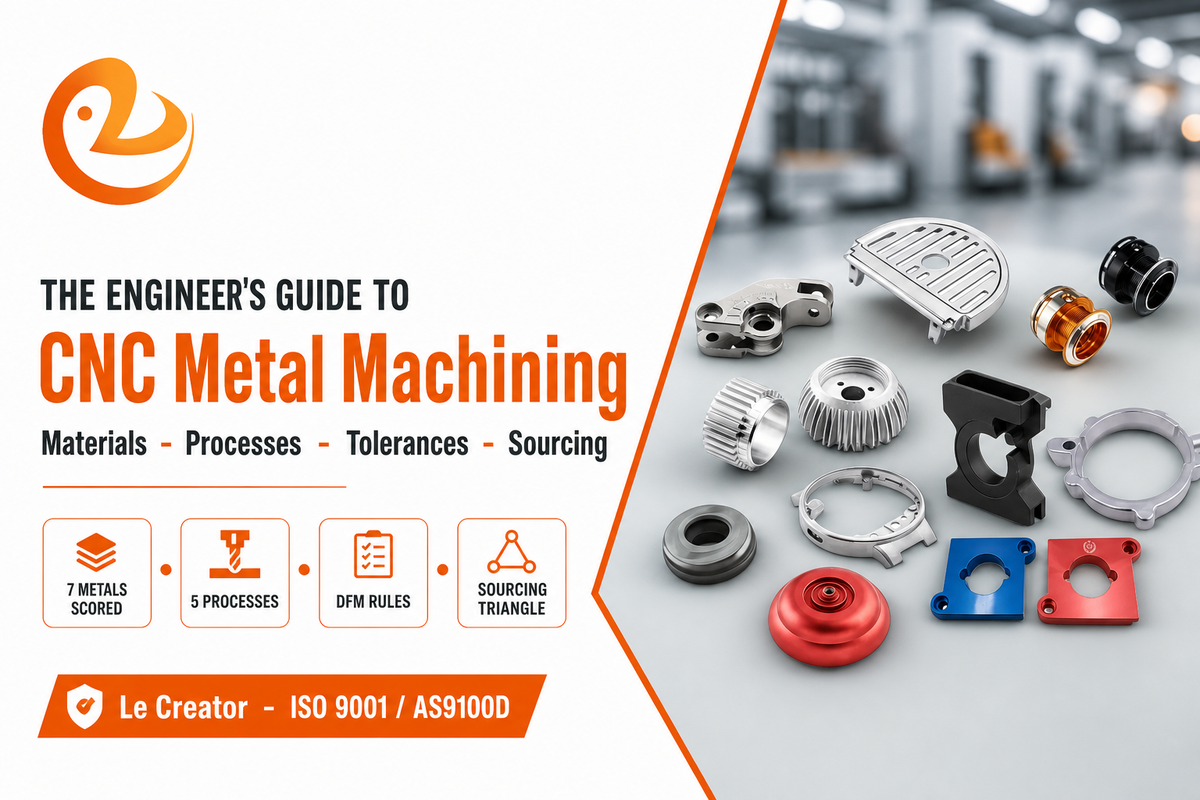
CNC metal machining is the computer-controlled, subtractive process of turning a solid block of metal into a finished, high-precision part by removing material. This guide to ordering custom CNC metal parts is written for engineering and procurement teams who have to choose a metal, pick a process, set realistic tolerances, and decide which metal machining services to use, not for hobbyists shopping for a desktop machine. It’s the same precision CNC machining that produces high-precision parts for regulated industries. We pull the numbers that most “cnc metal” pages leave out: machinability by metal, achievable tolerances, the five things that move price, and the sourcing rules (including the ones that keep some parts onshore).
| Standard tolerance | ISO 2768-m general (size-dependent, ~±0.1 mm mid-size); tight features ~±0.050 mm; select ±0.005 mm |
| Common metals | Aluminum, stainless, titanium, brass, copper, magnesium, carbon & alloy steel |
| Core processes | CNC milling, CNC turning, Swiss, 5-axis, wire EDM |
| Typical surface finish | As-machined Ra 3.2 / 1.6 / 0.8 µm; plus anodize, passivate, plate, bead blast |
| Best for | Prototypes and low-to-mid volume precision metal parts with tight tolerances |
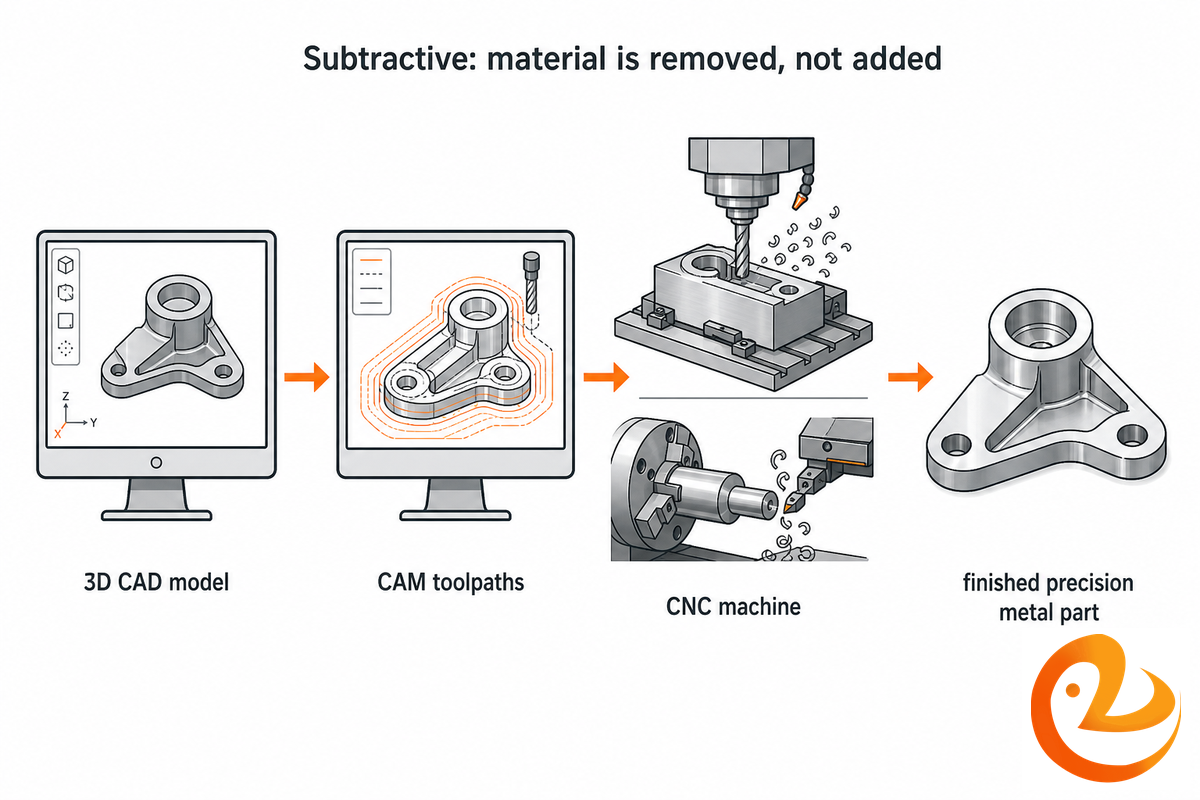
CNC metal machining is a subtractive manufacturing process: a computer numerical control (CNC) machine, a mill, lathe, or electrical discharge machine, removes material from solid metal stock by following toolpaths generated from a CAD model. Because the geometry is driven by numerical control rather than by hand, the same machined part can be repeated to the same tolerance across production parts in the hundreds or thousands.
What actually matters is when to machine versus cast, forge, 3D print, or fabricate from sheet. Machining wins on tolerance and surface finish and needs no tooling, so it’s the default for prototypes and low-to-mid volumes. The other process win when geometry, grain strength, or per-part cost at high volume matter more than precision.
| Process | Best when | Watch out for |
|---|---|---|
| CNC machining | Tight tolerance, no tooling, 1–1,000s of parts | Material waste; cost climbs with complexity |
| Casting | Complex shapes, high volume | Looser tolerance; often machined afterward |
| Forging | Highest fatigue strength (grain flow) | Die cost; still machined to final size |
| Metal 3D printing | Organic geometry, internal channels | Surface finish; post-machining of critical faces |
| Sheet-metal fabrication | Thin flat/bent parts, enclosures | Not for solid 3D features |
If your part is a solid, prismatic or cylindrical metal component that needs precise features, CNC machining is almost always the starting point. These next four sections give you the metal, the process, the tolerance, and the cost to make that call defensibly. For production work you can hand off a model to our metal CNC machining service.
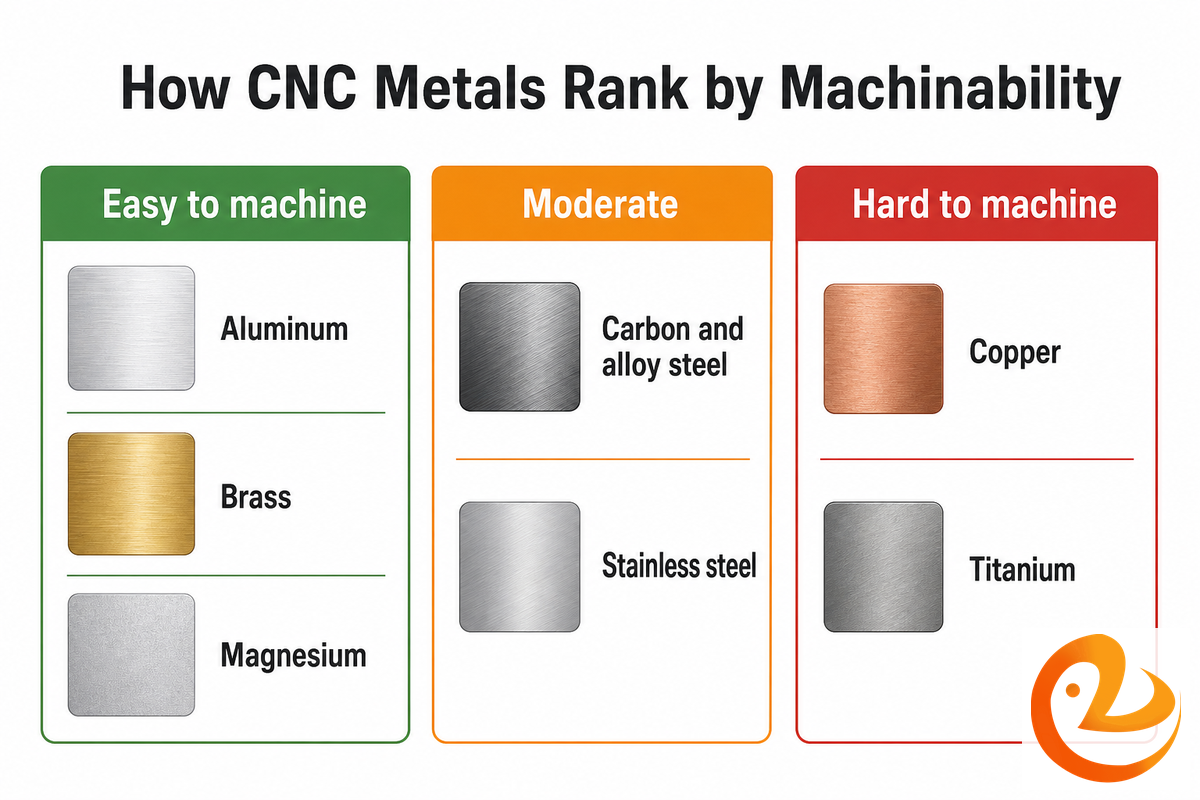
Choosing among CNC machining materials drives both how fast a part can be cut and what it costs, and it fixes the mechanical properties of the finished machined metal. Engineers compare metals with a machinability rating, an index where free-machining B1112 steel is set to 100% and easier-cutting metals score higher. Treat the numbers below as an approximate, process-dependent comparison, not a fixed spec, there’s no single universally accepted way to quantify machinability, and published ratings shift with the cutting operation and baseline used.
| Metal type / grade | Machinability class (approx.) | Relative cost | Key property | Top machining challenge |
|---|---|---|---|---|
| Brass C360 | ~100% (free-cutting reference) | Medium | Easy cutting, conductive | Cost of copper alloy |
| Aluminum 6061 | ~150–190% (Excellent) | Low | Light, corrosion-resistant | Built-up edge if soft temper |
| Aluminum 7075 | ~120–140% (Excellent) | Medium | High strength, aerospace | Costlier than 6061 |
| Magnesium AZ31 | Very high (Excellent) | Medium | Lightest structural metal | ⚠ Flammable chips — fire control |
| Carbon steel 1018 | ~50–78% (Good) | Low | Weldable, tough | Rusts without finish |
| Alloy steel 4140 | ~55–65% (Good) | Low–Medium | High strength, fatigue-resistant | Harder after heat treatment |
| Copper C110 | ~20% (Moderate) | Medium–High | Best thermal/electrical conductor | Gummy, built-up edge |
| Stainless 304 | ~45% (Moderate) | Medium | Corrosion-resistant, common | Work-hardens if dwelled |
| Stainless 316 | ~36–45% (Moderate) | Medium–High | Marine/medical corrosion resistance | Work-hardens, gummy |
| Stainless 17-4 PH | ~35–45% (Moderate) | High | High strength + corrosion | Hardness after aging |
| Titanium Ti-6Al-4V | ~20–22% (Difficult) | High | Best strength-to-weight | Low thermal conductivity, heat stays in tool |
Ratings approximate (AISI machinability index, B1112 = 100%); exact values vary by source and operation. Titanium and nickel alloys such as Inconel (~18%) sit hardest because their low thermal conductivity keeps cutting heat in the tool.
Almost any solid metal can be CNC machined. In practice, most metal parts use one of seven families: aluminum (the volume default for its machinability and weight), stainless steel (corrosion resistance), titanium (strength-to-weight for aerospace and medical), brass and copper (conductivity and easy cutting), magnesium (lightest, with fire-safe handling), and carbon or alloy steel (strength and cost).
Each maps to a different machinability and cost tier above, which is why the metal is the first variable to lock down. We hold in-house lines for aluminum, stainless steel, titanium, brass, copper, magnesium, and steel.
Machinability and strength pull in opposite directions. Aluminum 6061 cuts 7–9× faster than Ti-6Al-4V but has a fraction of titanium’s strength-to-weight. Pick the lowest-strength metal that still meet the load case, it’s almost always the cheaper part.
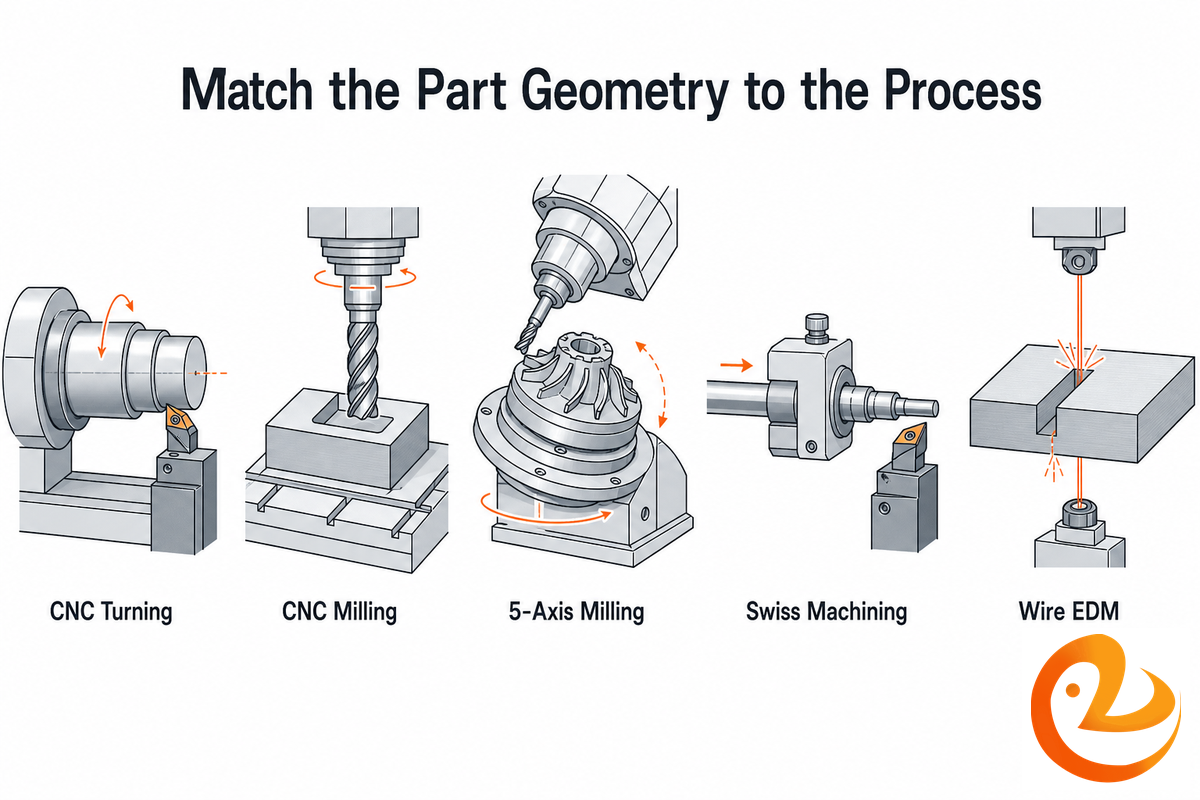
There’s no single “CNC machine.” Your part’s geometry decides the process, and most precision metal parts use a combination of machining capabilities, from simple turning to 5-axis CNC for parts with complex geometries. The playbook below maps part features to the right process and the tolerance you can reasonably expect from each. Matching the part to the process is the core of CNC machining capabilities for high-precision CNC machining.
| If your part is… | Use | Why | Typical tolerance |
|---|---|---|---|
| Round / cylindrical (shafts, pins, bushings) | CNC turning | Workpiece spins against a fixed tool on a lathe | ±0.025–0.05 mm |
| Prismatic with pockets, holes, slots | 3-axis CNC milling | Rotating cutter removes material from a fixed block | ±0.05–0.125 mm |
| Complex contours, undercuts, multi-face | 5-axis milling | Three linear plus two rotary axes reach all faces in one setup | ±0.025–0.05 mm |
| Small, high-volume precision (connectors, screws) | Swiss machining | Sliding headstock supports the bar close to the tool | ±0.005–0.02 mm |
| Hardened metal, sharp internal corners, thin profiles | Wire EDM | An electrically charged wire erodes conductive metal — no cutting force | ±0.005–0.02 mm |
In CNC turning the part rotates and a stationary cutting tool shapes it, which is why turning makes round, cylindrical geometry, shafts, pins, fittings, quickly. In CNC milling the tool rotates and moves across a stationary block, which suits prismatic parts with flat faces, pockets, and holes.
Many real parts need both: a turned body with milled flats or cross-holes, run on a mill-turn machine using CNC turning with live tooling in a single setup. Across many CNC machining operations, including 5-axis indexed milling processes, the right process pairing is what keeps cost down. Choosing the wrong one is a common source of avoidable cost, so start from the dominant geometry. For a deeper comparison see our guide on CNC milling vs CNC turning. These processes serve automotive, aerospace, medical, and industrial parts across our CNC machining service.
Tolerance, the heart of high precision, is where most buyers either overpay or get surprised when ordering precise parts. A widely used default for un-toleranced dimensions is ISO 2768, a general-tolerance standard with four classes, fine, medium, coarse, very coarse. Most shops quote to ISO 2768-m by default.
The formal default for un-toleranced dimensions is ISO 2768-m, whose general tolerance is size-dependent, roughly ±0.1 mm for mid-size features and looser as parts grow, not a single flat number. In common shop practice, tighter callouts reach about ±0.050 mm, and select critical features can be machined to ±0.025 mm (±0.001 in) or, on our equipment, down to ±0.005 mm on the right feature. So in practice: leave general features at ISO 2768-m; call out a press-fit bore explicitly at, say, ±0.012 mm; and reserve ±0.005 mm for the one or two features that truly need it.
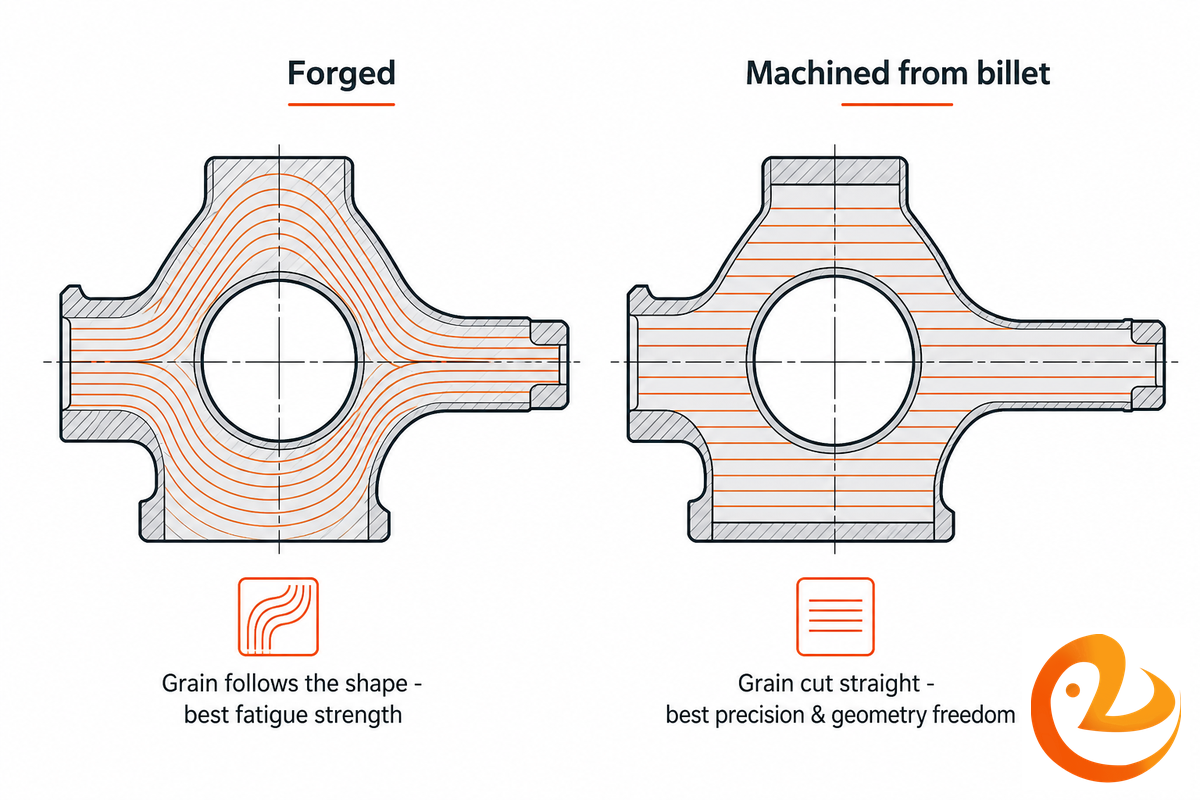
Not for fatigue. A part machined from solid billet is stronger than a cast part, because billet has no porosity. But forging is stronger than machining for fatigue loads: forging aligns the metal’s grain flow with the part shape, while machining cuts straight through the grain.
So the honest answer is that they win on different axes, forging for grain-driven fatigue strength, machining for geometry freedom and tolerance. For a structural part under cyclic load, a forged-then-machined blank is often the right combination; for a precise but lightly loaded part, machining from billet is faster and cheaper.
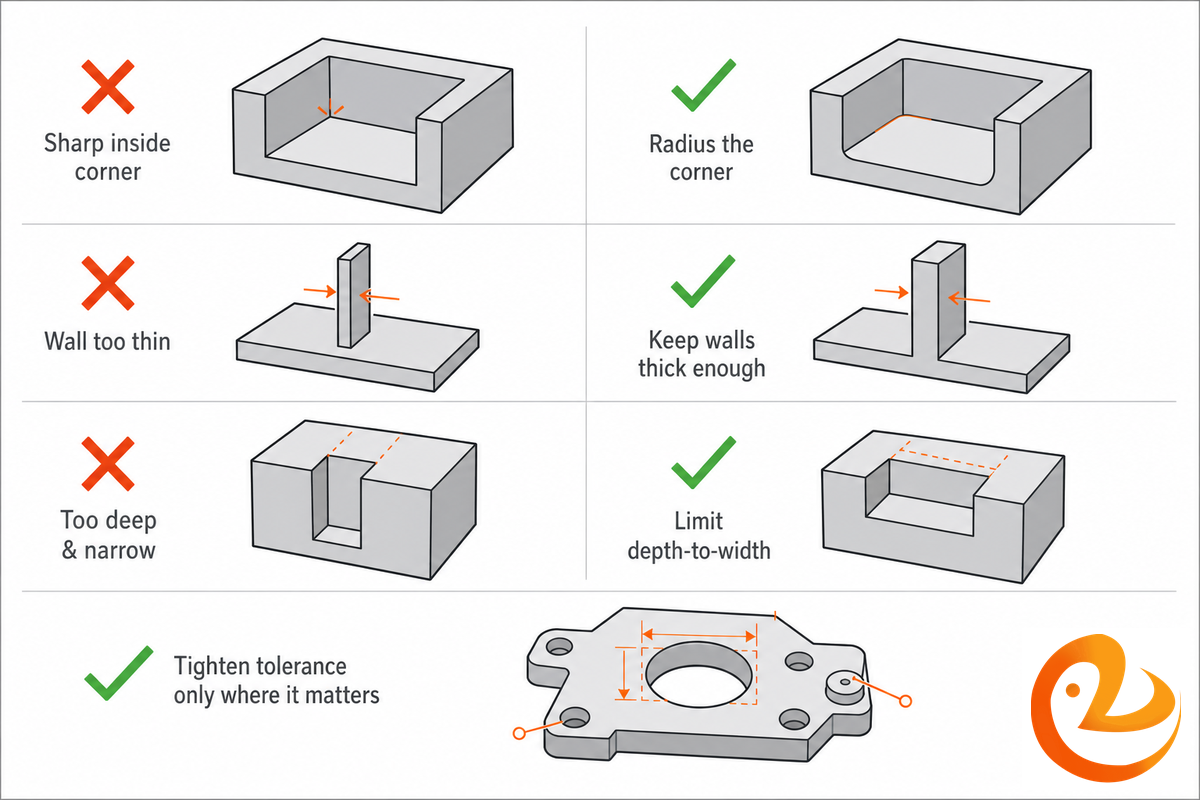
Design for manufacturing (DFM), or CNC machining design, is where you control most of the price before the machining process starts. A few rules in the CNC machining process carry most of the savings on machined metal parts:
“On a typical metal part, the biggest avoidable cost is a drawing that tolerances everything tightly. Open the non-critical features back to ISO 2768-m and reserve sub-0.01 mm callouts for the few that carry the fit, and the quote often drops 20 to 30% with no change in function.”
– Le Creator engineering team
Engineers commonly report that the costliest mistakes are upstream: poor datum selection, missing clearance, and blanket tight tolerances applied to a whole drawing. For more, see our guide to design changes that cut CNC costs and internal corners in CNC machining.
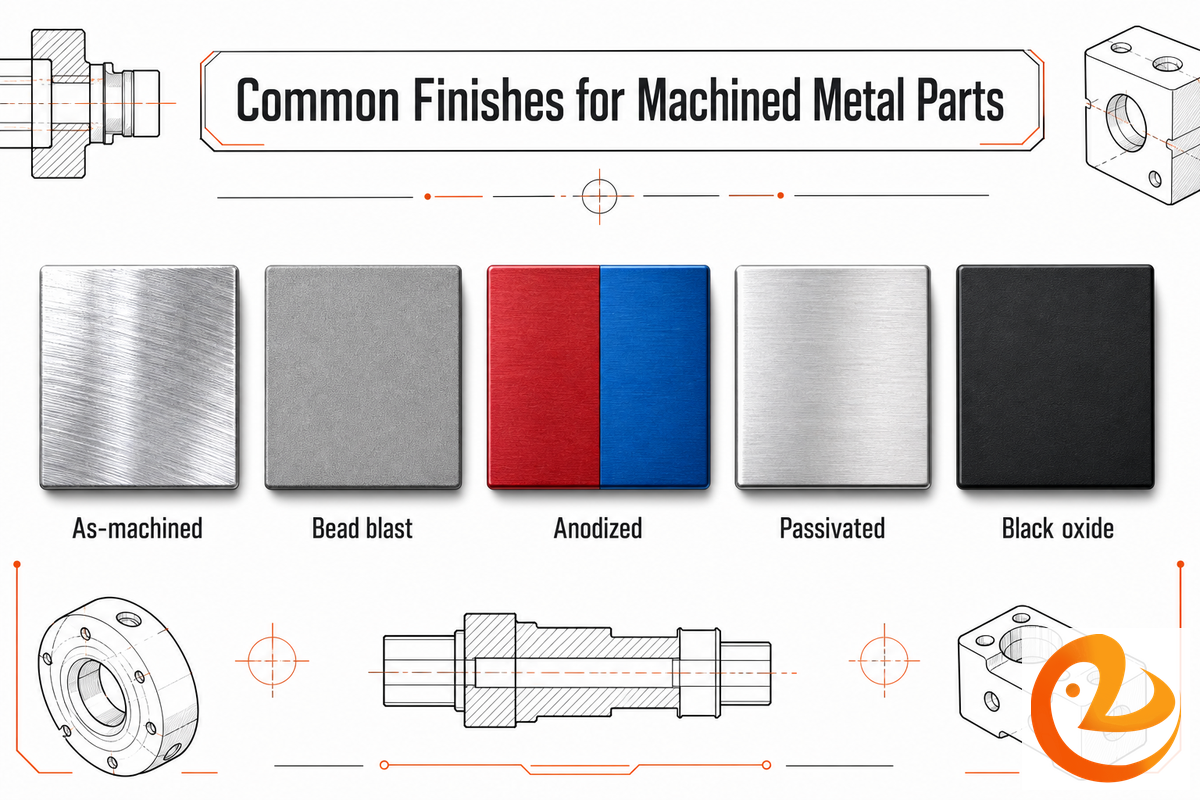
Surface finish is specified two ways: the as-machined roughness (Ra) and any post-machining treatment. Roughness is reported as Ra and measured per ASME B46.1-2019, the surface-texture standard, which defines how Ra is measured, not a single shop value, with measurement traceable to national metrology references at NIST. In practice, as-machined metal typically lands at Ra 3.2 µm, with finer passes reaching 1.6 or 0.8 µm at added cost.
| Finish | Function | Typical metals |
|---|---|---|
| As-machined (Ra 3.2–0.8 µm) | Lowest cost, functional | All |
| Bead blast | Uniform matte cosmetic | Aluminum, steel |
| Anodizing (Type II / III) | Corrosion + wear, color | Aluminum |
| Passivation (ASTM A967) | Restores corrosion resistance | Stainless steel |
| Black oxide / plating | Corrosion, conductivity, look | Steel, copper, brass |
Match the finish to the job: anodize aluminum for outdoor wear, passivate stainless to restore its corrosion layer after machining, and leave internal functional surfaces as-machined to save cost.
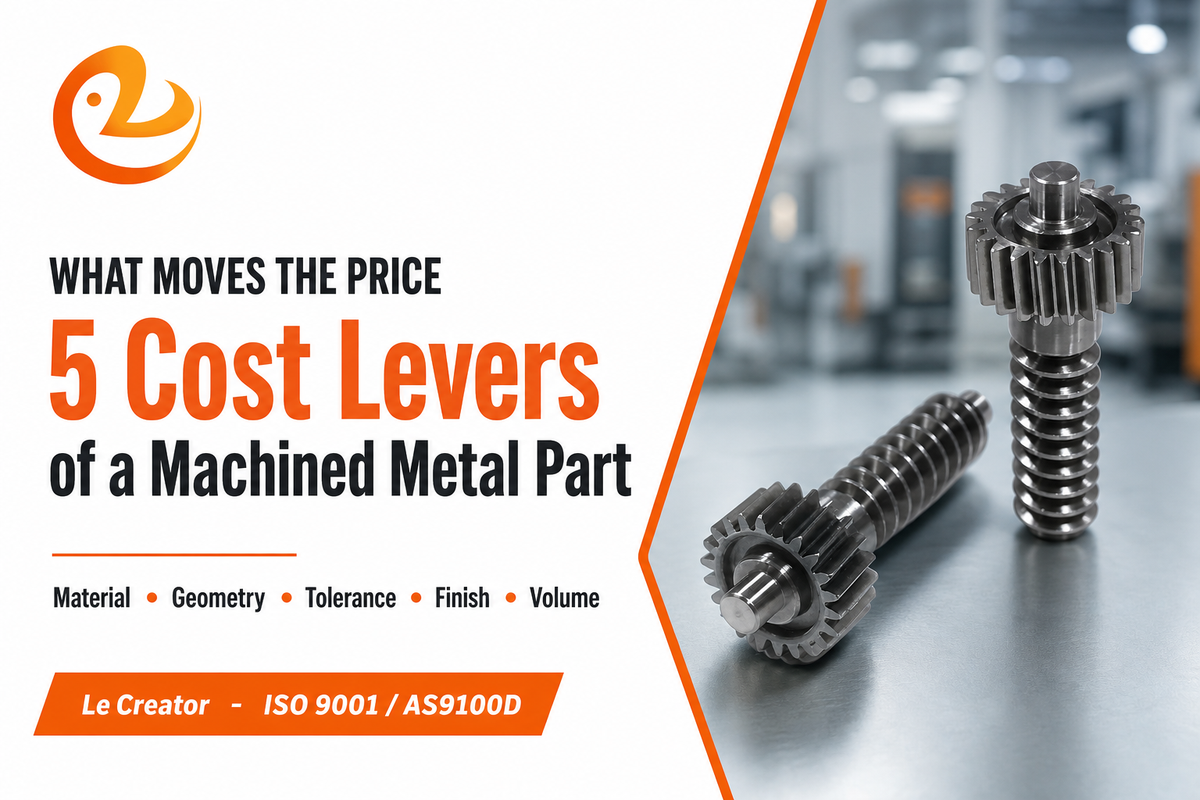
A CNC quote isn’t a black box. Five levers move almost the entire price of a machined metal part, pull the right ones and the same part can drop 20–50% without changing what it does.
There’s no flat rate, cost is computed from the five levers above against your specific CAD file, because material, complexity, tolerance, finish, and quantity all change the machine time. A simple aluminum prototype and a tight-tolerance titanium production part can differ by more than 10×.
A practical move is to upload the model for a quote and then use the levers to negotiate: relax non-critical tolerances, pick a more machinable metal where the load case allow, and confirm volume pricing. Our guides on CNC machining cost breakdown and how material selection affects pricing go deeper.
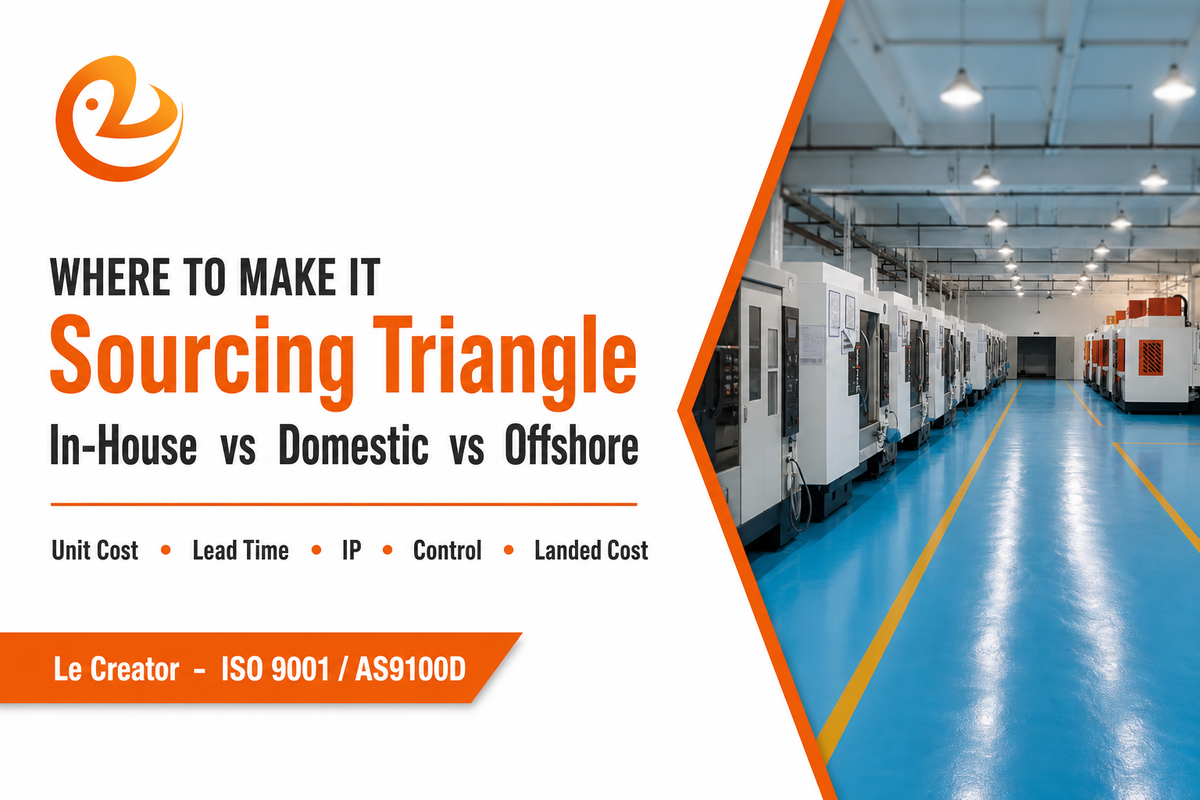
Once the part is designed, the last decision is where to make it. That trade-off is rarely just unit price, it’s unit cost against lead time, control, and risk. The sourcing triangle below frames it.
| Factor | In-house | Domestic shop | Offshore (e.g. China) |
|---|---|---|---|
| Unit cost | High (fixed overhead) | Medium–High | Low |
| Lead time | Fastest for small runs | Short | Longer (transit) — offset by capacity |
| Tooling / NRE & capacity | You carry it all | Shared | Shared, large capacity |
| IP / control | Highest | High | Manage via NDA + vetting |
| Landed cost / tariff | None | None | Add duty (US Section 301) to compare true landed cost |
1. Regulated parts stay onshore. Defense and aerospace parts under DFARS 252.225-7009 require specialty metals to be melted or produced in the United States or a qualifying country, and ITAR-controlled items carry their own export rules. Those parts aren’t an offshore decision at all, offshore shops serve commercial, industrial, and non-restricted parts.
2. In-house carries hidden EHS cost. Running your own machines means managing metalworking-fluid mist: NIOSH sets a recommended exposure limit of 0.4 mg/m³ thoracic particulate for metalworking-fluid aerosols because of respiratory and skin risk. That coolant-management and monitoring overhead is real total-cost-of-ownership that an outsourced part doesn’t carry.
For non-restricted commercial and industrial parts, offshore metal machining services usually win on landed cost once you compare the true number with tariff in it, provided the supplier is vetted. The strongest shops offer custom CNC machining of both metal and plastic production parts and can show their CNC metal machining services and machining capabilities for custom parts up front. Mature metal CNC services document how their machining works before you commit, so parts made using CNC technology arrive to spec. A practical vetting checklist: ISO 9001 quality system, relevant industry certs (IATF 16949 for automotive, AS9100D for aerospace, ISO 13485 for medical), material certificates, first-article inspection (FAI) plus CMM data, an NDA, demonstrated capacity, clear communication, and a sample before the full run.
As a reference point, our own shop holds ISO 9001:2015, IATF 16949, AS9100D, and ISO 13485, runs seven in-house metal lines with milling, turning, Swiss, and wire-EDM machining capabilities, and reports 15+ years of operation, 50,000+ delivered projects, and 98.5% on-time delivery at a best-feature tolerance of ±0.005 mm for custom CNC metal parts. We see the most common offshore sourcing mistake as buyers comparing quoted unit price instead of landed cost with inspection built in, the cheapest quote rarely stays cheapest. See our guides on vetting a CNC supplier in China and domestic vs offshore total cost.
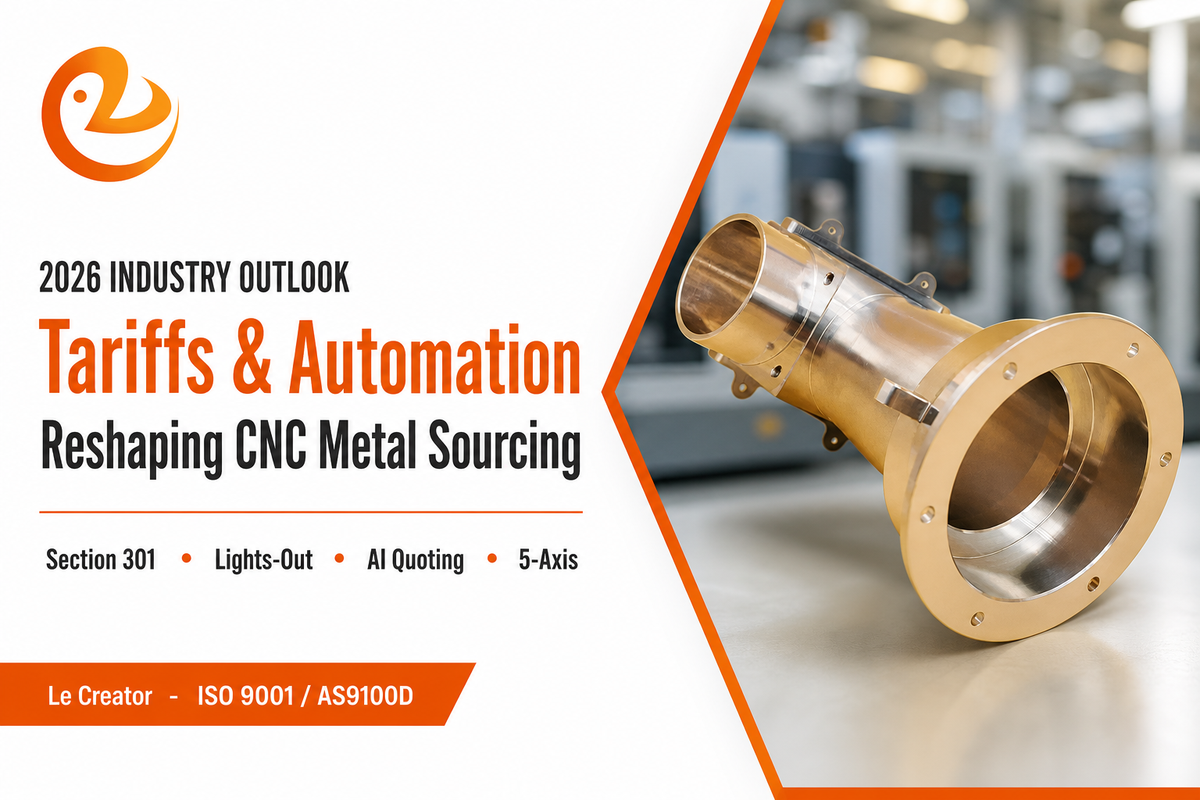
Two shifts are changing how engineering teams source machined metal in 2026, and both are about decisions more than headlines.
Tariffs are now a permanent input to the sourcing math, not a temporary shock. US Section 301 tariffs are increasingly treated as a durable floor rather than a passing measure, which means landed-cost comparisons, not list price, should drive offshore-vs-domestic decisions. Reshoring is more nuanced than the headlines: data through 2026 questions whether a clean reshoring “boom” is actually happening, so the real move is part-by-part, restricted and short-lead parts onshore, cost-driven commercial volume offshore with tariff costed in.
Automation is lowering the cost of precision, especially in small batches. Lights-out (unattended) machining, AI-assisted quoting, and a new generation of 5-axis machines with pallet changers and high-speed rotary axes are compressing setup time and letting shops run smaller lots economically. For buyers, that means tighter tolerances and 5-axis geometry are getting cheaper to source than they were even two years ago. One standard to watch: ISO 2768 itself entered a draft revision in 2025, so general-tolerance defaults may shift, worth confirming the edition your supplier quotes against. Globally, the precision-machining market sits around the low-hundreds of billions of dollars and is projected to keep growing through the early 2030s, but for a sourcing decision the drivers above matter more than the market size.
What to do now: for any recurring metal part, lock annual-volume pricing while you can, compare landed cost with tariff in it, and confirm whether the part fall under origin or export restrictions before you commit a supplier.
This guide combines machinability, tolerance, and surface-finish data from public engineering and standards sources (ISO 2768, ASME B46.1-2019, ASTM A967, NIST, US government regulations) with our own production experience CNC machining seven metal families, from corrosion-resistant stainless with strong corrosion resistance to structural parts in alloy steel, into precision parts and precise parts to ±0.005 mm best-feature tolerance across 50,000+ projects. Figures such as machinability ratings are presented as approximate comparisons because machinability is process-dependent; confirm critical numbers against your part and supplier. Reviewed by the Le Creator Technology Co., Ltd. technical team.