

Supportive, Professional, Client-Focused Service
From prototypes to full-scale production, we’ve got you covered.


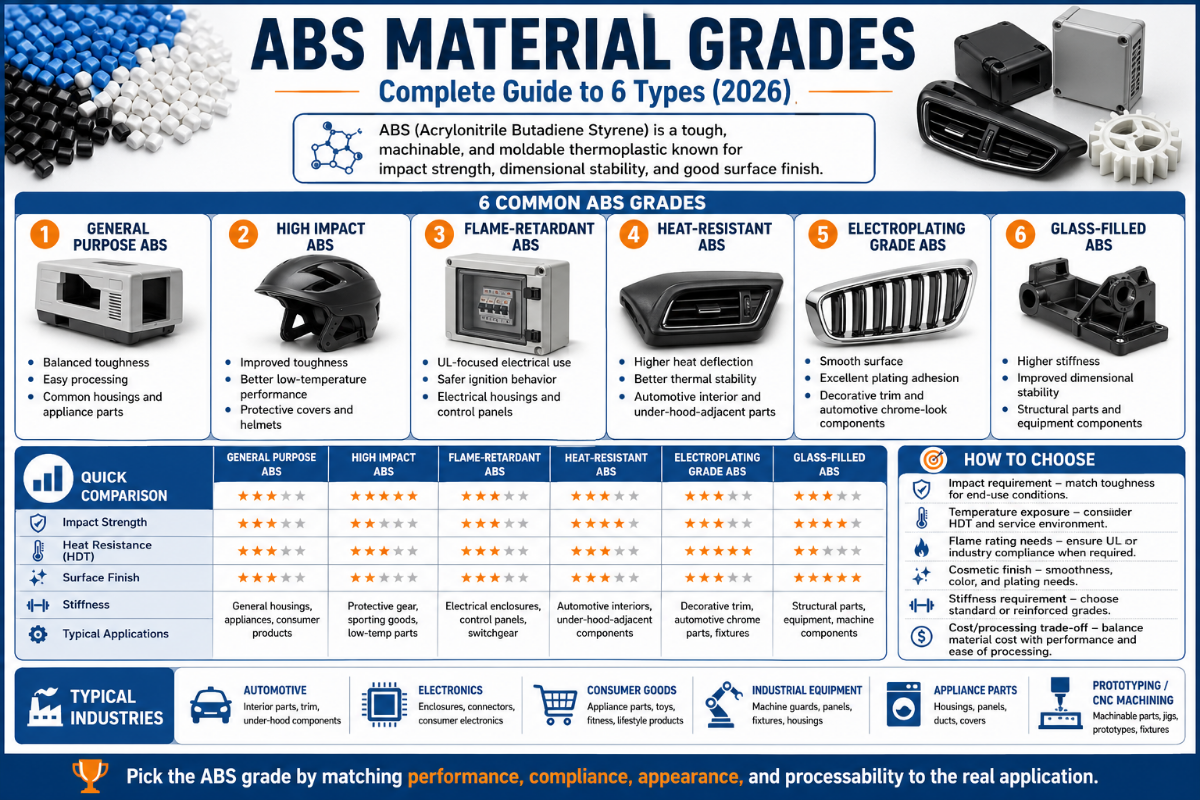
Decision between numerous ABS material grades—cost-oriented general purpose, or engineered flame retardant, heat resistant and ESD-safe materials—where choosing the wrong grade can be expensive (cracked housings, failed UL94 audits), or even guaranteed to cause warranty claims (warped plastic parts at 90 C). This guide compares 6 central ABS grades against ASTM referenced specifications, application data sheets based on actual machining projects, and an easy to follow flow chart—4 questions to pull your part specification, and find the right ABS grade.
| Density | 1.04–1.07 g/cm³ (ASTM D792) |
| Tensile Strength | 29.6–60 MPa / 4,300–8,700 psi (ASTM D638) |
| Flexural Modulus | 2.1–2.4 GPa / 305,000–348,000 psi (ASTM D790) |
| Notched Izod Impact | 200–420 J/m (high-impact grades; ASTM D256) |
| Heat Deflection (HDT) | 88–110°C @ 1.8 MPa (ASTM D648) |
| Operating Temp Range | −20°C to +80°C (general); cold-stable grades extend to −40°C |
| Shore D Hardness | 75–85 (ASTM D2240) |
| Dielectric Strength | 15–17 kV/mm (ASTM D149) |
| Water Absorption (24h) | 0.2–0.4% (ASTM D570) |
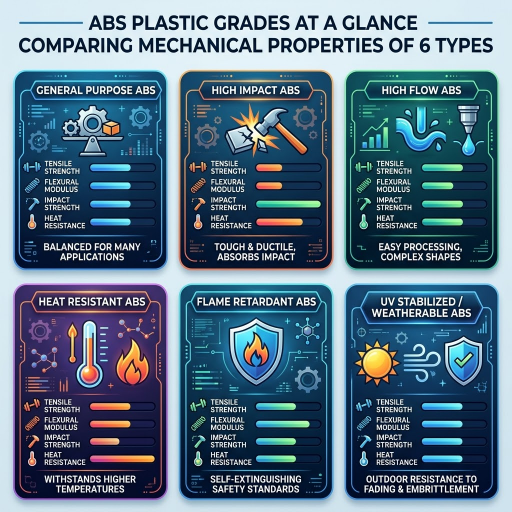
Six available ABS grades are used in engineering and manufacturing: General-Purpose, High-Impact, Flame-Retardant, Heat-Resistant, ESD-Safe, and Machine-Grade. While they all use a common acrylonitrile-butadiene-styrene backbone, they are distinguished by anywhere from one to two engineered physical properties – flame rating, heat barrier, impact strength, surface resistivity, or shape stability. Each grade scores a premium on a different axis, as the table demonstrates.
| Grade | Tensile (MPa) | Notched Izod (J/m) | HDT (°C) | Flame Rating | Surface Resistivity | Typical Use |
|---|---|---|---|---|---|---|
| General-Purpose | 29.6–44 | 200–300 | 88–95 | UL94 HB | 10¹⁵+ Ω/sq | Consumer goods, prototypes, signage |
| High-Impact | 35–48 | 350–420 | 85–92 | UL94 HB | 10¹⁵+ Ω/sq | Cobot end effectors, drop-rated housings |
| Flame-Retardant | 40–55 | 150–250 | 85–95 | UL94 V-0 / V-1 | 10¹⁴ Ω/sq | Electronics enclosures, medical devices |
| Heat-Resistant | 35–50 | 180–280 | 100–110 | UL94 HB | 10¹⁵+ Ω/sq | Automotive interior, dashboards |
| ESD-Safe | 35–48 | 200–320 | 88–98 | UL94 HB / V-0 | 10⁶–10⁹ Ω/sq | PCB handling fixtures, cleanroom tools |
| Machine-Grade | 38–50 | 220–340 | 90–100 | UL94 HB | 10¹⁵+ Ω/sq | Precision CNC parts, jigs and fixtures |
The 6-2-1 Rule for ABS Grade Selection
Six mainstream grades are distributed in two tiers of price (commodity -GP, HI and Heat, specialty -FR, ESD, Machine), where each grade is characterized by a single dominant differentiator (impact, heat, flame, static or dimensional stability). Naming this dominant property first — ahead of tensile or hardness — saves days in the spec dialogue with the supplier. For the majority of applications, the optimal grade is determined at the crossing of one regulatory specification + one mechanical specification.
In addition to the six standard grades, two purposely-developed types – PC-ABS mixture, and glass-filled (ABS-GF) – take the family into higher-temperature and larger-stiffness regions respectively. These specialty grades are below. To obtain fully Quoted competitive prices for all of the grades mentioned above, see Le-creator’s ABS CNC machining services page for types of tolerances and finishes offered.

ABS – acrylonitrile butadiene styrene – is a terpolymer. It is manufactured by polymerizing three monomers at controlled ratios — 15–35% acrylonitrile, 5–30% butadiene, and 40–60% styrene. Each monomer contributes distinct characteristics to the polymer, and adjusting the ratios produces the full variety of ABS grades.
Heat-resistant (a.k.a. high temperature) ABS—replaces some styrene with about 20% alpha-methyl styrene (AMS): this increases the glass transition temperature and moves the HDT into the 100-110C window. Fire-retardant ABS—adds inorganic or halogen-free organic fire-retarding agents. ESD-safe ABS—mixes in conductive fillers, most often carbon based particles, to fall surface resistivity six to nine orders of magnitude.
For a more exhaustive polymer chemistry digression Wikipedia’s ABS entry provides the monomer/copolymer universe.
📐 Engineering Note
Most acids and alkalis are resisted by ABS, but is quickly degraded by ketones, esters and chlorinated solvents. Surface is partially dissolved by Acetone – useful for vapor polishing and solvent bonded joints, but causes problems in service. Field engineers report failures of ABS pipe at solvent weld joints in hot-water lines, where extreme thermal cycling accelerates joint creep. Design joints away from temperature-cycling regions, and where chemical exposure is uncertain, ask for a 7 day soak test before final material lock-in. To compare with other engineered plastics, see our acrylic and engineered plastic design guidelines.
Searching “ABS Grade A” bounces up a hodgepodge of plastic spec sheets and shipbuilding steel pages – they share the same acronym but little else. In plastics ABS refers to the polymer discussed here, in marine steel the American Bureau of Shipping classification society certifies hull steel, by division, under the designations Grade A, B, D and E.
| Aspect | ABS Plastic (this guide) | ABS Marine Steel |
|---|---|---|
| Acronym Source | Acrylonitrile Butadiene Styrene (chemical name) | American Bureau of Shipping (classification society) |
| Material | Engineering thermoplastic polymer | Carbon and low-alloy structural steel |
| Grade Names | General-Purpose, High-Impact, Flame-Retardant, etc. | Grade A, B, D, E (notch-toughness tiers) |
| Typical Use | Enclosures, prototypes, automotive interiors | Ship hull plates, deck plates, marine structures |
| “ABS Grade A vs A36” | Not applicable — A36 is a steel standard | A36 is a general-purpose structural steel; ABS Grade A is the marine-certified equivalent |
If your project is shipbuilding-related then the rest of this guide is irrelevant, turn to the ABS classification society documents to determine your steel of choice. If you are working with plastics, continue below.

General-purpose ABS is the stalwart grade that most engineers default to when no special property is needed. Mechanical properties are maximized with tensile strength of 29.6-44 MPa, notched Izod impact of 200-300 J/m, and HDT of 88-95C. Surface finish is glossy in the mold and machine-ready with no special tooling investment. Cost is roughly 30-40% lower than the FR or ESD-proof grades, which is why mass-market consumer electronics, retail signage, and rapid-prototyping work shops all keep general-purpose ABS as standard inventory.
General-purpose ABS appears in keyboard shells, Jenga bricks, automotive interior panels, kitchen appliance bodies, point-of-purchase signage, vacuum-formed clamshells, and the dimensional prototypes used in engineering validation. ABS can be painted, glued, plated, and textured, which means it is the default for aesthetic parts with moderate mechanical strength. Material selection is only critical when one specific attribute – flame, heat, impact, electrostatic – exceeds what regular grade chemistry can support. For design-stage decisions on whether to specify the next-highest grade, turn to the comparison table at the beginning of this guide.

High-impact (HI) grades move notched Izod impact from the 200-300 J/m range of general-purpose onto 350-420 J/m by boosting butadiene content, creating a superior impact resistant grade at the expense of duller surface gloss and a softer tensile modulus. HI ABS becomes appropriate where parts are intended to be drop tested, repeatedly impacted, or exposed to low temperatures. Notched Izod values for ABS fall by roughly 40% when going from room temperature to 30C – a fact that catches teams designing for refrigerated equipment or outdoor enclosures unaware.
Le-creator machined high-impact ABS end effectors for RoboArm Dynamics, an Ohio-based industrial-robotics maker whose collaborative-robot line needed ISO 10218-1-compliant force-limited operation. The aluminum end effectors carried over from the previous generation were too heavy. Switching to high-impact ABS with internal ribbing geometry achieved a 35% weight reduction while maintaining 420 J/m notched Izod, satisfying the collision-energy absorption requirement. Annual production reached 1,200 units across eight gripper configurations. Machined ABS components for similar cobot applications follow the same workflow.
“Switching from aluminum to high-impact ABS was a turning point. We hit the impact resistance the cobot specification required while shedding 35% of the weight, which let our robots stay inside ISO 10218 force limits without redesigning the drive train.”

Every product standard that involves mains power, medical electronics, and aerospace cabins demands flame-retardant ABS. UL 94 reveals the appropriate flame scale: HB (slowest – general-purpose), V-2, V-1, and V-0 (most stringent, resists 10 seconds self-extinction, no flaming drips). Everything from cell phones and laptops to V-0-compliant audio equipment must specify V-0 flame-retardant ABS for the enclosure. Substituting non-conforming general-purpose grade into a V-0 approved device constitutes a product recall, not a warranty nightmare.
Halogen-free FR-ABS has moved away from premium specification to default choice for products rolling out into EU and Japanese markets in 2025-2026, prompted by RoHS, REACH, and IEC 61249-2-21. Brominated systems still meet UL94 V-0, but procurement teams targeting export markets increasingly want to avoid restricted-substance exposure in three of the four largest electronics markets. When sourcing FR-ABS for CE-certified export programs, lock in halogen-free chemistry first, then verify the V-0 rating on the resin lot.
Le-creator machined UL94 V-0 flame-retardant ABS that was destined for FDA 510(k) clearance for MedDiagnostics Corp’s blood analyser was imaged. The casings had to demonstrate compliance to IEC 60601-1 medical electrical equipment standard and simultaneously maintain 0.002″ tolerance for IP54 ingress protection sealing. All lot traceability points, design history data, and documentation has been covered in the FDA audit on first evaluation. 500 units produced annually makes injection molding mold-making uneconomical, and CNC turning with proper UL certificate of compliance on lot, substance testing on material, and first article report assured FDA on first round of review.
Heat-resistant ABS substitutes alpha-methyl styrene for a portion of the styrene fraction, lifting the HDT into the 100–110 °C window. This grade has been the workhorse for automotive dashboard trim, instrument grab handles, vent housings, hair dryers, and coffee-machine bodies for years. For service temperatures above 110 °C, step up to PC-ABS (HDT ~130 °C); above 130 °C, move out of the ABS family entirely to nylon (220 °C+) or PEEK.
Le-creator machined heat-stable ABS dashboard trim assemblies for AutoTech Components, a Tier 1 auto supplier based in Michigan. Their program demanded 200 prototype assemblies producing 8 variations to 2 vehicle formats in 18 months. Custom injection mold tooling would have exceeded $85,000 12-week lead time. Bridging from heat-stable ABS stock through 5-axis CNC machining yielded first article production in 10 days, validated six design iterations, and saved well over $51,000 in tooling investment before final tool commitment. The 14 snap-fit features per part mandated full interface 5-axis programming, and Class A surface finished to Ra 0.4m by vapor polishing the machined parts.
Specific ABS grades meet FDA 21 CFR 177.1530 regulation for indirect-food contact when combined with noncontaminating compounding procedures (no flame-retardants, no plasticizer migration agent above conversion limits, and pigments from the FDA list). The resin material is supplied as FDA-compliant or food-grade ABS. Generic general-purpose ABS is not considered food-safe; the compounder must recertify the batch against a CFR entry, and the converter (CNC manufacturer, blow-molder, thermoformer) must show compliance against downstream contamination. Hot-fill applications change the equation, because ABS softens above ~90 °C; dishwasher-compatible parts typically migrate to PC, PP, or PETG.

ESD-safe ABS reduces surface resistivity from the baseline 10¹⁵ Ω/sq into the 10⁶–10⁹ Ω/sq static-dissipative range by adding conductive carbon-based fillers, altering the polymer’s electrical properties without compromising its mechanical or thermal performance. Below 10⁶ Ω/sq the grade is conductive (used for grounding straps and trays); 10⁶–10⁹ is static-dissipative (used for handling fixtures); above 10¹² is insulative (the standard ABS family). The relevant standard is ANSI/ESD S20.20, which codifies the resistivity envelope for ESD-protected work environments.
Typical used for PCB handling jigs, cleanroom carts, semiconductor wafer trays, and fixtures that risk hostile electric discharge between 100 and 2,000 volts that could damage sensitive electronics. ESD-safe ABS holds Class 100 and Class 1000 cleanroom ratings by sourcing from cleanroom-classified stock and deploying under particle-controlled manufacturing conditions. Where deeper fill features are necessary, glass-filled ESD ABS grades are available at a cost of machinability for stiffness.
When the six base grades miss one acceptance criteria, three specialty grades fill in: machine-grade ABS to satisfy machine tool CNC requirements, glass-beaded ABS (ABS-GF) to satisfy stiffness standards, and PC-ABS to satisfy impact and thermal needs.
Machine-grade ABS has been designed to ease CNC machining, with low internal stress levels and excellent dimensional stability. Standard ABS extruded sheet retains excessive residual stress from the cooling profile that accounts for CNC-induced warping. The machine-grade stock is annealed for stress reduction, which yields parts that keep 0.002″ or better over larger features. Le-creator’s baseline CNC tolerances for ABS are 0.005″ with accuracy options to 0.002″ and ultra-precision to 0.001″ for jigs and gauging fixtures.
Glass-filled ABS (ABS-GF) increases the Tensile Modulus by about 30-80%, depending on amount of glass loading (generally about 10-30% by weight), and increased HDT to near PC-ABS range. Disadvantages include lower impact strength, more abrasive tooling wear during machining, and a less glossy, relatively matte surface. Glass-filled grades are used for structural brackets, and parts where strength without weight or high price are desired.
PC-ABS is a hybrid polymer alloy: the polycarbonate fraction supplies heat resistance and impact strength, while the ABS fraction improves melt flow and surface finish. HDT moves up from the 88–110 °C ABS range to 110–130 °C, depending on the PC content in the blend. Top-tier PC-ABS grades reach 500–700 J/m notched Izod, which is why the alloy is the go-to choice for solar-loaded automotive interiors (dashboards), drop-rated electronics housings, and mobile-device bodies. Cost runs 1.5–2× standard ABS. When the application exceeds PC-ABS limits, the next step up is PEEK for higher-temperature and aerospace-grade environments. Le-creator’s specialty ABS grades page lists supported variants and lead times.

ABS falls mid-way in the engineered-thermoplastic hierarchy. It is more affordable and easier to machine than polycarbonate; stiffer and more dimensionally stable than HDPE; tougher and easier to bond than rigid polyvinyl chloride (PVC); and more heat-resistant than PETG across most of its grade range. Usually it is down to one or two properties which are deciding factors – and the table below is structured around these.
| Property | ABS | PC (Polycarbonate) | PVC | HDPE | PETG |
|---|---|---|---|---|---|
| Tensile (MPa) | 29.6–60 | 55–75 | 40–65 | 22–32 | 50–60 |
| Notched Izod (J/m) | 200–420 | 600–850 | 30–100 | 90–200 | 90–115 |
| HDT (°C) | 88–110 | 125–135 | 60–80 | 75–90 | 65–75 |
| Cost Index (ABS=1.0) | 1.0 | 1.6–2.2 | 0.7–0.9 | 0.6–0.8 | 1.1–1.3 |
| Chemical Resistance | Acids/alkalis OK; ketones poor | Better than ABS; sensitive to alkalis | Excellent — most acids/bases | Excellent — broadest resistance | Good — acids and many solvents |
Another popular question – “what’s stronger, ABS or HDPE?” – has a multi-tier answer. ABS clearly wins in the category of tensile strength (29.6-60 MPa vs 22-32 MPa). ABS occurs in front in stiffness as well.
HDPE narrowly wins in resistance to industrial cleaning chemicals, and the two are neck and neck in cold temperature impact. When the “failure mode” isn’t revealed, fans of each both pick the wrong one 50% of the time.
Le-creator conducted a formal ABS vs. PC evaluation for TechInstruments LLC, a Colorado industrial-equipment manufacturer developing portable test enclosures. For each material, Le-creator engineers built 20 identical enclosures and subjected them to IEC 60068-2-31 (1-meter drop, six orientations), industrial solvent and IPA exposure, and torque-test stress on screw bosses.
All ABS enclosures passed every drop orientation with no stress cracks; chemical resistance proved equivalent to polycarbonate across the test panel; and ABS came in 28% cheaper on the bill of materials. The selection was settled on data, not preference.
“We assumed polycarbonate would outperform ABS for portable test equipment. Structured evaluation showed ABS winning on chemical resistance and cost — 28% cheaper, zero stress cracks, identical drop survival. Data prevented us from over-specifying.”
For broader plastic-versus-metal substitution decisions, our engineered plastic versus metal substitution analysis walks through the performance-to-cost trade-offs.
The fastest path by questions through the grade selection scenario is a four-question path. Each question separates the family by one engineered property and then quickly provides an estimated grade for each family to choose from.
The Flame → Heat → Impact → ESD Decision Tree
A use-case-to-grade matrix below covers the most common pairings:
| Application | Recommended Grade | Driving Requirement |
|---|---|---|
| Automotive dashboard trim | Heat-Resistant ABS | Solar-loaded interior temperatures |
| FDA medical device enclosure | Flame-Retardant ABS (halogen-free) | IEC 60601-1 + ISO 13485 documentation |
| Cobot end effector | High-Impact ABS | ISO 10218-1 force limits + collision energy |
| Cleanroom PCB fixture | ESD-Safe ABS | ANSI/ESD S20.20 protection |
| Outdoor signage / housing | General-Purpose ABS + UV stabilizer | Aesthetic surface + cost |
| CNC inspection fixture | Machine-Grade ABS | ±0.002″ tolerance hold |
Get an ABS grade selection consultation →
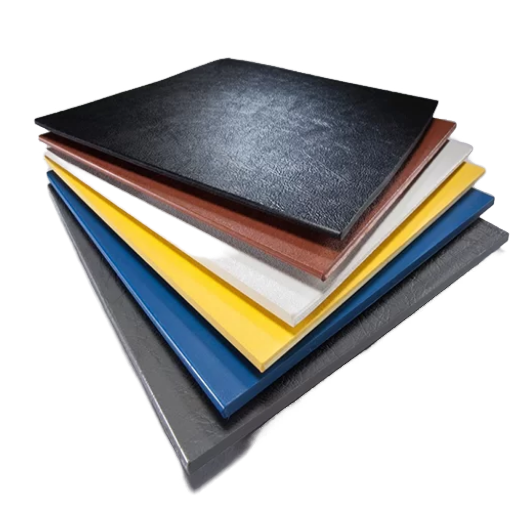
Three drivers are driving a fundamental redefinition of how an engineer prescribes ABS in 2026: recycled-content directives, halogen-free flame-retardant expectations, and bio-attributed feedstock pilot programs from current resin manufacturers.
Recycled ABS accounted for an estimated $9.4 billion in 2025, and industry analysis predicts growth to $19.8 billion by 2034 at a near-8.6% CAGR third-party forecast. While recycled ABS comprises a single-digit percentage of world production, quality variability batch-to-batch is the primary barrier to accepting recycled ABS at tolerances previously achievable with virgin ABS. Mechanical recycling produces grades up to the non-critical housing and packaging/dunnage level; depolymerizing back to monomer granules yields virgin-quality – if more expensive – resin.
Beginning in 2026 the revised European Packaging and Packaging Waste Regulation (PPWR) establishes mandatory recycled-content directives that propel beyond packaging into consumer electronics housings and auto OEM trim as counterpart supplier flow-downs. Specification documents written in 2024 that do not have recycled content language are candidates for rewriting in 2026 procurement revisions. For projects that go live in late 2026 or early 2027, the contingency is selecting the virgin and 30% recycled input grades against the same impact/dimensional specification rubric, then leave the final procurement decision delivered at the volume level.
Halogen-free flame-retardant systems are the second 2026 default optimization node. Global resin suppliers – including INEOS Styrolution and Trinseo – have issued bio-attributed and halogen-free fire-retardant ABS roadmap offerings consistent with standard IEC 61249-2-21 and ASTM F2466-10. For engineers producing new specifications, default toward halogen-free fire-retardant ABS versus legacy brominated grades even where local codes/state procedures are not yet superseding the rule, to avoid rework in 18 months. For more detail on the trade-offs of moving from metal substrates to plastics in more sustainable feedstocks, see our PEEK versus metal substitution analysis.

This guide draws on Le-creator’s machining of all six core ABS grades — including heat-resistant ABS for AutoTech’s dashboard trim program, UL94 V-0 flame-retardant ABS for MedDiagnostics’ blood analyzer enclosures, and high-impact ABS for RoboArm Dynamics’ collaborative-robot end effectors. Specifications cite published ASTM, UL, and FDA standards rather than supplier marketing claims, and the four cases referenced here are documented on our ABS service page. Reviewed by the Le-creator engineering team — 17+ years of CNC plastic machining experience, ISO 9001:2015 and ISO 13485 certified.