

Supportive, Professional, Client-Focused Service
From prototypes to full-scale production, we’ve got you covered.


Polyoxymethylene, or POM for short, better known as acetal, Polyacetal, and by the trade name Delrin®, is a high-performance engineering thermoplastic that should be chosen over alternatives for its exceptional mechanical strength, low friction, and excellent dimensional stability. Hence, this is one of the most common material choices for precise CNC machining applications.
Since the 1960s, when marketed by DuPont, POM has become a material used across industries for its metal-like strength and plastic benefits, such as lower weight, self-lubrication, and corrosion resistance.
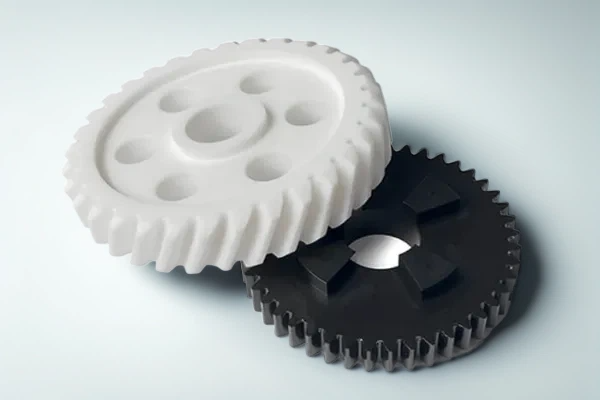
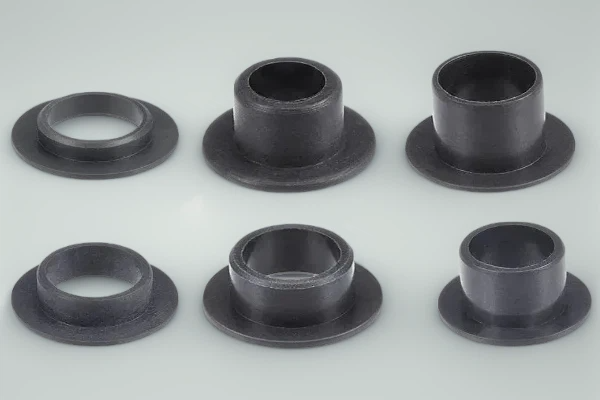
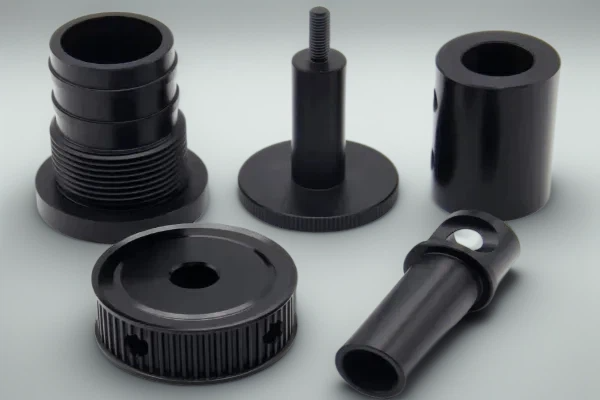
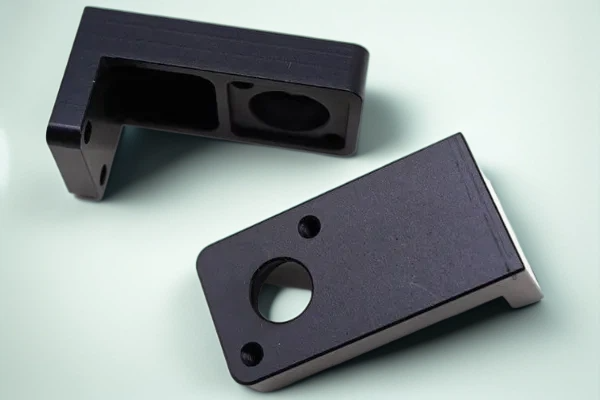
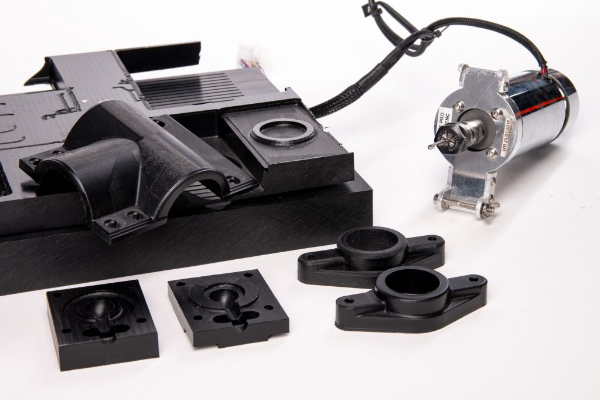
Explore our gallery of custom POM parts. See examples of high-quality, precision-machined Polyoxymethylene components for various industrial applications.



| Property | Value | Test Standard |
|---|---|---|
| Density | 1.41-1.42 g/cm³ | ISO 1183 |
| Tensile Strength | 60-70 MPa | ISO 527 |
| Flexural Modulus | 2.8-3.5 GPa | ISO 178 |
| Hardness | Shore D 85-95 | ISO 868 |
| Melting Point | 165-175°C | ISO 11357 |
| Continuous Use Temperature | -40°C to +80°C | – |
| Coefficient of Friction | 0.04 (dry) | ASTM D1894 |
| Water Absorption (24hr) | 0.2-0.5% | ISO 62 |
| Operation | Cutting Speed (m/min) | Cutting Speed (SFM) | Notes |
|---|---|---|---|
| Turning | 150-300 | 500-1000 | Use sharp carbide tools |
| Milling | 200-500 | 650-1650 | End mills with 2-3 flutes preferred |
| Drilling | 50-100 | 165-330 | Peck drilling for deep holes |
| Tapping | 10-30 | 35-100 | Use spiral flute taps |
Explore our precision Delrin® and Acetal components engineered for high-performance applications.

Burr-free teeth machining for high wear resistance systems.

Low friction components designed for high-load environments.

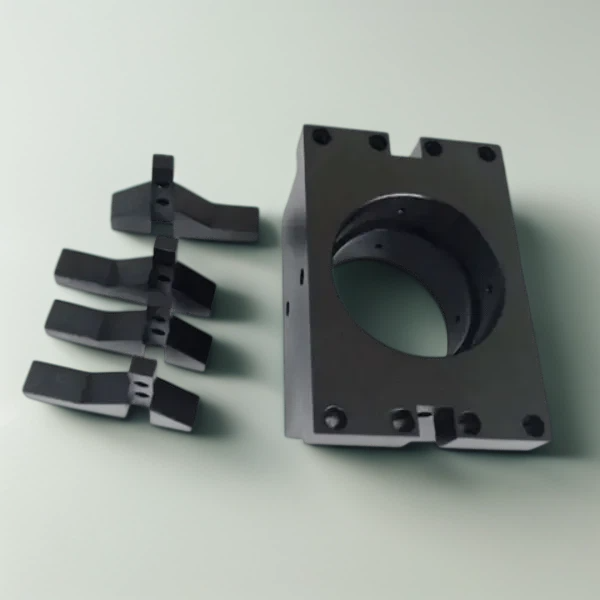
Intricate black POM housings with micro-drilled holes.

Leak-proof designs with precision internal threading.
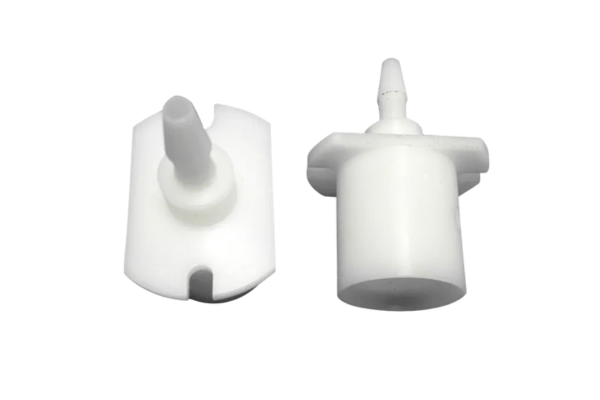
FDA compliant, biocompatible parts for surgical use.
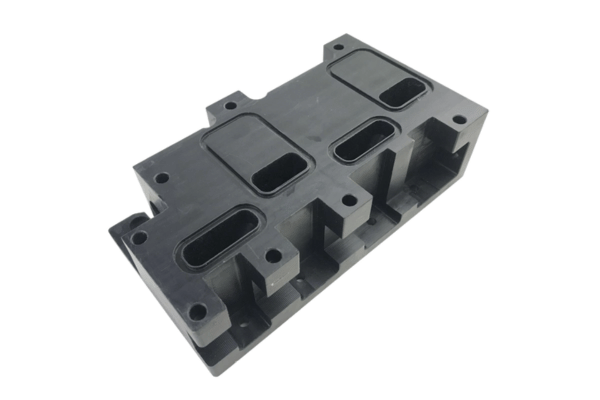
Chemical resistant black Delrin with ±0.02mm tolerances.
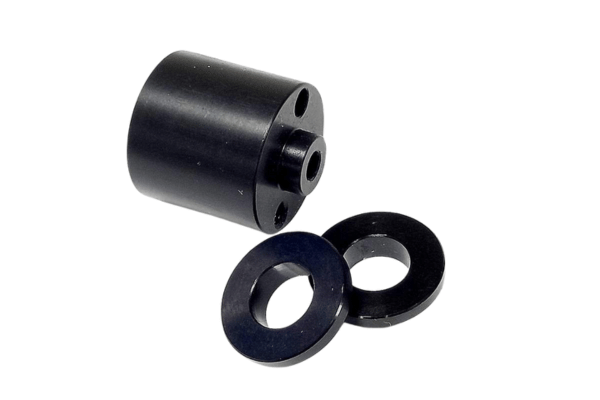
Aesthetic parts with Ra 0.4μm finish for consumer goods.
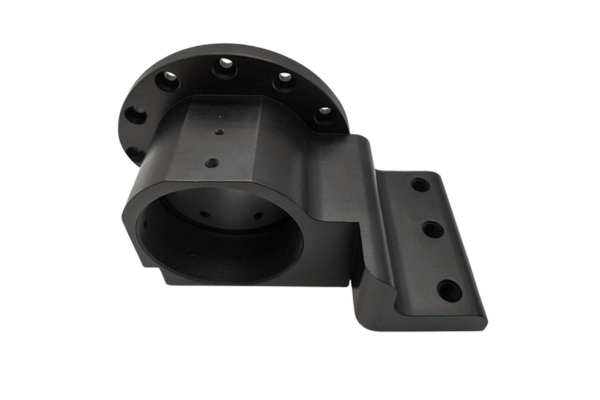
Low volume production runs for design verification.
POM’s outstanding dimensional stability and machinability enable tight-tolerance machining capabilities rivaling those of metals. Here is what one can expect:
| Standard | Linear Tolerance | Hole Diameter | Surface Finish | Cost Impact |
|---|---|---|---|---|
| Baseline | ±0.1 mm | ±0.05 mm | Ra 1.6-3.2 μm | Baseline |
| Precision | ±0.05 mm | ±0.025 mm | Ra 0.8-1.6 μm | +20-40% |
| Ultra-Precision | ±0.025 mm | ±0.01 mm | Ra 0.4 μm | +50-100% |

| Factor | CNC Machining | Injection Molding |
|---|---|---|
| Ideal Quantity | 1 – 1,000 parts | 1,000+ parts |
| Tooling Cost | None ($0) | $5,000 – $50,000+ |
| Lead Time | 3-10 days | 4-8 weeks (including tooling) |
| Design Changes | Easy & low cost | Expensive mold modifications |
| Part Complexity | Limited undercuts | Complex geometries possible |
| Tolerances | ±0.025mm achievable | ±0.1mm typical |
| Surface Finish | Ra 0.4μm possible | Depends on mold quality |
Real-world examples of how we solve warping, tolerance, and surface finish challenges for Delrin® and Acetal components.
Client required POM-H (Delrin) gears with high fatigue resistance. Previous suppliers failed due to heat deformation and poor surface finish leading to noise >65dB.
We utilized Carbide tooling to reduce friction and implemented a double-cooling system to manage POM’s low melting point. Optimized feed rates minimized burrs.
Needed Medical Grade POM-C parts capable of withstanding repeated autoclave sterilization. Critical requirement: absolute zero stress cracking and burr-free finish.
Performed annealing treatment post-roughing to release internal stress. Applied cryogenic deburring to ensure clean edges without altering dimensions.
Project involved thin-wall POM machining. The primary pain point was warping due to clamping force and material removal, affecting the assembly fit.
We designed custom vacuum fixtures to hold parts without mechanical stress. Programmed symmetric material removal paths to balance internal forces during milling.
POM machining refers to CNC machining of POM (polyoxymethylene), also known as acetal or polyacetal. POM is an engineering thermoplastic having excellent dimensional stability, low friction, and excellent mechanical strength, suitable for various equipment and products requiring precise accuracy. As it is engineered to resist wear, POM is also used in a range of industries, from automotive to medical devices, where precision parts with tight tolerances are required for operation.
Computerized numerical control milling and injection molding are standard techniques used to manufacture POM articles. CNC-machined POM components can be manufactured for POM prototypes, custom small-run production of POM applications, or low- to medium-volume applications that require high-quality POM materials and precision CNC machining. Injection molding is intended for very high manufacturing volumes, which will initially lower the cost per part, but only for a limited period. Depending on the case, both CNC machining and injection molding may be used for complex POM parts, where precision is required and tight tolerances must be maintained to account for volume and lead time.
Working with POM is a good way to machine the material, given its ease of machining and excellent characteristics such as low cutting force, good chip formation, and reduced burring. The best results in machining POM are achieved with sharp tools, controlled speeds, and proper cooling to prevent melting. POM material removal, as done in modern CNC operations, is highly effective for standard practices and precise CNC methods, turning crude parts into finished products with the tightest tolerance.
Yes, that is a fact. POM parts with very intricate shapes can be made by plastic machining methods, including the technique of precision cnc and milling, in order to custom-make POM-made components according to the customer’s exact specifications. Some POM machining parts are capable of realizing great precision and good repeatability over time, owing to the way the plastic is machined on an advanced CNC machine. For these reasons, pump parts, gears, and other parts with demanding performance requirements, such as those crucial for aerospace applications and even some within the food and beverages sectors, favor the processing of POM.
POM is used in numerous industrial sectors where its low friction, dimensional stability, and chemical resistance are required. It provides superior wear properties in parts and, as such, is typically used in pump components, bearings, sliding components, fasteners, and gears. The material may be medicated to enhance its properties, for example, to improve heat conduction. Naturally resistant to moisture and retaining good mechanical properties over time, POM is governing markets across the automotive, consumer products, and industrial machinery industries.
While making a design for prototyping or custom machining using CNC, always follow the material removal process and operational norms: avoid overly thin walls that carry high loads, keep the radiating easy and friendly to allow the milling cutter, and do everything in relation to precise CNC technology, that is, bracketing the tolerancing. Design-for-manufacturability minimizes manufacturing costs and helps ensure that the final parts satisfy the target specifications. Keep in constant communication with the shop in matters that pertain to the surface finish, tolerances, and the need or absence of the second operations like drilling and placing.
High-quality POM components can be manufactured to tight tolerances, with finishes that are mostly smooth or polishable; in some cases, a bit of deburring and light polishing may be needed to smooth the edges. Such desirable finishes can be executed via precision CNC machining, which ensures consistent dimensions and repeatable quality. Finally, these components may undergo ultrasonic cleaning or assembly to become ready-to-use plastic products; in some cases, machining can be performed without further finishing, unlike processes for other thermoplastics.
A lot of issues come into play with POM cutting, specifically heat and pressure combining to cause melting and tool wear due to the fiber-reinforced plastics, improper processing would cause dimension changes. Thus, the prevention of several defects is accelerated by using sharp tools with appropriate feed and speed, and by employing good chip-control strategies. Proper clamping and cooling processes in CNC machining help maintain tolerances. The consistent behavior of engineering plastics such as POM ensures the production of parts with near-tolerance and high performance. Best-practice guidelines in POM processing aim to minimize defects and maintain tolerance.
There are several mechanical properties that make POM attractive for CNC machining: tensile strength, flexural modulus, and impact resistance are among the key properties. On the one hand, high tensile strength enables the material to resist significant tensile forces without failure, while high flexural modulus provides resistance to shear forces. Impact resistance indicates that it can absorb sudden shocks without fracturing. Wear resistance is another significant benefit of POM, making it suitable for friction- and abrasion-resistant applications. These mechanical properties, taken together with the polymer’s combinations, include low coefficients of friction and good dimensional stability, rendering it the best material for machining outstanding performance CNC applications that need durability, precision, and long-term operability. This is why POM is ideal for high-performance parts, given its unique combination of properties.